
A useful academic humanizer changes how a passage expresses its reasoning without changing the reasoning itself. Compare the original and revised text for sentence structure, specificity, and flow, then check citations, numbers, terminology, and claim strength. A paragraph that merely swaps synonyms is not necessarily a better paragraph.
The seven before-and-after examples below show what that review looks like across an essay, abstract, literature review, methods section, results paragraph, discussion, and conclusion. They are editorially constructed teaching examples, not customer submissions, captured PaperHumanizer outputs, or detector benchmarks. All study details, named citations, and numerical results in the examples are fictional and must not be cited as research.
Better expression, unchanged evidence: use the examples as a review method, not as a promise of identical output.
If you already have a draft, try PaperHumanizer with one paragraph. Keep it beside your original and apply the same checks illustrated here.
What should change in a humanized academic paragraph?
Look for a clearer opening, fewer empty framing phrases, a better connection between ideas, and sentence lengths suited to the argument. Not every formal phrase needs removing, and not every repeated technical term needs a substitute.
| Reasonable editing change | Detail that needs protection |
|---|---|
| Replace an empty opener with the actual point | The scope of that point |
| Split or combine sentences for clarity | Logical relationships between claims |
| Remove unnecessary repetition | Defined terms that need consistent wording |
| Make the evidence-to-interpretation link explicit | The cited source and level of certainty |
| Improve paragraph rhythm | Data, procedures, quotations, and limitations |
An academic rewrite should not invent a stronger argument, an additional source, or a personal experience to make the text more engaging. Those changes require evidence and author input, not stylistic automation.
1. Essay example: replace vague framing with a position
Before
In today's educational landscape, it is important to consider the issue of university attendance policies. Mandatory attendance can help students maintain a routine, but it can also disadvantage students whose employment schedules change each week. Therefore, the question of flexibility is significant.
Illustrative revision
University attendance policies need to balance routine with flexibility. Mandatory attendance can help students maintain a routine, yet it can disadvantage those whose employment schedules change each week. That tension makes flexibility a practical issue rather than a minor exception.
What changed: The paragraph now opens with the actual position, not a broad statement about the educational landscape. The final sentence interprets the existing tension instead of announcing that the issue is “significant.”
What stayed: Both sides of the argument remain. The rewrite does not claim that attendance requirements are universally harmful or that flexible policies always improve grades.
Reject: “Universities should abolish attendance requirements because working students cannot attend.” That is a different and much stronger position.
For a full coursework process, see the college essay humanizer guide. Add evidence for empirical claims in your actual essay; an illustrative paragraph is not a substitute for sources.
2. Abstract example: keep design, result, and limitation visible
Before
The purpose of this study was to investigate the association between weekly planning and deadline stress. A cross-sectional survey of 184 undergraduates was conducted. The results indicated that weekly planning was associated with lower self-reported stress. However, the cross-sectional design does not establish causality.
Illustrative revision
This study examined the association between weekly planning and deadline stress in a cross-sectional survey of 184 undergraduates. Weekly planning was associated with lower self-reported stress, although the design does not establish causality.
What changed: The purpose and design now share a sentence. The result and limitation are connected directly, making it harder to read the finding without its qualification.
What stayed: The sample size, undergraduate population, cross-sectional design, self-reported outcome, and causal limitation all remain.
Reject: “A study of 184 students showed that weekly planning reduces stress.” It turns an association into a causal effect and drops the measurement context.
The abstract humanizer guide covers balancing brevity with enough methodological detail. In your own abstract, check journal requirements before shortening any required component.
3. Literature review example: synthesize without mixing sources
Before
Furthermore, Patel (2023) reported an association between feedback frequency and revision confidence. Moreover, Rivera (2024) found that students valued specific comments more than the number of comments. These studies are important in understanding feedback.
Illustrative revision
Patel (2023) linked feedback frequency with revision confidence, whereas Rivera (2024) found that students valued comment specificity more than comment count. Together, the studies suggest that both frequency and specificity deserve attention when discussing feedback.
What changed: The two findings are organized around a comparison rather than stacked with interchangeable transitions. The synthesis names the dimensions the paragraph is discussing.
What stayed: Each citation stays attached to its own finding. The combined interpretation is cautious and does not claim that either study tested the other's outcome.
Reject: “Patel and Rivera proved that frequent, specific feedback improves revision quality.” It merges separate findings, introduces a new outcome, and strengthens the evidence.
When revising a real review, read the underlying sources before accepting a synthesized sentence. Our literature-review guide explains how to organize evidence across studies without flattening their differences.
4. Methods example: improve flow without changing the procedure
Before
The participants were randomly assigned to one of two conditions. The first condition involved written feedback and the second condition involved audio feedback. All participants completed the same revision task within 30 minutes.
Illustrative revision
Participants were randomly assigned to written-feedback or audio-feedback conditions. All completed the same revision task within 30 minutes.
What changed: The condition labels are integrated into the assignment sentence. Repetition is removed without replacing the method with a vague description.
What stayed: Random assignment, two conditions, the same task, and the 30-minute window are preserved. The revision does not introduce blinding, matching, or additional procedures.
Reject: “Participants chose written or audio feedback before completing a timed task.” Choosing a condition is not random assignment, and “timed” loses the duration.
Use a precise academic tone for procedural passages, and read the methodology revision guide before changing technical wording. Passive voice can be appropriate; removing it everywhere is not a quality standard.
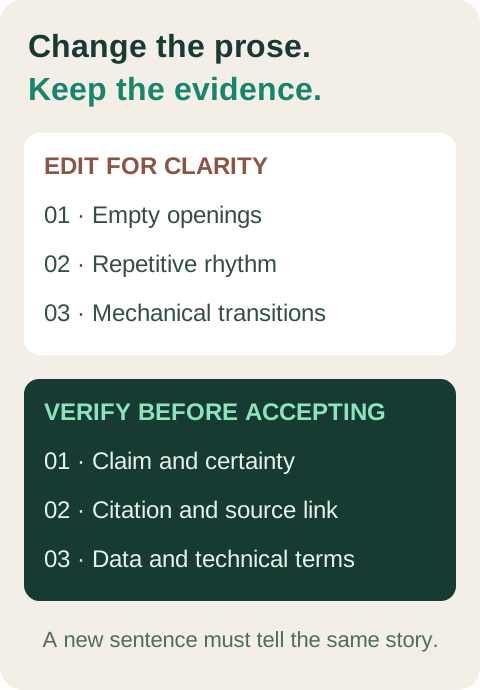
Review the change and the protected detail together. A clearer sentence is useful only if it still represents the same evidence.
5. Results example: retain the exact numerical finding
Before
The mean completion time in the written-feedback condition was 418 ms (SD = 52 ms). The mean completion time in the audio-feedback condition was 447 ms (SD = 61 ms). The difference was statistically significant (p = .031).
Illustrative revision
Mean completion time was 418 ms (SD = 52 ms) with written feedback and 447 ms (SD = 61 ms) with audio feedback. The difference was statistically significant (p = .031).
What changed: A repeated reporting structure is combined into one sentence. The significance statement stays separate so that the numerical comparison remains easy to inspect.
What stayed: The group labels, means, standard deviations, milliseconds, and exact p-value are unchanged.
Reject: “Written feedback was substantially more effective.” Completion time is the reported measure; general effectiveness and practical importance are not established by that sentence.
Do not infer effect size, educational importance, or a stronger conclusion from a p-value alone. For this part of a paper, follow the results-section review guide and compare every number with the source output.
6. Discussion example: keep a possible explanation possible
Before
One possible explanation for the observed pattern is that audio feedback required additional listening time. However, listening behavior was not measured in this study, and therefore this interpretation should be treated cautiously.
Illustrative revision
Additional listening time may explain the observed pattern with audio feedback. Because the study did not measure listening behavior, this explanation remains tentative.
What changed: The possible explanation is stated directly and connected to the reason for caution. The paragraph becomes easier to follow without pretending that the explanation was tested.
What stayed: The interpretation is still tentative. The missing measurement remains visible rather than being trimmed as unnecessary detail.
Reject: “Audio feedback took longer because students spent more time listening.” That presents an unmeasured mechanism as fact.
The discussion-section guide covers the boundary between reporting a finding and interpreting it. Preserve words such as “may” when they do real evidential work.
7. Conclusion example: stop at the boundary of the study
Before
In conclusion, the findings suggest that the format of feedback deserves attention in revision tasks. It is important to note that the study used one task at a single institution. Further research should examine whether the pattern occurs in other settings.
Illustrative revision
Feedback format deserves attention in revision tasks, but this study examined only one task at a single institution. Future research should test whether the pattern holds in other settings.
What changed: The conclusion removes a formulaic announcement and brings the study boundary into the main sentence. The next-step recommendation is more direct.
What stayed: The restricted setting and need for further testing remain. The paragraph does not generalize the result to every student, course, or institution.
Reject: “These findings establish the best feedback format for university teaching.” The study described here does not support that general conclusion.
See the research conclusion guide for a larger closing-section workflow. A conclusion should draw together the paper, not introduce unsupported findings.
How to test PaperHumanizer on your own writing
For an assistant-generated draft, the Gemini revision guide shows how to check sources before rewriting. For product selection, use the QuillBot comparison and apply the same evidence checks to each output.
Use these examples as review criteria, not as text to insert into an assignment. Choose a non-sensitive passage you wrote or are authorized to edit, ideally containing a citation, a precise detail, and a qualification you can check.
- Record the passage's job. Write a one-sentence description of what the paragraph needs to accomplish.
- List what must stay. Note claims, sources, numbers, terms, and limitations.
- Choose the right setting. In PaperHumanizer, select the purpose and an appropriate academic tone.
- Compare the completed result. Check the protected details before judging sentence rhythm.
- Approve selectively. Keep useful changes, restore errors, and make the final wording your own.
For an uploaded Word file, use our DOCX humanization workflow to return approved prose to the formatted master. For broader tool selection, read PaperHumanizer versus general AI rewriting.
If you are evaluating a named alternative, our HumanizeMyPaper comparison and PaperTuned comparison explain the published workflows and how to run your own fair test. The examples here do not establish comparative product performance.
A better scorecard than “it sounds different”
Keep a short review log for your test paragraph:
| Check | What to record |
|---|---|
| Claim fidelity | Any change to certainty, causality, scope, or interpretation |
| Citation fidelity | Missing markers, altered details, or a changed supporting relationship |
| Data and terminology | Any changed value, unit, method, or defined term |
| Clarity and voice | Whether the revision is easier to follow and still fits your writing |
| Manual corrections | What you had to restore before accepting the paragraph |
Do not treat the number of changed words as the main success metric. A methods sentence may need almost no revision; a vague essay opening may benefit from restructuring. The correct amount of change depends on the task.
If detector feedback matters, use the actual report available to you and interpret it separately. The detector-style scores shown in PaperHumanizer are simulated presentation values, not external Turnitin, GPTZero, Originality.ai, or ZeroGPT tests. These examples therefore make no numerical detection-rate claim.
Frequently asked questions
Are these real PaperHumanizer before-and-after results?
No. They are constructed, annotated examples of editing decisions. Run your own passage through the product to evaluate an actual output. We label the examples so that instructional text is not mistaken for an independent benchmark or customer result.
Why are there no AI-detection percentages beside the examples?
No reproducible external detector test was performed for these passages. Adding percentages would imply evidence that this article does not have. The comparisons instead show inspectable changes to prose and evidence.
Should an academic humanizer remove every formal expression?
No. Formality, conventional methods language, and consistent terminology can be appropriate. Edit empty framing and unnecessary repetition, not the vocabulary that makes a finding precise.
Can a humanizer preserve citations automatically?
PaperHumanizer is designed for citation-conscious academic rewriting, but you still need to verify each marker and its supporting claim. Visible citation text also does not preserve a Word reference-manager field. See the research-paper citation checklist.
How do I know whether a paid plan is worthwhile?
Evaluate a real paragraph first. If the changes are useful, the evidence checks pass, and the remaining manual work is acceptable for your recurring writing tasks, compare the available plans. Do not make that decision from an illustrative example or a detector-style number alone.
Try one paragraph, then decide
The best test is your own text with evidence you understand. Try the academic AI Humanizer, compare the result, and use the scorecard above before accepting it. Start small, keep control of the argument, and expand the workflow only when the revision earns its place in your draft.