
A research discussion section moves beyond reporting results. It explains what the findings may mean, compares them with prior evidence, considers alternative explanations, acknowledges limitations, and identifies implications. That interpretive work makes the discussion more flexible than results, but also easier to distort during rewriting.
A discussion section humanizer should improve the argument's flow without moving any claim beyond the evidence that supports it. The revised prose must preserve uncertainty, citation relationships, contradictory findings, study limitations, and the boundary between an observed result and an interpretation.
This guide explains how to humanize a research discussion while keeping the argument accountable to the findings.
Why discussion sections are difficult to humanize safely
AI-assisted discussion prose often sounds polished but generic. Common patterns include:
- Restating every result before interpreting it
- Repeating “This finding is consistent with...” paragraph after paragraph
- Treating all cited studies as if they reached the same conclusion
- Moving too quickly from association to explanation
- Presenting one preferred interpretation without alternatives
- Listing limitations at the end without showing how they affect claims
- Ending with implications that exceed the sample or design
Humanization can improve these weaknesses only when the underlying reasoning is already yours and the sources have been verified. It cannot decide which interpretation is scientifically justified.
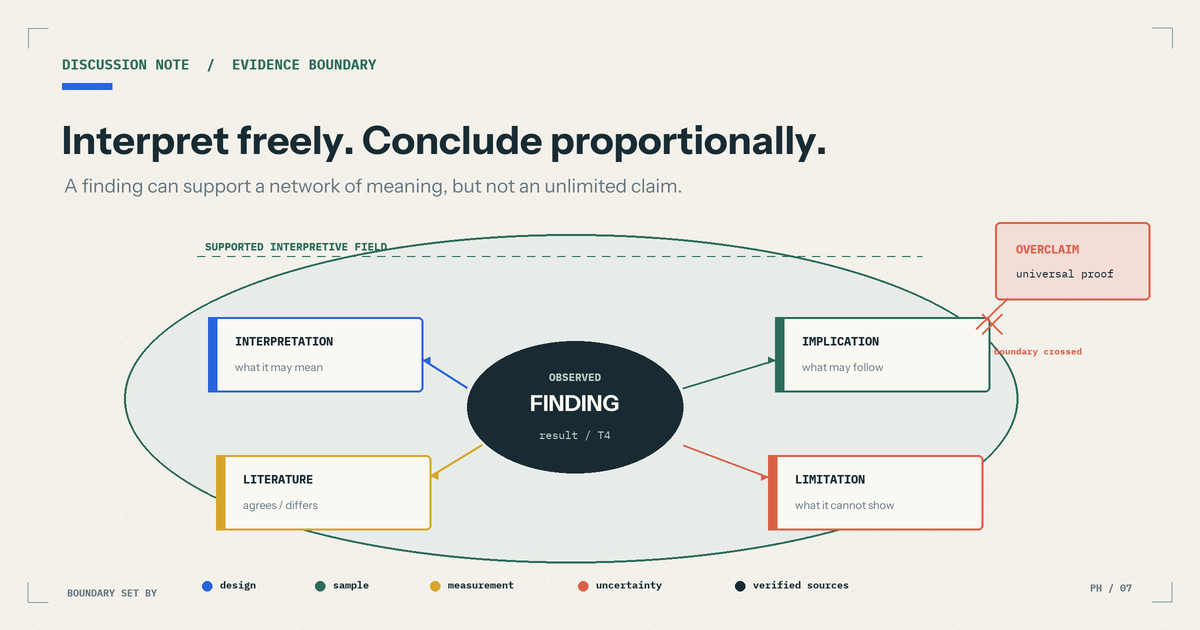
A discussion may broaden the meaning of a result, but it cannot cross the boundary set by design, evidence, and uncertainty.
The five layers of a strong discussion paragraph
Most effective discussion paragraphs combine several distinct reasoning layers:
- Finding: the result being discussed
- Interpretation: what the result may indicate
- Literature: where it agrees, differs, or adds context
- Boundary: limitations, alternatives, and uncertainty
- Implication: what follows for theory, practice, or future research
These layers should remain distinguishable after humanization. A finding is not an interpretation; a plausible interpretation is not a demonstrated mechanism; and an implication is not a universal recommendation.
What to protect before rewriting discussion prose
Create an evidence-boundary sheet for each major claim.
| Control point | What to record |
|---|---|
| Supporting result | Exact finding, direction, uncertainty, and relevant table or figure |
| Study design | What the design can and cannot establish |
| Population and setting | Who and where the finding applies to |
| Prior literature | Source, agreement or disagreement, and methodological differences |
| Alternative explanation | Other plausible reasons for the observed pattern |
| Limitation | How the limitation changes interpretation or generalizability |
| Permitted implication | The strongest conclusion justified by the combined evidence |
Keep this sheet beside the editor. It gives you a concrete standard for rejecting a fluent rewrite that overstates the study.
How to humanize a discussion section step by step
1. Verify the intellectual structure
Write the discussion's main claims as short notes without looking at the existing prose. For each claim, identify the result, source, limitation, and implication that support it.
This reveals whether the draft contains a real argument or only a sequence of smooth academic phrases. Fix missing reasoning before editing style.
Ask:
- Does the discussion answer the research question?
- Are the most important findings interpreted first?
- Are unexpected and null findings addressed?
- Does each literature comparison use a verified source?
- Do limitations modify the relevant claims?
- Does the conclusion stay within the sample and design?
2. Separate observation from interpretation
Mark phrases that report evidence and phrases that interpret it.
Observation: “Response time was lower in the intervention group.”
Interpretation: “The structured feedback may have reduced uncertainty during the task.”
The second sentence is plausible, but it introduces a mechanism. It requires support from the design, measures, theory, or prior literature. A rewrite must not remove “may,” turn the mechanism into a finding, or imply that it was directly measured when it was not.
Use the results-section fidelity workflow to confirm the reported finding before revising its interpretation.
3. Protect degrees of certainty
Highlight language that calibrates a claim:
- may, might, appears, suggests
- is consistent with, could reflect
- in this sample, under these conditions
- cannot determine, remains unclear
- one possible explanation
- preliminary, exploratory, indirect
These phrases are not empty hedging when they accurately represent the evidence. Preserve or deliberately replace them with wording of equal strength.
Watch for subtle upgrades:
| Supported wording | Unsupported upgrade |
|---|---|
| was associated with | caused |
| may reflect | demonstrates |
| is consistent with | proves |
| in this sample | generally |
| warrants further study | should be implemented |
4. Revise one argument unit at a time
Paste one or two paragraphs built around the same finding into PaperHumanizer. Keep the result, source articles, and evidence-boundary sheet visible.
Use Scholarly tone for theoretical interpretation, literature comparison, and nuanced argument. Technical / STEM may fit a compact discussion focused on mechanisms, measurements, or engineering performance. Standard Academic is appropriate for clear coursework and general research reports.
Choose the lightest humanization depth that solves the language problem. A deeper restructuring, when available, may improve repetitive discussion prose but requires a complete claim-by-claim comparison. See Academic Writing Tones Explained for tone selection.
5. Audit the claim ladder
Every discussion claim occupies a level. The higher it moves, the more support it needs.
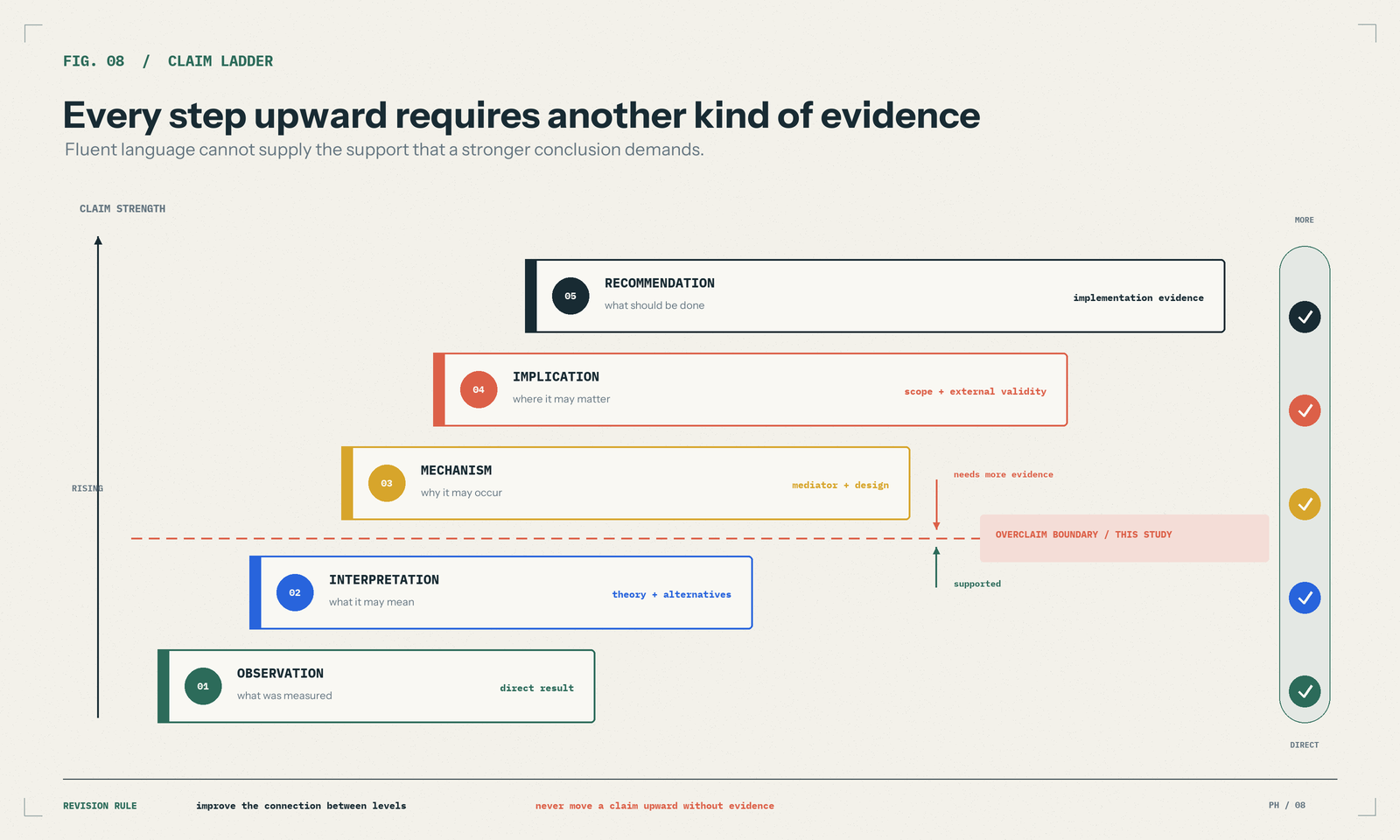
A rewrite may improve the path between levels, but it must not move a claim upward without additional evidence.
For every revised paragraph, check:
- Is the result stated accurately?
- Is the interpretation labeled as interpretation?
- Does the proposed mechanism have evidence?
- Are citations attached to the claims they support?
- Are conflicting studies still represented fairly?
- Does the limitation constrain the right conclusion?
- Is the implication appropriate for the population and setting?
- Has a suggestion become a recommendation?
6. Verify every literature relationship
Discussion sections depend on relational language. “Consistent with,” “extends,” “contrasts with,” and “partially supports” are not interchangeable.
Return to each cited source and confirm:
- The population and context
- The method and outcome being compared
- The direction and strength of the finding
- Whether the source tested the same mechanism
- Whether the comparison concerns evidence or interpretation
Do not let a humanizer merge studies with different designs into a false consensus. The literature review workflow provides a detailed source-relationship audit.
7. Integrate limitations where they matter
A limitation should change how a reader interprets a claim. Do not treat limitations as a detachable compliance paragraph.
For example:
The intervention was associated with faster responses, although the single-session design does not show whether the difference persists over time.
The limitation directly narrows the temporal implication. If the limitation appears only several pages later, the earlier claim may sound stronger than the study allows.
8. Restore your disciplinary judgment
After the automated pass, add back the choices that belong to the researcher: why one explanation is more credible, which contradiction matters, what a limitation changes, and what future study would distinguish between alternatives.
A human voice in discussion comes from accountable judgment, not casual wording or artificial imperfections.
Before and after: improve flow without upgrading the claim
Generic AI-assisted draft
The intervention significantly improved response time. This finding demonstrates that structured feedback enhances cognitive processing. Furthermore, this result is consistent with Lewis et al. (2024), who proved that feedback improves performance. Therefore, structured feedback should be widely implemented in educational settings.
Controlled revision
Participants who received structured feedback responded more quickly than the control group. One possible explanation is that the feedback reduced uncertainty during the task, although the study did not measure cognitive processing directly. The pattern is consistent with the performance difference reported by Lewis et al. (2024), but the single-session design does not establish whether the benefit persists in educational settings.
The revision improves the logical sequence and identifies the proposed mechanism. It also restores the design boundary: cognitive processing was not measured, and long-term educational implementation is not supported by a single-session result.
Handling different parts of a discussion
Opening synthesis
Answer the research question directly and prioritize the most important findings. Do not repeat the full results section or introduce a new analysis.
Comparison with prior studies
Organize by relationship, not by citation order. Explain whether the study confirms, extends, narrows, or contradicts prior evidence and why methodological differences may matter.
Mechanisms and alternative explanations
Distinguish measured mediators from proposed mechanisms. Present credible alternatives when the design cannot separate them.
Limitations
Explain the consequence of each limitation. Sample, measurement, design, and context limitations affect different parts of the interpretation.
Implications
Separate theoretical, methodological, practical, and policy implications. Match their strength to the evidence and avoid universal recommendations from narrow samples.
Future research
Recommend studies that resolve a specific uncertainty rather than ending with the generic statement that “more research is needed.”
Common discussion-rewrite errors
Reject a revision if it:
- Turns association into causation
- Presents an unmeasured mechanism as a result
- Removes cautious or population-specific wording
- Treats one study as proof of a general principle
- Erases a null, unexpected, or contradictory finding
- Makes several cited studies sound more consistent than they are
- Moves a citation away from the supported claim
- Lists a limitation without narrowing the interpretation
- Converts a tentative implication into a recommendation
- Introduces a new source or claim that you have not verified
Final discussion-section checklist
- Every interpreted finding matches the results section
- Observation and interpretation remain distinguishable
- Causal language is justified by the design
- Degrees of certainty and scope are preserved
- Every citation accurately represents its source
- Conflicting and null evidence remains visible
- Limitations constrain the relevant claims
- Implications match the population, setting, and study duration
- No unmeasured mechanism is presented as demonstrated
- The final reasoning and judgment are recognizably the author's
Frequently asked questions
Can I use an AI humanizer for a research discussion section?
Yes, when the relevant policy permits language editing and you retain responsibility for the reasoning. Verify every revised claim against the results, sources, design, and limitations.
Which tone is best for a discussion section?
Scholarly tone is usually best for literature comparison and nuanced interpretation. Technical / STEM may fit mechanism-focused or engineering discussions, while Standard Academic works for clearer general reports.
How do I make a discussion section sound more human?
Organize paragraphs around real reasoning: state the finding, explain a plausible interpretation, compare the evidence, acknowledge alternatives, and identify the appropriate implication. Specific judgment sounds more human than varied transition words alone.
How can I stop an AI rewrite from overstating findings?
Create an evidence-boundary sheet, preserve uncertainty terms, compare claims level by level, and reject any revision that moves from association to causation or from implication to recommendation without support.
Should citations stay in the passage during humanization?
Yes. Keep citations attached to the claims they support, then verify authors, years, groupings, and source relationships afterward. Keep direct quotations outside the rewrite.
What is the difference between results and discussion humanization?
Results humanization protects data reporting and claim-to-output traceability. Discussion humanization protects interpretation, literature relationships, limitations, and the boundary of justified conclusions.
When the evidence-boundary sheet is complete, open the academic AI humanizer, choose the tone for your field, and revise one discussion argument you can fully defend.