
A research methodology section must be readable, but readability is not its main job. Its main job is reproducibility: another qualified researcher should be able to understand what you did, with whom, using which materials, in what order, and how you analyzed the evidence.
That makes methodology one of the highest-risk sections to rewrite. An AI methodology rewrite can improve repetitive, mechanical prose, but a small wording change can also alter the sample, procedure, measure, statistical model, or level of certainty. The goal is to humanize the language without humanizing away the method.
This guide gives you a controlled workflow for using a methodology section humanizer while preserving every technical decision.
Why AI-assisted methodology prose sounds mechanical
Methods writing is naturally structured. It uses repeated terms, chronological sequences, passive constructions, and precise qualifications. Those features are sometimes necessary, but AI-generated methods sections often add another layer of predictability:
- Every paragraph begins with a procedural transition
- Sentences repeat the same subject-verb pattern
- Obvious steps receive excessive explanation
- Technical choices are described with generic academic filler
- Limitations and deviations are smoothed into a perfect sequence
- The prose sounds certain even when the protocol involved judgment
Do not try to eliminate all repetition or passive voice. In a methods section, repeating the exact name of a measure can be more accurate than replacing it with a loose synonym. Humanization should improve the surrounding prose while keeping the terminology stable.
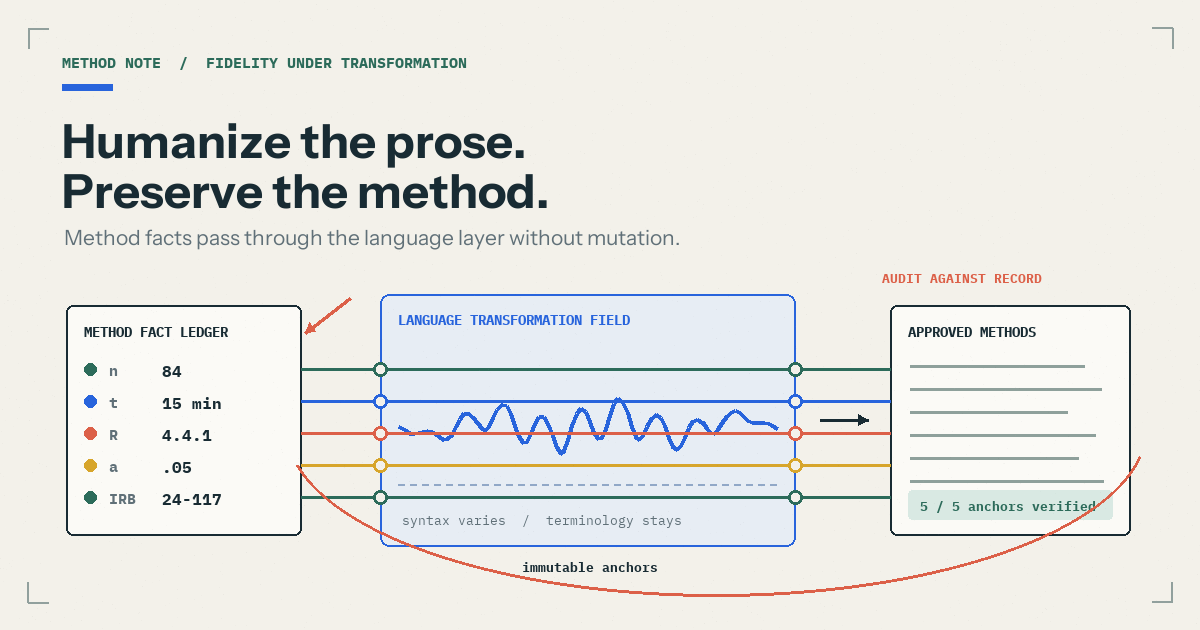
The wording may change only after the method facts have been identified and protected.
What must remain unchanged in a methods section
Before revising, create a method fact sheet from the approved protocol, preregistration, lab notes, analysis script, ethics documentation, or original draft. Do not rely on memory.
| Method category | Details to protect |
|---|---|
| Participants or samples | Counts, eligibility criteria, recruitment, exclusions, allocation, demographics |
| Materials and measures | Full names, versions, item counts, scales, units, reliability, calibration |
| Design | Variables, conditions, controls, grouping, randomization, blinding |
| Procedure | Order, timing, setting, instructions, interventions, stopping rules |
| Analysis | Software, packages, tests, models, thresholds, transformations, missing data |
| Ethics | Review body, approval number, consent process, privacy protections |
Also protect citations and qualifications. “Adapted from,” “validated for,” and “administered according to” describe different relationships. A humanizer should not collapse them into a generic claim that a measure was “based on” prior research.
A step-by-step methodology humanization workflow
1. Confirm that the method is complete and accurate
Humanization is a language-editing step, not a method-design step. Before opening the editor, verify the section against the research record.
Ask:
- Does the participant flow match the actual sample?
- Are inclusion and exclusion criteria complete?
- Are instrument names and versions correct?
- Does the procedure reflect what happened rather than what was planned?
- Are statistical tests and software reported accurately?
- Are deviations from the protocol disclosed where required?
Do not polish invented or uncertain details. Resolve them from the source record or with the responsible researcher first.
2. Mark immutable details
Highlight every value, name, unit, threshold, sequence, and identifier that must survive exactly. Examples include:
n = 84and group counts20 mg,450 ms,37 degrees C, or5 mL- Instrument and questionnaire names
- Software versions and package names
p < .05, confidence levels, and model terms- Ethics approval and registry numbers
- Quoted participant instructions
If a term has a defined meaning in your field, add it to the protected list even when it looks like ordinary language. “Recall,” “recognition,” and “retrieval,” for example, may not be interchangeable constructs.
3. Split the section by methodological function
Paste one subsection at a time into PaperHumanizer. Useful boundaries include:
- Study design
- Participants or sampling
- Materials and measures
- Procedure
- Data preparation
- Statistical analysis
- Ethics
This approach gives the model enough local context while limiting the number of facts you must audit after each pass. Do not combine the methods, results, and discussion in one request; each section has a different rhetorical purpose.
4. Choose Technical / STEM tone
The Technical / STEM tone is the best starting point for quantitative, laboratory, clinical, engineering, and computational methods. It favors precise, methodology-focused language and is less likely to replace field terms with broad conversational synonyms.
For qualitative research, Technical tone still works well for sampling, data collection, coding procedures, and software. Scholarly tone may fit reflexivity or methodological-positioning passages, but only if it retains the established qualitative vocabulary.
Use Standard humanization when the section already reads accurately and needs only a lighter improvement to flow. Use Deep mode when broader restructuring is necessary and available, then apply a stricter line-by-line audit. Review the academic tone guide before mixing tones within one section.
5. Give the passage one deliberate pass
Repeatedly processing the same methods paragraph increases the chance of semantic drift. Generate one revision, compare it with the source, and edit remaining awkward sentences manually.
A good methodology revision may:
- Combine short, repetitive procedural sentences
- Remove generic transitions such as “Furthermore” and “Additionally”
- Vary sentence openings without changing the sequence
- Clarify which action belongs to the researcher or participant
- Reduce redundant explanations around a standard term
It should not add methodological sophistication that was not present. A vague analysis does not become valid because the rewrite introduces “robust,” “systematic,” or “rigorous.”
6. Audit every method element
Compare the output with the original draft and the primary research record. Check content by category rather than reading only for general similarity.
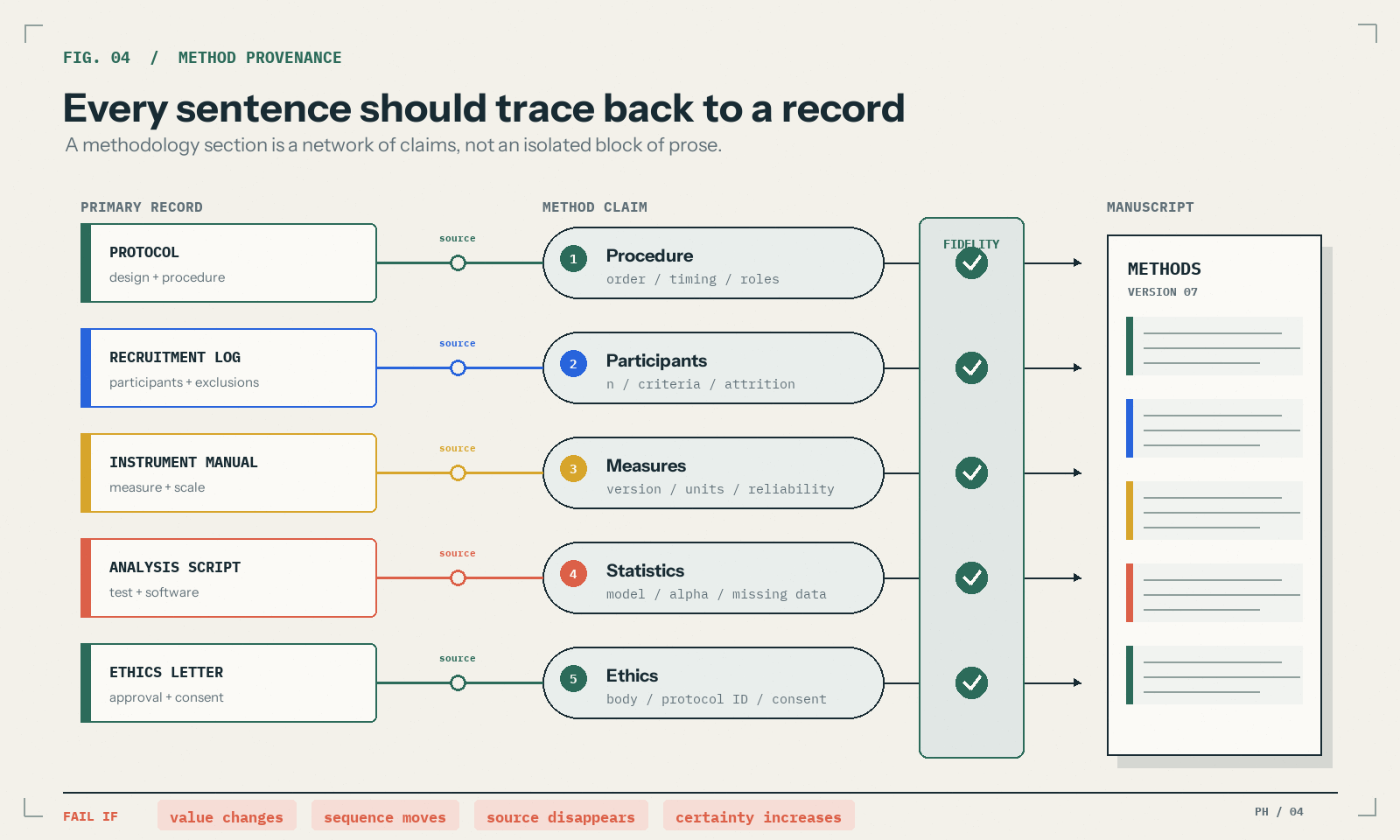
The approved protocol, analysis record, and original draft remain the sources of truth during the audit.
For each sentence, ask:
- Are all numbers, units, names, and thresholds identical?
- Is the chronological order unchanged?
- Does the same person, group, or system perform each action?
- Are mandatory, optional, and conditional steps still distinguished?
- Has a planned action been confused with a completed action?
- Are citations still attached to the methods they support?
- Has a limitation, exclusion, or deviation disappeared?
Use the Compare view to inspect the original and revision side by side. The research integrity guide contains an expanded audit for citations, data, technical terms, and claims.
7. Restore the researcher's voice and disciplinary convention
A human methods section does not need casual language or artificial errors. It sounds credible because it reports concrete decisions accurately and uses the conventions of its field.
After the automated pass, restore terminology preferred by your lab, discipline, supervisor, or target journal. Check journal reporting standards and required checklists, such as the applicable study-design guideline. A humanizer cannot determine whether your report satisfies a field-specific standard.
Before and after: improve the prose without changing the procedure
Mechanical AI-assisted draft
First, participants were asked to complete the demographic questionnaire. Next, participants were asked to complete the 20-item Task Engagement Scale using a seven-point response format. Subsequently, participants completed the computer task for 15 minutes. Finally, the response data were exported and analyzed in R version 4.4.1.
Controlled revision
Participants first completed the demographic questionnaire and the 20-item Task Engagement Scale, which used a seven-point response format. They then performed the computer task for 15 minutes. Response data were exported and analyzed in R version 4.4.1.
The revision removes repetitive transitions and combines related steps. It preserves the order, item count, response scale, duration, software, and version. It does not claim that the scale was validated, the task was randomized, or the analysis used a test that the original did not report.
How the workflow changes by research design
Quantitative studies
Prioritize numeric fidelity. Check sample sizes, variable coding, scale direction, statistical assumptions, tests, model terms, thresholds, and missing-data procedures. A changed minus sign or reference category can reverse the meaning.
Qualitative studies
Protect the methodological framework, sampling logic, interview format, coding stages, researcher roles, reflexivity statements, and saturation claims. Do not let “thematic analysis,” “content analysis,” and “grounded theory” become interchangeable labels.
Mixed-methods studies
Preserve the relationship and order between components. “Sequential explanatory,” “sequential exploratory,” and “convergent” designs differ in when and why evidence is integrated.
Computational and engineering research
Lock algorithm names, datasets, preprocessing steps, hyperparameters, software environments, hardware details, evaluation metrics, and random seeds. Keep code outside the humanizer.
Clinical or laboratory studies
Verify dosages, concentrations, equipment models, calibration, timing, temperatures, safety procedures, eligibility criteria, adverse-event handling, registration details, and ethics language.
Methodology rewrite errors that require immediate correction
Stop and return to the source if the revision:
- Changes a participant count or denominator
- Reorders the procedure
- Replaces a validated instrument with a generic description
- Adds randomization, blinding, or a control group not present in the study
- Changes past tense to future tense or turns a planned method into a completed one
- Replaces an association test with a causal model
- Removes exclusions, deviations, or missing-data handling
- Alters the ethics body, approval number, or consent description
- Introduces a citation, statistic, or methodological claim you did not provide
These are research-record errors. Correct them manually rather than asking for another stylistic rewrite.
A final methodology section checklist
- The section matches the protocol, research record, and actual procedure
- Sample and group counts are unchanged
- Measures, versions, scales, and units are exact
- Procedure order, duration, conditions, and roles are unchanged
- Statistical tests, software, parameters, and thresholds are exact
- Citations still support the correct methods
- Ethics and consent details match the approved wording
- Limitations and deviations remain visible
- The section follows the target journal or institutional standard
- A coauthor or supervisor has reviewed high-risk changes when required
Frequently asked questions
Can I use an AI humanizer for a research methodology section?
Yes, when the applicable academic or publication policy permits language editing. Use it to improve expression, not to design the method or invent missing details. Retain the source record and disclose assistance when required.
Which PaperHumanizer tone is best for methodology?
Technical / STEM is usually the best fit because it prioritizes precise, methodology-focused language. Qualitative positioning passages may suit Scholarly tone, but defined methodological terminology must remain unchanged.
How do I make a methodology section sound human?
Remove unnecessary procedural transitions, combine closely related steps, clarify who performed each action, and vary sentence openings. Preserve repeated technical names when consistency matters more than stylistic variety.
Will humanizing the methods section change numbers or statistics?
The workflow is designed to preserve those details, but no automated rewrite removes the need for verification. Compare every number, unit, test, threshold, and software version with the original and the analysis record.
Should I paste the entire methodology chapter at once?
No. Process focused subsections such as participants, measures, procedure, and analysis separately. Smaller passages are easier to audit and reduce the impact of any unwanted change.
Can a methodology humanizer fix an incomplete method?
No. It can improve wording but cannot reconstruct unrecorded procedures, validate a design, or determine whether reporting is complete. Resolve missing information from the research record and responsible researchers before editing.
When your fact sheet is ready, open the academic AI humanizer, choose Technical / STEM tone, and revise one methods subsection you can verify from beginning to end.