
A research conclusion compresses the paper's answer, contribution, limits, and implications into a small amount of prose. Because every sentence carries several dependencies, even a minor stylistic change can make a finding sound more general, a contribution sound more novel, or a recommendation sound more certain than the evidence permits.
A conclusion section humanizer should improve emphasis and rhythm without changing the final claims. No new result, citation, mechanism, population, or recommendation should appear simply because it makes the ending sound stronger.
This guide explains how to humanize a research conclusion while keeping it traceable to the full paper.
Why conclusions are risky to rewrite
Conclusions often contain familiar, compressed phrases:
- “The findings of this study demonstrate that...”
- “In conclusion, it is evident that...”
- “These results have important implications for...”
- “This study makes a significant contribution to...”
- “Future research should further explore...”
Replacing those phrases can improve the ending, but compression creates risk. A qualifier removed from one sentence may alter the entire paper's final message. A broad noun such as “users” may silently replace a defined sample. A suggestion for future research may become an implementation recommendation.
The goal is not to make the conclusion dramatic. It is to make the paper's actual contribution unmistakable and proportionate.
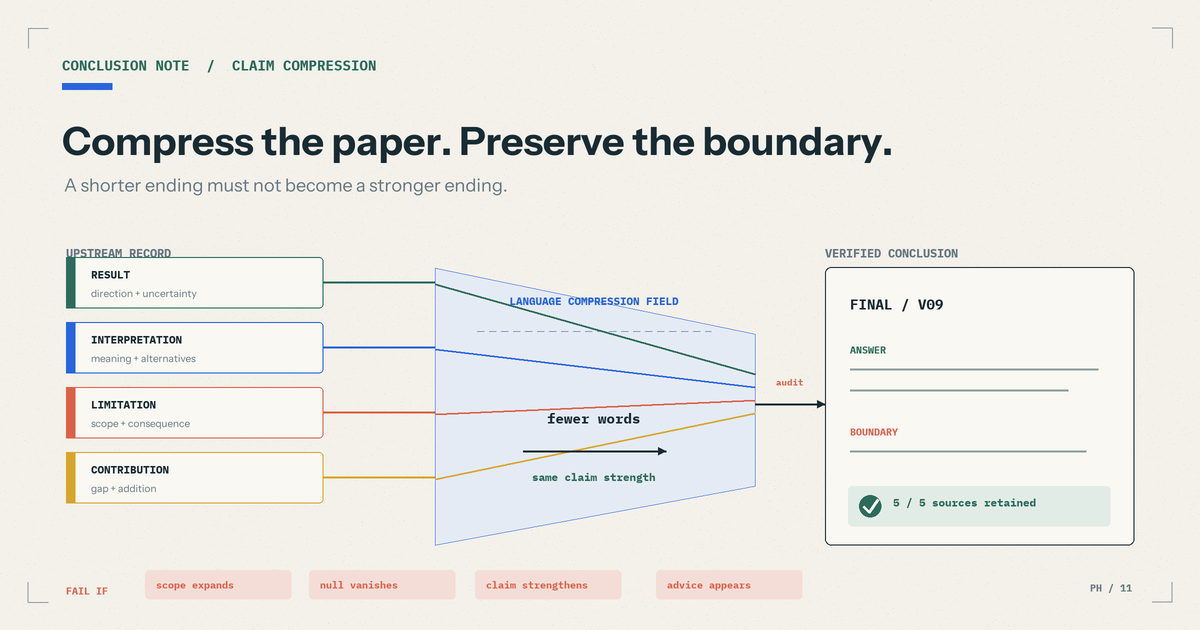
A conclusion compresses the paper, but every final claim must retain its source, scope, and level of certainty.
The five jobs of a research conclusion
A strong conclusion usually performs five related jobs:
- Answer: gives the most direct answer to the research question
- Synthesize: identifies the central pattern rather than repeating every result
- Contribute: explains what the study adds to existing knowledge
- Bound: states the conditions and limitations that constrain the answer
- Extend: identifies a justified implication or next research step
Not every paper needs five separate paragraphs. A short journal conclusion may perform all five jobs in 150 words; a thesis conclusion may devote a section to each. The logical distinctions still matter during revision.
Build a conclusion claim ledger first
Record the source and maximum permitted strength of each conclusion statement.
| Conclusion element | Source of truth | What must remain fixed |
|---|---|---|
| Main answer | Research question and final results | Outcome, direction, uncertainty, population |
| Synthesis | Results and discussion | Which findings are central and how they relate |
| Contribution | Introduction gap and discussion | Type and scope of novelty |
| Limitation | Design, sample, measures, and analysis | Consequence for interpretation or generalizability |
| Implication | Supported interpretation | Domain, audience, conditions, and degree of certainty |
| Future research | Unresolved limitation or question | The specific uncertainty to be addressed |
The ledger establishes a ceiling. A revised sentence may be clearer than the original, but it cannot rise above the strongest statement supported by its source.
How to humanize a research conclusion step by step
1. Write the answer in one plain sentence
Before editing the conclusion, answer the research question without academic framing. Include the population or setting and the appropriate degree of certainty.
For example:
In this undergraduate sample, structured feedback was associated with faster responses, while accuracy remained unchanged.
This sentence becomes the anchor for the conclusion. It contains the direction, scope, relationship, and null finding. If a rewrite implies that feedback generally improves performance, it has crossed the anchor's evidence boundary.
Use the results-section fidelity workflow to verify every value, direction, and null result before conclusion editing begins.
2. Separate synthesis from repetition
A conclusion should not reproduce the results section line by line. Group related findings around the research question and identify the pattern that matters.
However, synthesis is not permission to hide inconvenient evidence. Preserve null results, contradictory findings, subgroup differences, and uncertainty when they affect the answer.
Ask:
- Which result directly answers the primary question?
- Which secondary result changes how that answer should be understood?
- Which detail belongs in results rather than conclusion?
- What cannot be combined without losing meaning?
3. Trace the claimed contribution back to the gap
Return to the final paragraphs of the introduction. The conclusion should answer the same gap that justified the study.
Distinguish among contributions:
- New evidence in a defined population or setting
- A replication or boundary-condition test
- A methodological improvement
- A theoretical refinement
- A new dataset, instrument, framework, or implementation finding
Do not let “provides evidence in a new context” become “introduces a new theory.” Do not let a partial replication become a definitive resolution of a debate.
The introduction humanization workflow provides a matching audit for the gap, rationale, and study purpose.
4. Define the scope of every final claim
Underline words that control generalizability:
- in this sample
- under these conditions
- during the study period
- for the measured outcome
- within the observed range
- may, suggests, is consistent with
- preliminary, exploratory, short-term
These terms are part of the finding. Keep them or replace them with language of equivalent strength.
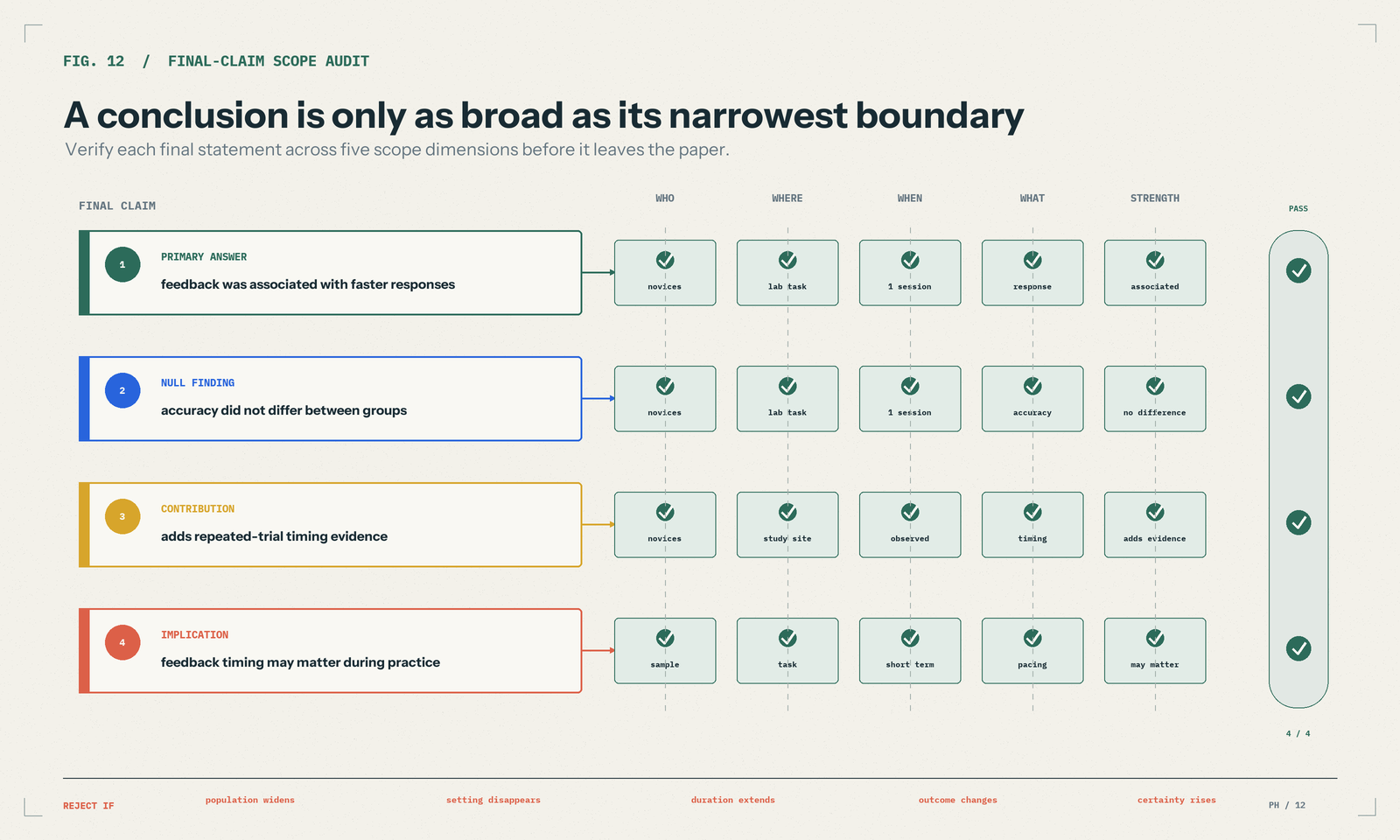
Before approving a final claim, verify who, where, when, what, and how strongly the study supports it.
5. Revise one conclusion unit at a time
Paste one coherent conclusion passage into PaperHumanizer. A short journal conclusion may fit in one pass. Process a thesis or dissertation conclusion by function: synthesis, contribution, limitations, implications, and future research.
Use Scholarly tone when the conclusion emphasizes theoretical contribution and disciplinary debate. Technical / STEM is appropriate for concise findings, system performance, clinical outcomes, or engineering constraints. Standard Academic works for direct empirical and coursework conclusions.
Choose the lightest humanization depth that improves the prose. A broad restructure may be useful for repetitive thesis conclusions, but it requires a complete alignment audit. Review the academic tone guide before changing tone across sections.
6. Compare every claim with its upstream source
Use Compare view to match revised conclusion sentences with the introduction, results, and discussion.
For each sentence, identify:
- The research question it answers
- The result or pattern it summarizes
- The interpretation that supports it
- The limitation that constrains it
- The population and setting to which it applies
- Whether it is a finding, implication, or recommendation
If a sentence has no upstream source, remove it or return it to the section where it can be developed and supported.
The discussion-section evidence boundary helps distinguish a measured result from an interpretation, mechanism, implication, or recommendation.
7. Remove new evidence and unsupported citations
A conclusion normally synthesizes evidence already presented. Do not add a new result, literature source, statistic, quotation, theory, or limitation merely to strengthen the ending.
Some disciplines permit citations in conclusions, particularly in long theses or review articles. If yours does, the cited relationship must already be established earlier in the paper and must still be verified against the source.
8. Calibrate implications and recommendations
An implication identifies what a finding may mean. A recommendation says what someone should do. The second requires a higher level of evidence.
Compare:
| Claim level | Example |
|---|---|
| Finding | Structured feedback was associated with faster responses in this sample. |
| Implication | The result suggests that feedback timing may matter during repeated tasks. |
| Research direction | Longer studies should test whether this pattern persists. |
| Practice recommendation | Programs should adopt structured feedback for all learners. |
The practice recommendation is not justified by a short, single-sample study merely because it provides a decisive final sentence.
9. Align the conclusion with the abstract
The abstract and conclusion are two compressions of the same paper. Compare them after revision.
Verify that they share:
- The same primary answer
- The same direction and degree of certainty
- The same study population and context
- Compatible contribution language
- Compatible implications
If the conclusion changes, update the abstract only after confirming the new wording against the full paper. The abstract humanizer guide explains how to protect dense summary claims.
Before and after: end clearly without overstating
Generic draft
In conclusion, this study clearly demonstrates that structured feedback is an effective way to improve student performance. These important findings have broad implications for education and show that institutions should implement structured feedback. Future studies should continue to explore this important topic.
Controlled revision
In this undergraduate sample, structured feedback was associated with faster responses across repeated trials but not with higher accuracy. The pattern suggests that feedback may influence task pacing rather than overall performance. Because the study examined a single session, longer studies are needed to determine whether the response-time difference persists and transfers to classroom settings.
The revision preserves the null accuracy finding, changes a universal effectiveness claim into a bounded interpretation, and links future research to a specific temporal and contextual limitation. It closes the paper without turning one study into an implementation mandate.
Humanizing different kinds of conclusions
Journal article conclusions
Prioritize the direct answer and contribution. Avoid repeating methods or every secondary result. Keep implications proportionate to the design and journal format.
Thesis and dissertation conclusions
Maintain alignment across chapter-level findings and the central research problem. Process long sections separately, then verify that the overall contribution does not exceed the combined evidence.
Systematic review conclusions
Preserve certainty ratings, heterogeneity, evidence gaps, and limits of the search. Do not convert “low-certainty evidence suggests” into a settled recommendation.
Qualitative study conclusions
Retain context, participant perspective, negative cases, and the distinction between interpretation and prevalence. Do not imply statistical generalizability.
Technical and engineering reports
Keep operating conditions, benchmarks, tolerances, failure cases, and comparison baselines visible. “Improved performance” is incomplete without the metric and conditions.
Common conclusion-rewrite errors
Reject or correct a revision if it:
- Adds a result, source, statistic, or mechanism not developed earlier
- Removes a null, mixed, or unexpected finding that changes the answer
- Replaces a defined population with a general audience
- Changes association into causation
- Expands short-term evidence into a lasting effect
- Calls a contextual finding universally applicable
- Inflates an incremental contribution into a breakthrough
- Turns an implication into a policy or practice recommendation
- Introduces generic future research unrelated to a limitation
- Conflicts with the abstract, introduction, results, or discussion
Final conclusion-section checklist
- The conclusion directly answers the original research question
- Every final claim has an identifiable upstream source
- Findings, interpretations, and recommendations remain distinct
- Null, mixed, and contradictory evidence remains visible
- Population, setting, duration, and outcome boundaries are preserved
- Contribution language matches the original research gap
- Limitations constrain the claims they affect
- No new evidence or unverified citation has been introduced
- The abstract and conclusion communicate the same answer
- The final wording reflects the author's own judgment
Frequently asked questions
Can I use an AI humanizer for a research conclusion?
Yes, when applicable academic or publisher policy permits language editing. Verify the output against the research question, results, discussion, limitations, and abstract before using it.
How do I make a research conclusion sound more human?
Lead with the actual answer, name the contribution specifically, connect limitations to their consequences, and identify a justified next step. Avoid generic declarations of importance and broad claims that the study did not test.
Can a humanizer change the meaning of a conclusion?
It can unintentionally remove qualifiers, broaden the population, strengthen causality, or convert an implication into a recommendation. A claim ledger and side-by-side comparison are therefore essential.
What is the best tone for a conclusion section?
Scholarly tone fits theoretical synthesis, Technical / STEM fits precise empirical or system conclusions, and Standard Academic fits clear general research writing. Match the tone used in the rest of the paper.
Should a conclusion repeat the results?
It should synthesize the results that answer the research question, not reproduce every value or table. Preserve exact values only when they are necessary to the final answer or required by the format.
How do I humanize a thesis conclusion?
Process one functional subsection at a time, maintain a chapter-to-claim ledger, and perform a final audit across the thesis question, chapter findings, contribution, limitations, and abstract.
When the conclusion claim ledger is complete, open the academic AI humanizer and revise one final claim whose source and scope you can verify across the paper.