
PaperHumanizer can produce a better academic rewrite than a general AI assistant because the tools are optimized for different jobs. ChatGPT and Gemini are broad conversational systems: they answer questions, summarize, brainstorm, code, and rewrite when prompted. PaperHumanizer is a focused rewriting workflow built to change detectable writing patterns while protecting an academic draft's meaning, citations, terminology, and tone.
That does not mean a specialized humanizer is better at every AI task. It means specialization matters when the task is narrow: turn an AI-assisted essay, thesis section, or research paragraph into more natural academic prose that remains easy to verify.
For a step-by-step Gemini draft workflow, use our Gemini humanizer guide, including a controlled prompt, source checks, and annotated examples. To compare a dedicated paraphrasing product, read QuillBot versus PaperHumanizer.
Try the purpose-built academic humanizer →

The useful comparison is not which tool can generate more text. It is which workflow gives an academic writer better control over the final rewrite.
The short answer: a different optimization target
If you ask a general model to “make this sound human,” it must infer what human means, how much to rewrite, which details to lock, what academic register to use, and whether you care about detector-sensitive patterns. A carefully engineered prompt can improve the result, but the user has to design and repeat that process.
PaperHumanizer starts with that purpose already defined. Its workflow is organized around academic humanization rather than open-ended conversation.
| Decision point | General AI tool such as ChatGPT or Gemini | PaperHumanizer |
|---|---|---|
| Primary job | Broad generation, explanation, and conversation | Humanizing an existing academic draft |
| Default rewrite | Follows the user's prompt; quality depends heavily on instructions | Uses a dedicated academic rewriting workflow |
| Academic tone | Must be described and reinforced in the prompt | Standard Academic, Scholarly, and Technical / STEM controls |
| Pattern reduction | May paraphrase vocabulary while leaving uniform rhythm | Targets phrasing, transitions, sentence rhythm, and paragraph regularity together |
| Citation handling | Requires explicit instructions and manual checking | Designed to preserve citation markers while rewriting surrounding prose |
| Review | Usually presents another answer in a chat | Original, output, and side-by-side Compare views |
| Repeated use | The prompt and constraints may need to be rebuilt | The controls stay consistent from section to section |
General AI tools are capable, but generality has a cost
ChatGPT and Gemini are powerful because they can adapt to thousands of tasks. The same flexibility creates uncertainty in a high-constraint rewrite.
A short request such as “rewrite this so it sounds human” leaves important decisions unstated. The model may simplify technical language, strengthen a cautious claim, replace a discipline-specific term, remove a citation it considers awkward, or produce a polished paragraph with the same predictable rhythm as the original.
You can write a longer prompt to prevent those changes. You can specify tone, sentence variation, citation rules, protected terminology, degree of rewriting, paragraph function, and output format. But at that point, you are building a humanization workflow inside the prompt every time you use the chat.
PaperHumanizer packages those decisions into a repeatable interface.
The technical advantage: a specialist editing agent, not a single vague prompt
“Agent” is often used to imply that several bots are talking to one another. That is not the useful distinction here. PaperHumanizer behaves like a specialist editing agent because a controller turns the user's purpose, tone, language, and document structure into a constrained rewriting job before the language model generates the result.
The underlying model supplies language reasoning and rewriting ability. The product advantage comes from the system built around that capability:
Purpose and tone routing
The controller combines the selected writing purpose—academic paper, essay, professional report, or blog—with Standard Academic, Scholarly, or Technical / STEM tone instructions. A methodology passage and a reflective essay therefore do not enter the model with the same generic “sound human” request.
A constraint policy for every generation
The rewrite is instructed to preserve the input language, citations, factual claims, paragraph order, and information density. It also receives explicit length and output-format limits. These constraints reduce the chance that a helpful general model will summarize, add commentary, or reorganize the argument when the user only requested a rewrite.
Structure-aware long-text planning
Long documents are divided along paragraph boundaries where possible. Oversized paragraphs are split at sentence boundaries, processed in order, and reassembled in the same sequence. This is more reliable than sending an oversized block and hoping the end is not truncated or compressed.
Focused generation rather than open conversation
The generation worker receives one role, one source passage, and one output contract. It is not distracted by an earlier brainstorming conversation or by changing instructions across several chat turns. That narrow context makes repeated section-by-section processing more consistent.
Human-in-the-loop verification
The final stage is not another hidden AI claim. It is the writer's Input, Output, and Compare views. The system produces the controlled rewrite; the user confirms citations, numbers, terminology, and claim strength before using it.
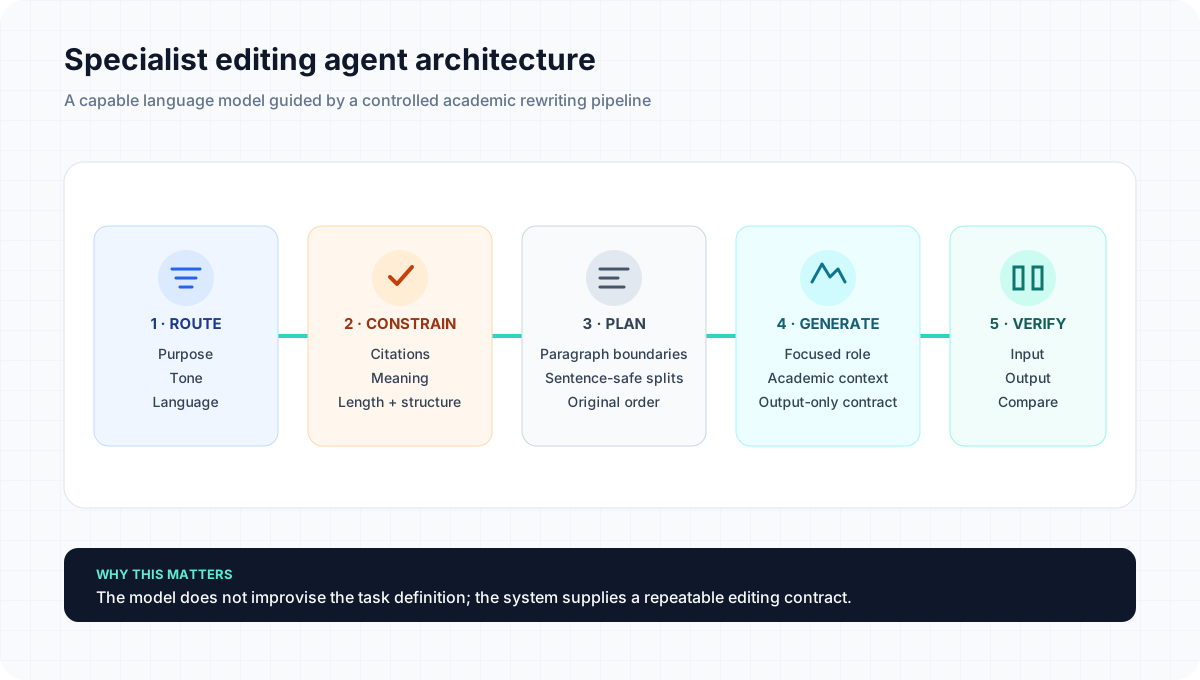
Model capability is one layer. Routing, constraints, document planning, and review turn it into a repeatable specialist editing workflow.
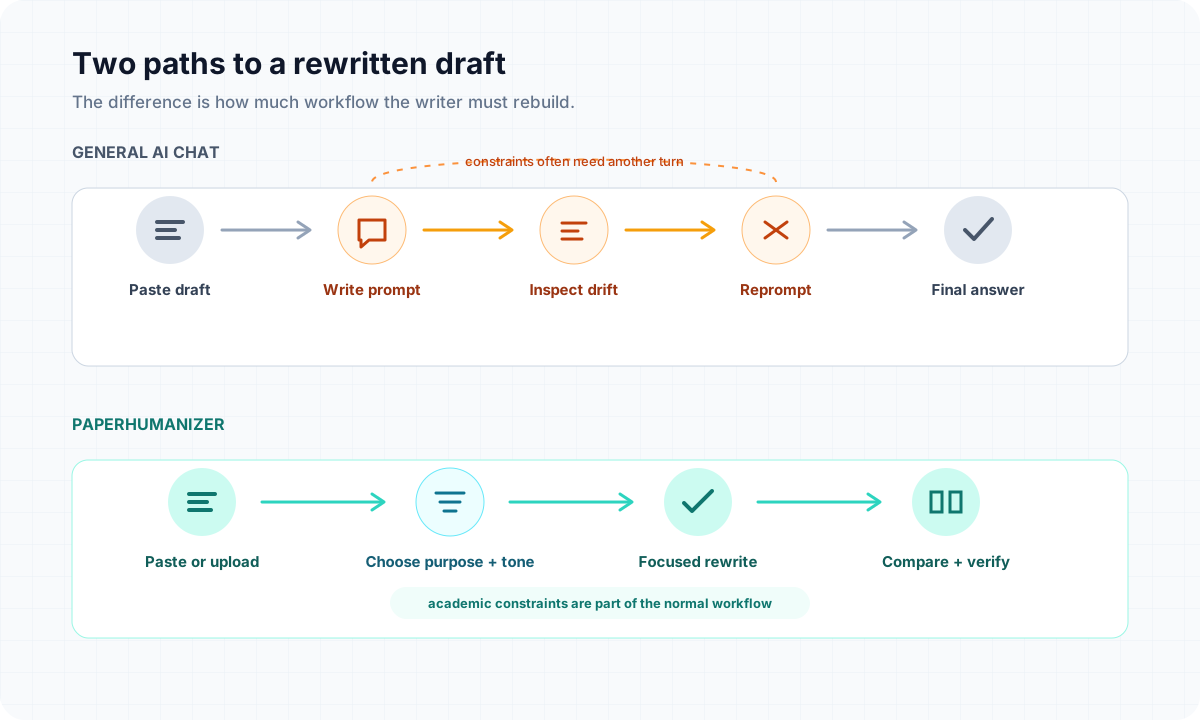
A general chat can reach a useful result, but a specialized workflow removes repeated prompt design and makes the review step explicit.
Seven reasons the specialized rewrite is often better
1. The tool begins with the right job definition
General assistants are designed to give a helpful response to the latest instruction. In a rewrite, “helpful” can mean adding context, making the prose clearer, shortening it, or improving the argument. Those changes may be welcome in ordinary editing but risky when the draft contains evidence, citations, or a carefully limited claim.
PaperHumanizer begins from a narrower rule: change how the text is expressed while keeping what it says. That constraint shapes the entire workflow.
2. It treats academic meaning as something to protect
Academic prose carries meaning through small distinctions:
- “is associated with” is weaker than “causes”
- “may indicate” is weaker than “demonstrates”
- “participants were assigned” may differ from “participants were randomly assigned”
- a citation after one clause does not necessarily support the next clause
A fluent rewrite can still be wrong if it changes one of those relationships. PaperHumanizer is designed around preserving arguments, references, technical terms, and the degree of certainty. The writer should still verify the output, but the interface makes fidelity a primary goal rather than an optional prompt instruction.
For citation-heavy work, use the research-paper citation checklist after rewriting.
3. It changes patterns, not only synonyms
Weak paraphrasing replaces words while retaining the original template. “Furthermore” becomes “Moreover,” but every paragraph still opens with a transition. Sentences remain similar in length. Claims arrive in the same order. The result looks different at word level and unchanged at structural level.
PaperHumanizer's deeper rewrite works across several layers:
- Formulaic phrases and overused transitions
- Sentence openings and clause structure
- Short, medium, and long sentence rhythm
- Repetition across a paragraph
- The relationship between claims and supporting detail
- Academic register appropriate to the selected purpose
This multi-layer change is why a purpose-built humanizer can outperform a casual “paraphrase this” prompt even when both systems generate grammatically correct text.
4. Academic tone is a control, not a vague request
“Make it academic” is not one style. A first-year essay, a humanities discussion, and a STEM methodology section require different language.
PaperHumanizer provides three practical tone paths:
- Standard Academic for essays, coursework, and clear formal prose
- Scholarly for nuanced argument, theory, humanities, and social-science discussion
- Technical / STEM for procedures, measurements, methods, and precise terminology
With a general model, users must describe these differences in the prompt and watch for drift during later turns. A visible control is faster and more consistent.
5. Citations remain part of the working text
Writers sometimes remove citations before asking a general model to rewrite a paragraph because they fear the references will be changed. That removes useful context and creates another opportunity for citations to be reattached to the wrong claim.
PaperHumanizer is designed to keep common academic citation markers in place while changing the surrounding language. You should still compare every source relationship, but you do not have to build a citation-protection prompt from scratch.
6. The interface is built for verification
A chat response encourages the reader to evaluate the new answer on its own. PaperHumanizer includes Input, Output, and Compare views so the writer can inspect what changed.
That matters because the best rewrite is not simply the most elegant paragraph. It is the paragraph that improves naturalness without altering:
- the thesis or paragraph function
- evidence and numerical values
- citations and quotations
- technical terminology
- uncertainty and limitations
- the writer's intended conclusion
The comparison step makes responsible review part of the product flow rather than an afterthought.
7. It produces a repeatable section-by-section process
Long academic documents should not be rewritten as one uncontrolled block. An abstract, introduction, method, results section, and discussion each have different constraints.
PaperHumanizer lets a writer apply the same settings and review method across manageable sections. File upload for PDF, DOCX, DOC, and TXT also reduces the friction of bringing an existing draft into the editor. For a complete sequence, see how to humanize an academic paper.
A practical rewrite example
Consider this deliberately formulaic source sentence:
Furthermore, the results indicate that peer feedback has a positive impact on revision quality among undergraduate students (Chen, 2024).
A generic paraphrase may change visible vocabulary while retaining the template:
Moreover, the findings suggest that peer feedback positively influences revision quality for undergraduate students (Chen, 2024).
The sentence is fluent, but its transition-led structure and predictable rhythm remain almost identical.
A more targeted revision might be:
Peer feedback improved revision quality among the undergraduate students in Chen's study (2024).
The targeted version removes the formulaic opening and changes the sentence structure while keeping the claim and citation relationship. This example is illustrative, not a detector benchmark; the appropriate wording still depends on what the cited source actually reports.
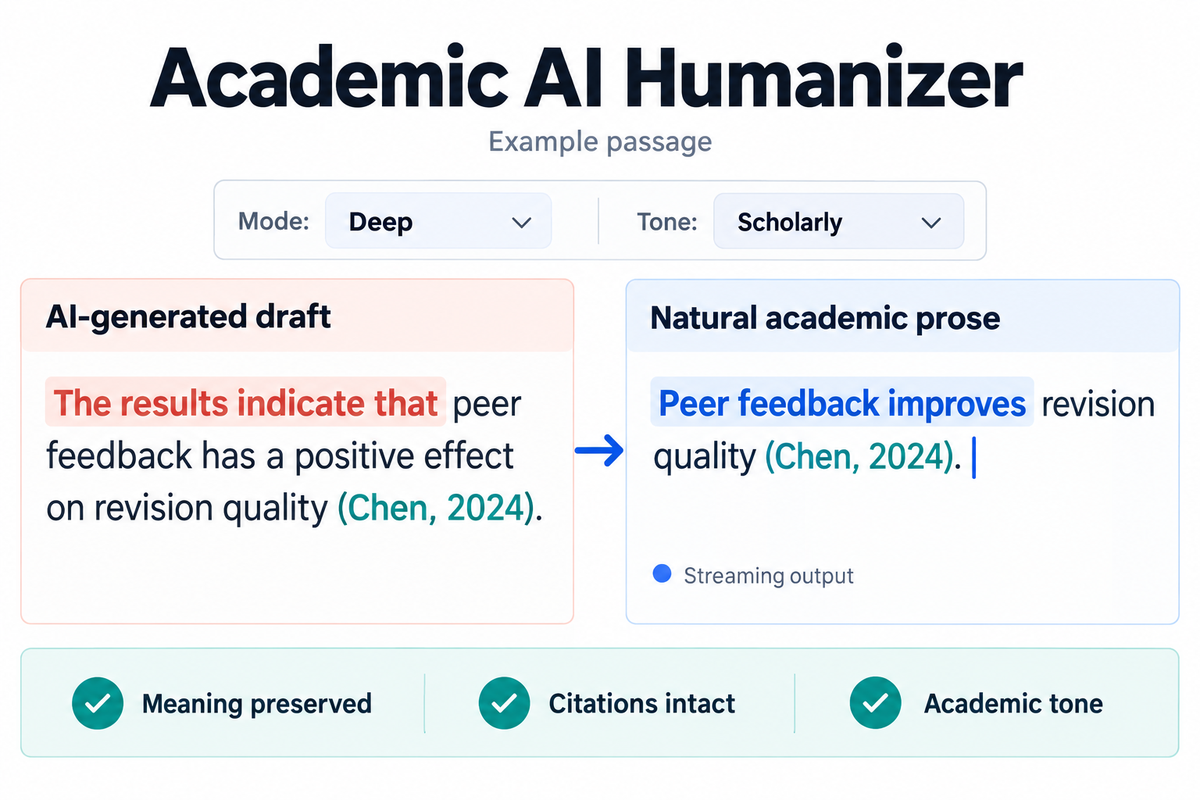
Effect comparison: what changes in the actual text
The table below evaluates the example above as text, not as a marketing score. It makes the quality difference inspectable.
| Check | Source | General paraphrase | Targeted PaperHumanizer-style rewrite |
|---|---|---|---|
| Formulaic transition | Begins with “Furthermore” | Replaces it with the equally formulaic “Moreover” | Removes the transition-led opening |
| Sentence structure | Reporting phrase before the finding | Keeps the same reporting template | Leads directly with the study finding |
| Citation retained | (Chen, 2024) | Retained | Retained |
| Main claim retained | Peer feedback improves revision quality | Retained | Retained |
| Academic concision | 19 words before the citation | 16 words before the citation | 11 words before the citation |
| Manual review needed | Yes | Yes | Yes |
Citation retention in this one example is therefore 1 of 1 for both outputs. The advantage is not a fabricated citation percentage; it is that PaperHumanizer combines citation-preservation instructions with structural pattern reduction in the normal workflow.
Why this page does not publish invented AI-detection rates
A claim such as “ChatGPT: 68% AI, PaperHumanizer: 7% AI” would only be meaningful if it named the source passages, prompt, product versions, detector, detector version, date, sample size, and aggregation method. Different detectors can assign very different probabilities to the same paragraph, and short passages are especially unstable.
PaperHumanizer is designed to reduce patterns that detectors commonly use, but no fixed percentage applies to every input. A defensible detector benchmark should:
- Use a disclosed set of academic passages across several disciplines
- Run the same untouched source through both workflows
- Lock the general-tool prompt and product versions
- Test every output with the same external detector on the same date
- Report median and range, not only the best example
- Separately measure citation retention, numerical fidelity, and claim-strength changes
Until that controlled benchmark exists, the honest product proof is a side-by-side output the user can inspect and an external detector result the user can reproduce. This is stronger evidence than a precise-looking number with no methodology.
Capability map: specialization instead of a fake score
The chart below is a qualitative workflow map, not a numerical test. It shows which controls are built into each experience by default. A skilled user can reproduce many specialized behaviors with a long general-model prompt; the difference is whether the workflow provides them consistently without rebuilding the instructions.
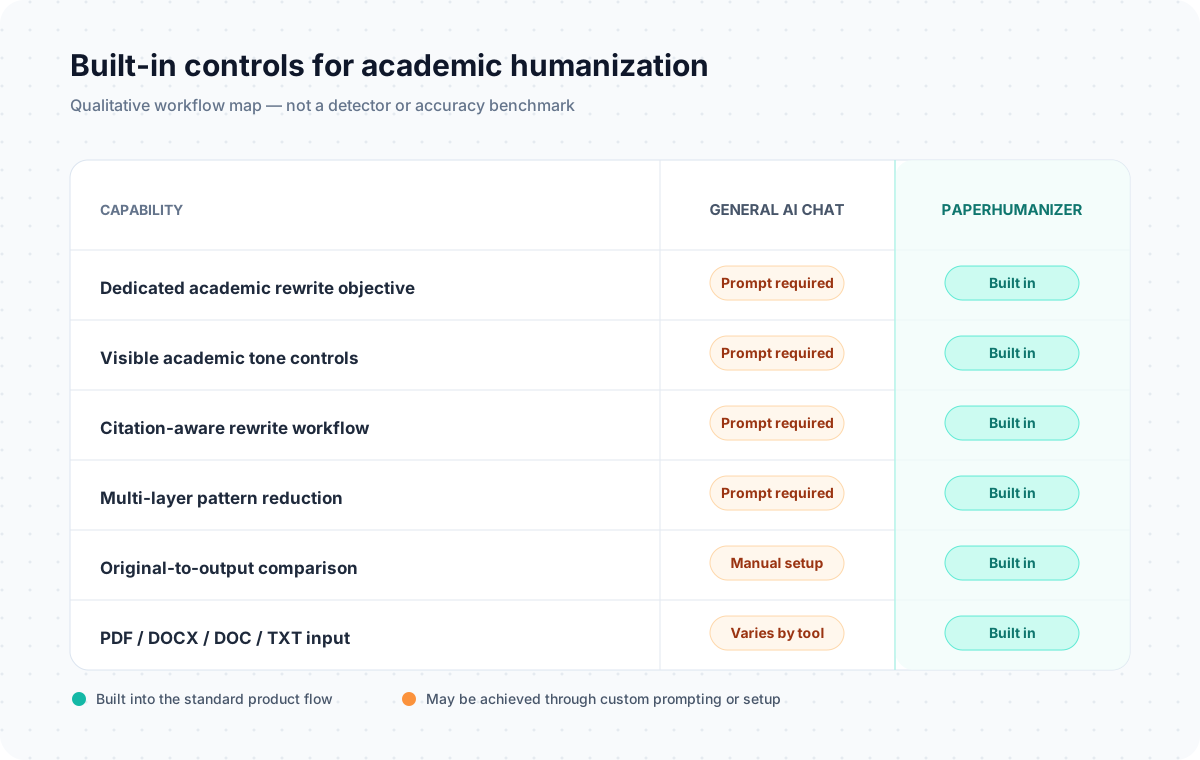
Built-in means the capability is visible in the normal workflow. General tools may approximate it when the user supplies detailed instructions.
When ChatGPT or Gemini is the better choice
Specialization cuts both ways. A general AI assistant is usually the better tool when you need to:
- brainstorm possible research questions
- explain an unfamiliar concept
- compare several outlines
- generate interview questions
- summarize material for your own study
- write code or analyze a non-writing problem
- continue a wide-ranging conversation across tasks
PaperHumanizer is not intended to replace those capabilities. It is the stronger choice when you already have a draft and the next job is controlled academic humanization.
This distinction also helps avoid a poor workflow: do not ask a humanizer to supply research, invent evidence, or decide your argument. Complete the intellectual work first, then revise the language.
How to compare the tools fairly with your own paragraph
You do not need to accept a marketing claim. Run a controlled comparison.
- Choose a 150-250 word paragraph containing one citation, one technical term, and one qualified claim.
- Save the original and list what must remain unchanged.
- Ask the general tool to humanize it using the prompt you would normally write.
- Run the same source paragraph through PaperHumanizer with the appropriate purpose and tone.
- Compare both outputs for meaning, citation placement, terminology, sentence variety, and naturalness.
- Count how many extra prompts or manual corrections each version requires.
- Choose the result you can verify and confidently revise further.
Do not judge only by a detector score. Third-party detectors are probabilistic and can disagree. The first test is whether the writing remains accurate, natural, and genuinely connected to your work.
What creates the conversion advantage for users
The value is not that PaperHumanizer can generate words that a general model cannot. The value is reduced workflow cost:
- less time writing and repeating complex prompts
- fewer opportunities for tone and constraints to drift
- a consistent editor for multiple paper sections
- visible controls for purpose and academic tone
- direct comparison between the source and rewrite
- one clear path from pasted or uploaded draft to reviewed output
For a writer who humanizes academic text repeatedly, consistency and reviewability are product features, not cosmetic differences.
Test the workflow with a paragraph you know well, then inspect every change. If the focused controls save you repeated prompting and manual correction, compare the available plans for longer or recurring work.
Frequently asked questions
Can ChatGPT or Gemini humanize text?
Yes. Both can rewrite text when prompted, and a detailed prompt can produce a strong result. The difference is that they are general assistants, so users must specify and monitor the academic constraints themselves. PaperHumanizer provides a dedicated workflow for that task.
Is PaperHumanizer always better than ChatGPT?
No. ChatGPT is better suited to many open-ended tasks such as brainstorming, explanation, coding, and conversation. PaperHumanizer is designed to be better for one narrower job: humanizing an existing academic draft while preserving its substance.
Does a specialized AI humanizer guarantee a detector result?
No responsible tool can guarantee a score from every third-party detector. Models and thresholds change, and detectors can produce false positives. PaperHumanizer targets common AI-writing patterns, but you should evaluate accuracy and naturalness and follow your institution's policy.
Will PaperHumanizer change citations or technical terms?
The workflow is designed to preserve citations, meaning, and discipline-specific language. Generated text still requires review, especially when a sentence contains data, a quotation, a technical procedure, or a carefully qualified claim.
Do I need to rewrite an entire paper at once?
No. Processing coherent sections is easier to verify and usually produces better control. Start with an introduction, literature-review passage, method subsection, or discussion paragraph and compare it with the source before continuing.
Use the right tool for the last mile
ChatGPT and Gemini are useful general-purpose systems. PaperHumanizer does not need to replace them to offer a better result at the final rewriting stage. Once your ideas, evidence, and argument are in place, a specialized academic humanizer gives you clearer controls, a more repeatable process, and a better way to verify the result.
See how PaperHumanizer rewrites your own draft →
ChatGPT and Gemini are trademarks of their respective owners. PaperHumanizer is independent and is not affiliated with or endorsed by OpenAI or Google. Product capabilities may change; evaluate current tools with your own text.