AI can help a writer explore an outline, diagnose an unclear paragraph, or produce a rough draft. It can also introduce false claims, invented references, generic analysis, and a voice that does not belong to the author. Responsible revision begins by recognizing that polished language is not evidence of accurate scholarship.
This workflow is for writers who are permitted to use AI assistance and want to turn a rough, machine-shaped draft into work they understand, verify, and can defend. It is not a way to conceal prohibited use. Your institution, publisher, supervisor, or client policy always takes priority.
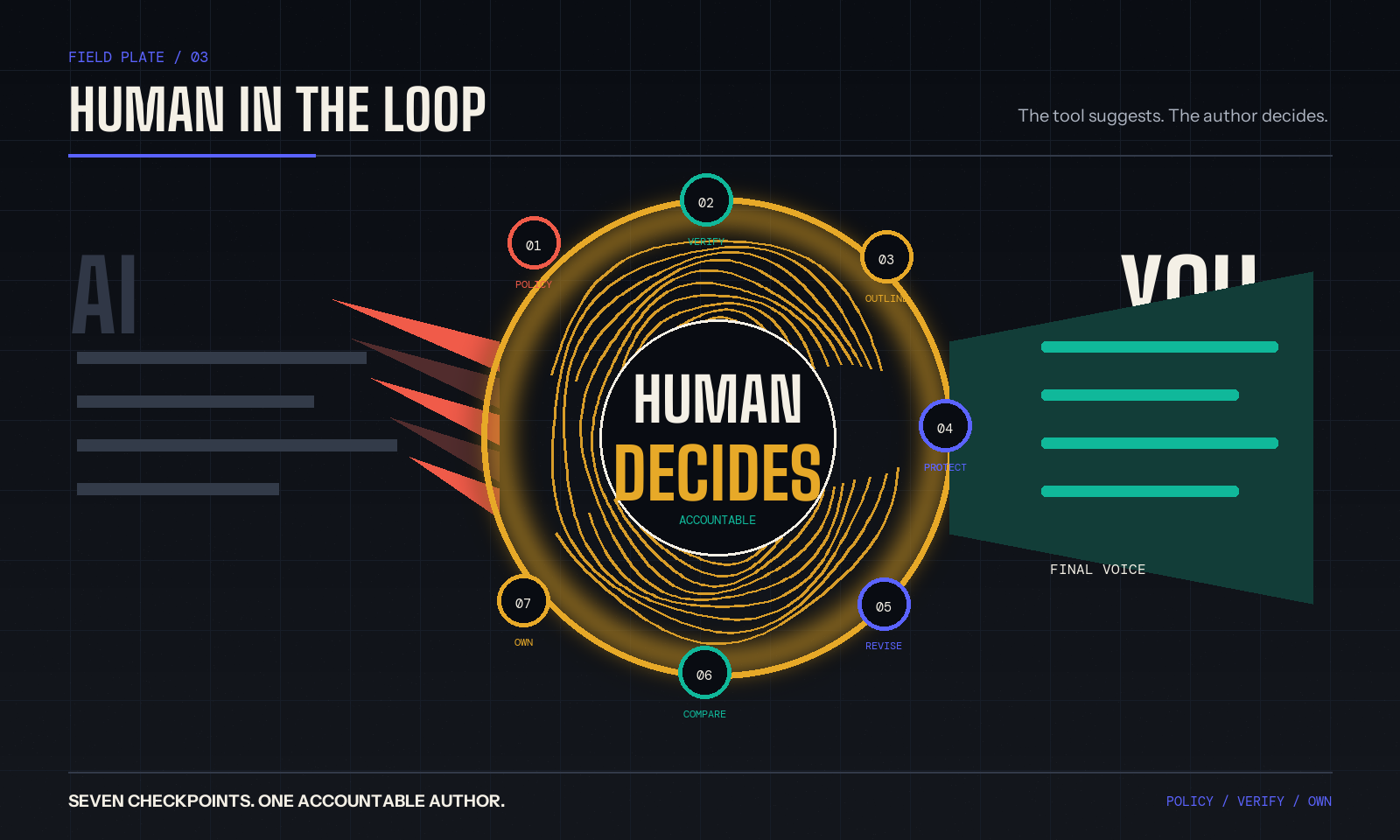
AI may suggest language, but the author controls the evidence, decisions, and final text.
Start with policy, not prose
Before editing, identify the rules that govern the work. Look for guidance from the course syllabus, university academic integrity policy, journal author instructions, research ethics board, or client agreement.
Policies commonly distinguish between different uses:
| Use of AI | Typical policy question |
|---|---|
| Brainstorming topics | Are generated ideas allowed during planning? |
| Improving grammar and clarity | Is language editing treated like a proofreading tool? |
| Rewriting complete paragraphs | Does this count as generative assistance? |
| Producing analysis or interpretation | Must the reasoning be entirely the author's? |
| Creating citations or evidence | Is the writer independently verifying every source? |
Do not assume that an available tool is an allowed tool. If the policy is unclear, ask the person responsible for assessing or publishing the work and keep their answer with your project records.
What responsible revision requires
An academically responsible draft should satisfy five conditions:
- The ideas are yours. You can explain how the argument was developed and why each piece of evidence is included.
- The sources are real and verified. You have opened and read the cited material rather than trusting a generated reference.
- The language is accurate. The wording does not exaggerate results, erase limitations, or change technical meaning.
- The process follows policy. Your use of AI falls within the rules that apply to the assignment or publication.
- Disclosure is complete when required. You describe the tool and its role at the level requested by the institution or publisher.
A humanizer can assist with the third condition by revising repetitive or unnatural expression. It cannot establish the other four for you.
Match the review depth to the risk
Not every sentence needs the same level of scrutiny. Review more deeply when an error could change the paper's evidence, interpretation, or compliance status.
| Content level | Examples | Minimum review |
|---|---|---|
| Lower risk | Transitions, repeated phrasing, sentence flow | Read in context and confirm the meaning is unchanged |
| Medium risk | Summaries, comparisons, disciplinary terms | Compare with the draft and check the relevant source |
| High risk | Citations, quotations, data, methods, claims | Verify against the primary source and preserve exact details |
Policy statements and disclosure language also deserve a high-risk review because their acceptability depends on the institution or publisher. When a passage contains several risk levels, apply the strictest review needed by any part of it.
A seven-step revision workflow
1. Save the original and record tool use
Keep the prompt, original output, your edited draft, and relevant policy. Version history makes it easier to distinguish your contribution from generated material and to explain the process if asked.
2. Remove unsupported content
Read the draft as a fact checker before reading it as an editor. Highlight claims that need evidence, citations you have not opened, exact numbers, quotations, named theories, and confident statements about consensus.
Delete or replace anything you cannot verify. Do not ask a humanizer to polish it first. Fluent misinformation is still misinformation.
3. Rebuild the argument in your own outline
Write the thesis, supporting claims, evidence, counterargument, and conclusion as short notes without looking at the generated prose. Compare that structure with the draft.
This step reveals whether the AI text represents your reasoning or merely sounds plausible. Move, remove, or rewrite sections until the structure matches the argument you intend to make.
4. Protect high-risk details
Mark content that must remain exact:
- In-text citations and source attributions
- Statistical values, units, sample sizes, and dates
- Direct quotations and page numbers
- Technical terms and defined constructs
- Method names and procedural steps
- Scope limitations and expressions of uncertainty
For research-heavy documents, use the citation-preservation workflow before revising style.
5. Revise focused passages
Paste one coherent section into PaperHumanizer. Choose a tone that matches the field and level of study, then generate one revision. Repeatedly humanizing the same text can create semantic drift and make it harder to trace what changed.
Treat the result as an editorial suggestion. You decide which sentences to keep, change, or reject.
6. Compare meaning, not just wording
Use a side-by-side review. For every paragraph, ask:
- Does the topic sentence make the same claim?
- Does each citation still support the sentence beside it?
- Are numbers, names, and technical terms unchanged?
- Has tentative evidence become a definite conclusion?
- Does the paragraph still connect to the next step in my argument?
The research integrity checklist covers these checks in more detail.
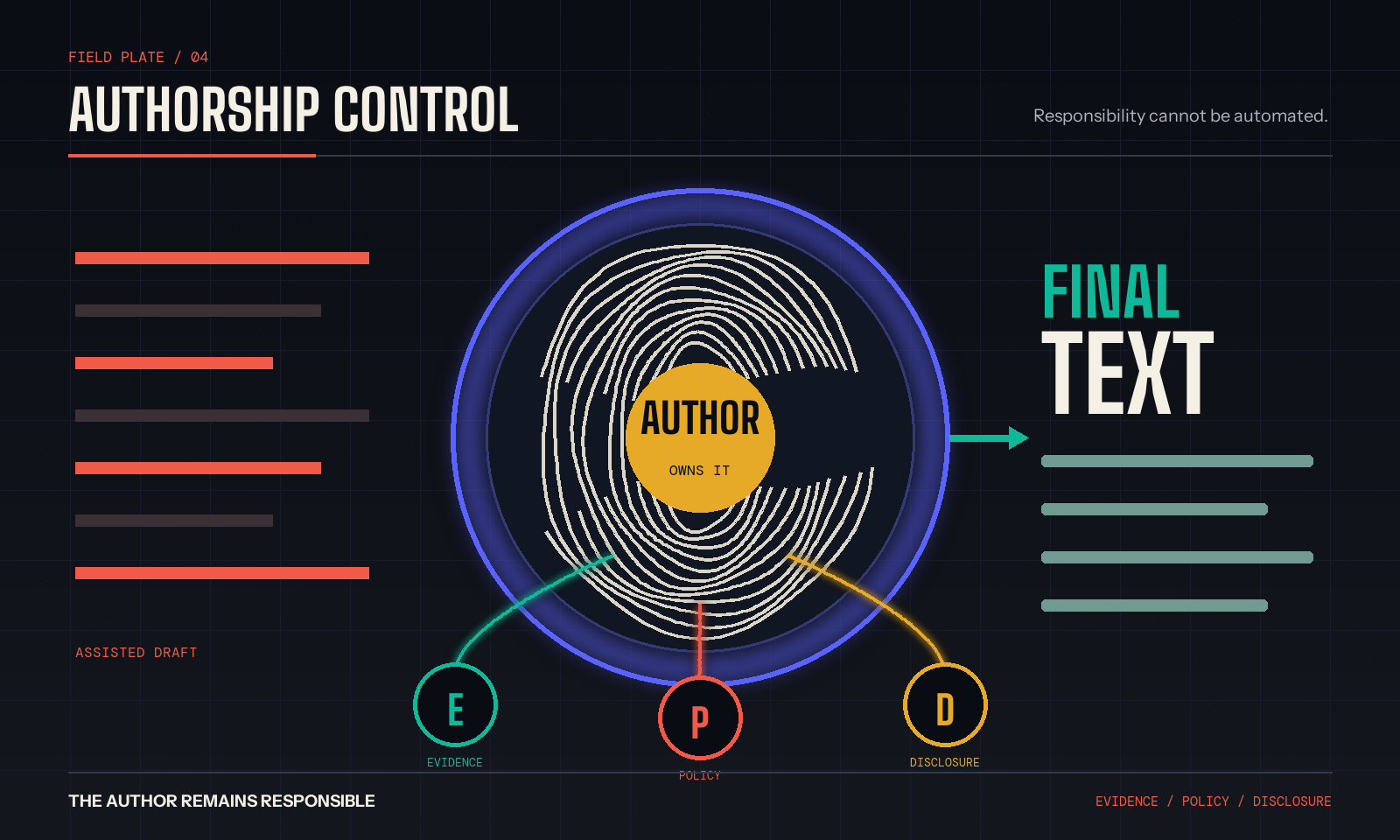
Evidence, policy, and disclosure are the control points between a generated suggestion and author-approved text.
7. Restore personal and disciplinary voice
Generic academic prose often uses smooth transitions without showing why one claim leads to the next. Add the reasoning that belongs to your project: define the local context, connect the evidence to your research question, acknowledge a limitation, or explain why one interpretation is more convincing.
This does not mean adding casual phrases or artificial errors. A human voice in academic work comes from specific judgment, not imperfection for its own sake.
Before and after: from generic language to accountable analysis
Generic AI-assisted draft
It is important to note that digital learning has transformed education in many ways. Furthermore, numerous studies have shown that technology can improve student engagement and learning outcomes. Therefore, institutions should continue to adopt digital tools.
Responsible revision
Digital tools do not improve learning simply because they are available. Their value depends on how they change the student's task, the feedback available, and the instructor's ability to identify misunderstanding. Before recommending wider adoption, a paper should name the learners, outcomes, and evidence relevant to its claim.
The revised version does not invent supporting studies or make a universal recommendation. It exposes what the writer still needs to specify and verify. That is more useful than merely replacing transition words.
Disclosure examples
Use the format required by the applicable policy. A brief statement might say:
The author used PaperHumanizer to suggest language-level revisions to selected paragraphs. All arguments, sources, interpretations, and final wording were reviewed and approved by the author.
This example is not a universal disclosure standard. Some venues require the tool version, dates, prompts, affected sections, or no AI use at all. Others treat language editing differently from content generation. Follow the exact instructions for your context.
Warning signs that require manual review
Stop and return to the source material if a revision:
- Adds a citation you did not provide
- Changes "associated with" to "caused"
- Replaces a precise technical term with a broad synonym
- Removes a limitation or counterargument
- Combines findings from studies with different populations
- Introduces a confident conclusion you cannot defend
- Makes every paragraph sound polished in exactly the same way
These are content problems, not style problems. Correct them manually with the evidence in front of you.
A final author checklist
Before submitting or publishing the revised work, confirm:
- I can explain and defend every claim in the document
- I opened and verified every cited source
- Direct quotations and page numbers are exact
- Data, methods, and technical terms match the source material
- The conclusion does not go beyond the evidence
- The writing follows the relevant AI-use policy
- I included the required disclosure
- The final voice and reasoning are recognizably mine
Related academic editing guides
- Humanize a Literature Review Without Losing Citations
- How to Humanize AI Papers
- Academic Writing Tones Explained
- Research Paper Humanizer
Frequently asked questions
Is it acceptable to humanize AI-assisted academic writing?
It depends on your institution, course, journal, and assignment. Use AI only within the applicable policy, retain intellectual ownership of the work, verify the output, and disclose assistance when required.
Can a humanizer make AI-generated research trustworthy?
No. A humanizer can revise expression, but it cannot validate evidence, repair invented citations, or supply original analysis. The author remains responsible for every claim and source.
What should I check after revising a passage?
Compare claims, citations, numbers, technical terms, quotations, and the level of certainty with the original. Then read the passage in context to confirm that it still advances your argument.
Should I disclose the use of PaperHumanizer?
Follow the most specific policy that applies to your work. Some institutions allow language editing without disclosure, while others require a statement for any generative or rewriting tool. When uncertain, ask the instructor, editor, or research supervisor.