
To humanize a Gemini essay or research draft, first verify its argument and sources, then revise the prose around those checked facts. Work one paragraph at a time, specify what must stay unchanged, and compare the rewrite with the original. A “sound human” request is not enough when a sentence contains a citation, a study limitation, or a technical claim.
A Gemini humanizer is an editing approach or tool for revising text drafted with Gemini; it is not a special file format or a Google-certified category. PaperHumanizer is an independent academic rewriting service, not a Gemini add-on or Google product.
You can use a controlled prompt in Gemini, or try PaperHumanizer on an existing passage. The important choice is how you will protect the evidence and review the changes—not whether you can make the text look different.
Keep the useful draft. Replace empty phrasing. Verify every important change.
Why a fluent Gemini draft can still need revision
A paragraph can be grammatical and still fail its academic job. It may introduce an issue broadly without making a position clear, repeat information in different words, or present an explanation more confidently than the evidence permits.
These are not exclusive Gemini fingerprints and do not establish authorship. Inspect the text in front of you rather than treating a phrase list as proof that a model wrote it.
Useful questions include:
- Does the opening state this paragraph's actual point?
- Does each sentence advance the reasoning?
- Does a transition name a real relationship between ideas?
- Can I verify every factual statement and citation?
- Does the wording match the certainty of the source?
- Would I be comfortable explaining this argument myself?
If the answer to the last question is no, do more reading or drafting before humanizing. Editing cannot replace your understanding of the assignment.
Verify Gemini's sources before polishing the language
Google's guidance on Gemini responses explains that generated answers can be inaccurate, including how they describe their own sourcing. Its related-sources documentation also says that not all responses contain source links. Treat links as material to inspect, not automatic proof of the paragraph's claims.
Before a rewrite, open the source and check the author, title, publication details, and finding. Ask whether the passage is supported by that source—not simply whether a plausible paper exists.
If the draft names a study you cannot verify, remove or correct the unsupported claim using legitimate evidence. Do not ask a humanizer to make the invented reference more convincing. Our research-paper citation guide provides a practical review checklist.
A Gemini humanizer prompt you can copy
Use this after you have checked the passage's facts. Replace the bracketed fields and provide a short section, not an entire long paper.
Edit the passage below for [course, discipline, or intended reader].
Its job is to [state the paragraph's purpose].

Improve clarity, sentence rhythm, and the connection between ideas.
Remove empty framing only where it adds no meaning.
Keep the claim, certainty, population, conditions, and limitations intact.
Preserve citation markers, verified facts, numbers, and technical terms.
Do not invent a source, statistic, personal experience, or new argument.
Do not rewrite direct quotations.
Return:
1. The revised passage.
2. A short list of substantive changes.
3. Any detail that requires my verification.

Passage:
[paste the checked draft]
A prompt can guide behavior; it cannot guarantee compliance. Read the actual output and check details that the change list may have missed. For more task-specific instructions, our academic humanizer prompt templates can be adapted to another assistant rather than copied without thought.
How to revise Gemini text in five controlled stages
1. Identify the paragraph's job
An essay introduction should set up a position. A literature review should connect source findings. A methods paragraph should describe what was done. A discussion should interpret a result without pretending that an explanation was tested.
Write a one-sentence job description before editing. For example: “Explain why the two studies cannot be compared directly because their populations differ.” That is more useful than “Make this academic.”
2. Mark what must not change
Create a short list of protected details. Include citation markers, quoted words, sample sizes, units, defined terms, and qualifications such as “in this sample,” “self-reported,” or “after adjustment.”
Those qualifications often look expendable in a shorter rewrite. They may actually define what the study established. Keep them unless you have a justified reason to revise the underlying argument.
3. Choose one editing path
Use the prompt in a clean Gemini conversation if you need flexible discussion about possible changes. Avoid mixing the rewrite with earlier brainstorming that contains invented findings or alternative arguments.
Use PaperHumanizer if you prefer purpose and academic tone controls with source-to-output comparison. Paste a checked paragraph, or extract text from a supported file. Select Essay / Assignment for coursework or Academic Paper for research. Use Standard Academic, Scholarly, or Technical / STEM according to the section.
The current input limit is 10,000 characters. For long drafts, use named sections and keep your own revision log. A Word document remains your formatting master; see the DOCX revision workflow.
4. Compare meaning before style
Review the protected list against the completed revision. Look for subtle shifts: “associated with” becoming “caused,” a specific population becoming “all students,” or a single-study finding becoming a general consensus.
Next, check the paragraph's job. A rewrite may preserve every citation while weakening the connection between the studies. Finally, judge readability and whether the voice fits your own work.
5. Make a final author edit
Keep useful changes and restore anything inaccurate. Add only details you can substantiate. Read the neighboring paragraphs so that transitions work in the full essay, not just in isolation.
Stop when the passage meets its purpose and passes the evidence checks. Repeatedly humanizing a revision can drift further from the original while becoming harder to audit.
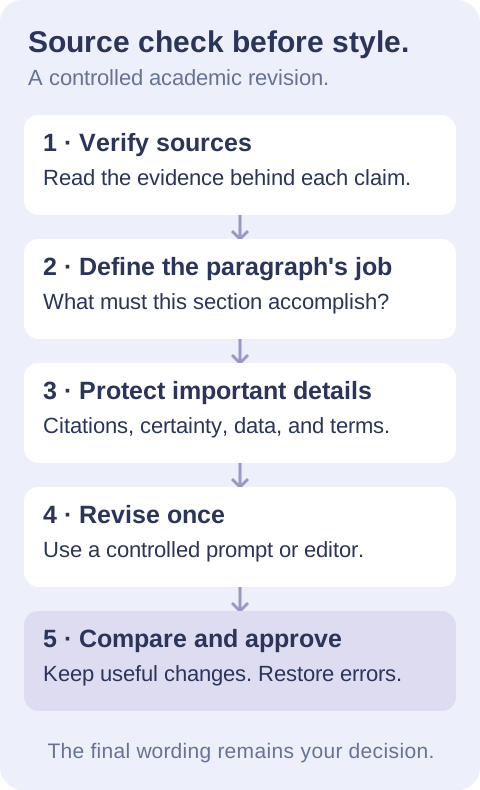
Source checking comes before style editing, whichever tool you use.
Example 1: an essay opening that says something specific
These examples are constructed illustrations, not captured Gemini or PaperHumanizer outputs. The academic study and citation in the second example are fictional.
Draft-style paragraph
In today's rapidly evolving educational landscape, group projects are an important topic. Group projects can provide opportunities for collaboration, but unclear responsibility can make assessment difficult. Therefore, it is essential to consider how individual contributions are evaluated.
Illustrative revision
Group projects can encourage collaboration, but unclear responsibility makes individual assessment difficult. The key question is how instructors can evaluate each student's contribution without losing the benefits of shared work.
The rewrite keeps the tension and turns the final sentence into a clear question. It does not add a new statistic, invent an experience, or claim that group projects are always unfair.
For a real essay, build the next paragraph around your evidence and position. See why an essay can sound AI-generated for more diagnosis of vague framing.
Example 2: a research paragraph where caution must survive
Draft-style paragraph
Furthermore, Chen (2024) reported that students who attended optional feedback sessions submitted more revisions in the course studied. This finding suggests that feedback sessions may support revision activity. However, students chose whether to attend, so the comparison does not establish a causal effect.
Illustrative revision
In the course Chen (2024) studied, students who attended optional feedback sessions submitted more revisions. The finding suggests that the sessions may support revision activity, but self-selected attendance prevents a causal conclusion from this comparison.
The wording changes, but the course boundary, optional attendance, outcome, citation, and causal limitation remain. “More revisions” has not become “better writing,” which would introduce a different outcome.
Reject: “Chen proved that feedback sessions improve writing quality.” It invents a stronger result and removes the limitation. Our academic example library shows similar checks for methods, results, discussion, and conclusions.
Gemini prompt or a dedicated humanizer: which should you use?
| Your task | A useful starting point |
|---|---|
| Explore your argument or ask why a sentence is unclear | A conversation with Gemini, followed by source review |
| Revise an existing academic paragraph repeatedly | PaperHumanizer's focused purpose, tone, and comparison workflow |
| Fix a quotation, missing evidence, or incorrect statistic | The original source and your own correction—not a style rewrite |
| Restore citation fields and document layout | Your Word or other authoring file |
This is a workflow recommendation, not a claim that one model always writes better. The broader PaperHumanizer versus ChatGPT and Gemini comparison explains the distinction between a general assistant and a specialized editor.
Frequently asked questions
Can Gemini humanize its own text?
It can be prompted to revise a passage. Use clear preservation instructions and inspect the output. The same conversation system that produces a fluent draft can still make a factual or interpretive mistake in a rewrite.
Will humanizing a Gemini essay guarantee that it passes an AI detector?
No particular detector result is established by this workflow. PaperHumanizer's on-screen detector-style scores are simulated presentation values, not external scans. Assess evidence, voice, and policy compliance rather than treating a number as proof of authorship.
Should I ask Gemini to add personal details to make the text natural?
Only provide genuine details you are permitted to share. Do not ask it to invent your experience or research activity. Specificity is valuable when it is true, not when it is manufactured to make a paragraph feel human.
Can I humanize a whole Gemini-generated essay at once?
Use coherent sections instead. Review the argument and sources first, then inspect each revision. Whole-essay rewriting makes unsupported claims and changed qualifications harder to isolate.
What if my course prohibits AI-assisted rewriting?
Follow that policy. Use source reading, your own drafting, and authorized feedback. A more natural style does not make prohibited assistance acceptable.
Try the method on a checked paragraph
Choose a passage whose sources you understand. Open PaperHumanizer, select a suitable academic tone, and compare the completed rewrite with your original. If the workflow fits your recurring writing needs, review the available plans after evaluating an actual output.
Keep the reasoning yours, keep the evidence intact, and use humanization to improve expression—not to conceal an argument you cannot defend.