
A literature review is not a list of source summaries. It is a structured account of what researchers agree on, where they disagree, how the evidence has developed, and which gap your study addresses. That makes it one of the most difficult academic sections to revise safely.
If an AI-assisted draft sounds repetitive or overly polished, changing a few synonyms will not solve the underlying problem. The revision needs to improve the prose without disturbing the citation network that supports it. This guide shows how to do that deliberately with PaperHumanizer.
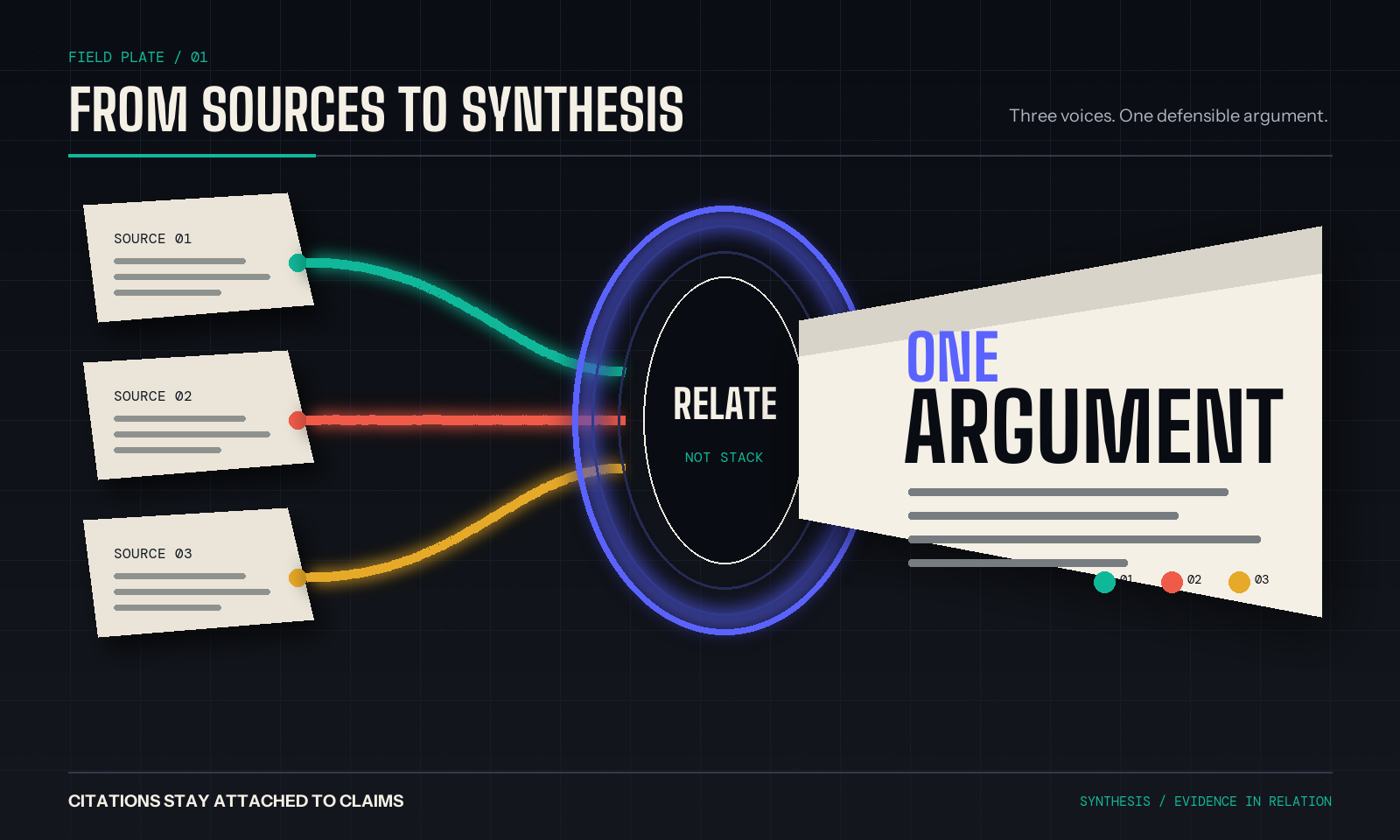
Strong synthesis explains how sources relate instead of presenting one summary after another.
What must remain unchanged
Before revising any literature review passage, mark the information that carries scholarly meaning. These elements are not stylistic decoration:
- Source attribution: The right author must remain attached to the right claim.
- Stance: "Demonstrates," "suggests," and "questions" express different levels of certainty.
- Relationships between studies: Agreement, extension, contrast, and methodological difference must stay explicit.
- Dates and study contexts: A finding from a 2012 laboratory study cannot silently become a general current consensus.
- Research gap: The limitation your project addresses must not become broader or more dramatic during rewriting.
- Citation form: Parenthetical and narrative citations need to remain readable and correctly positioned.
This is why a generic paraphraser is risky for literature reviews. A fluent sentence can still be academically wrong if it moves a citation, strengthens a cautious claim, or collapses two distinct findings into one.
Humanize synthesis, not source notes
The best time to humanize a literature review is after the evidence has been organized. Start with a source matrix or a clear outline that records each study's question, method, result, limitation, and relevance to your topic.
Then draft by theme, method, debate, or chronology. Do not send raw source notes into a humanizer and expect it to create a trustworthy synthesis. The tool should revise prose you have already checked, not decide what the literature means.
| Draft element | Revise with a humanizer? | Review requirement |
|---|---|---|
| Thematic synthesis paragraphs | Yes | Check every source relationship |
| Topic and transition sentences | Yes | Confirm they still match the section argument |
| Direct quotations | No | Keep the exact wording and page number |
| Reference list | No | Format it in your citation manager |
| Tables of included studies | No | Preserve structured data separately |
| Your research gap statement | With care | Compare scope and certainty word by word |
Choose the right revision unit
The safest unit is usually a thematic passage: two to five paragraphs that make one connected point. It gives the editor enough context to preserve the argument while keeping the comparison manageable.
| Revision unit | Best used for | Main risk |
|---|---|---|
| One sentence | Repairing a clearly isolated wording problem | The sentence may no longer fit the paragraph |
| One thematic passage | Improving flow across a single claim or debate | Requires a careful citation-by-citation comparison |
| A complete chapter | Rarely appropriate for automated language revision | Source relationships and small changes are obscured |
Split a long review at an intellectual boundary, not at an arbitrary word count. A new theory, population, method, time period, or side of a debate usually marks a sensible boundary. Keep the topic sentence with the evidence it frames and do not separate a limitation from the finding it qualifies.
A six-step literature review workflow
1. Define the job of the section
Write one sentence explaining what the passage needs to establish. For example: "This section compares how three recent studies define student engagement." This gives you a standard for judging whether the revised passage still performs the same function.
2. Separate synthesis from protected material
Keep the analytical paragraphs you want to revise. Set aside the reference list, block quotations, tables, headings required by your department, and any exact wording that must not change.
Leave ordinary in-text citations inside the prose. Their position helps preserve the connection between a sentence and its source. For unusual citation formats, process a short sample first and inspect the result.
3. Process one coherent theme
Paste a section that discusses one idea or debate into PaperHumanizer. A focused passage gives the editor enough context to vary the writing while keeping the logic visible. Processing isolated sentences can break paragraph flow; processing an entire chapter makes verification slow and unreliable.
Use a scholarly tone for conceptual or humanities writing. For method-heavy reviews in medicine, engineering, or the natural sciences, a technical tone may preserve discipline-specific language more effectively.
4. Compare claims side by side
Do not judge the output only by whether it sounds natural. Compare it with the original and ask:
- Does every cited study still make the same claim?
- Are disagreements and limitations still visible?
- Has any cautious language become too certain?
- Is the research gap still the same size and scope?
- Are all author names, years, and grouped citations intact?
If one sentence fails the check, restore the original or edit it manually. A clean paragraph is never worth a distorted source.
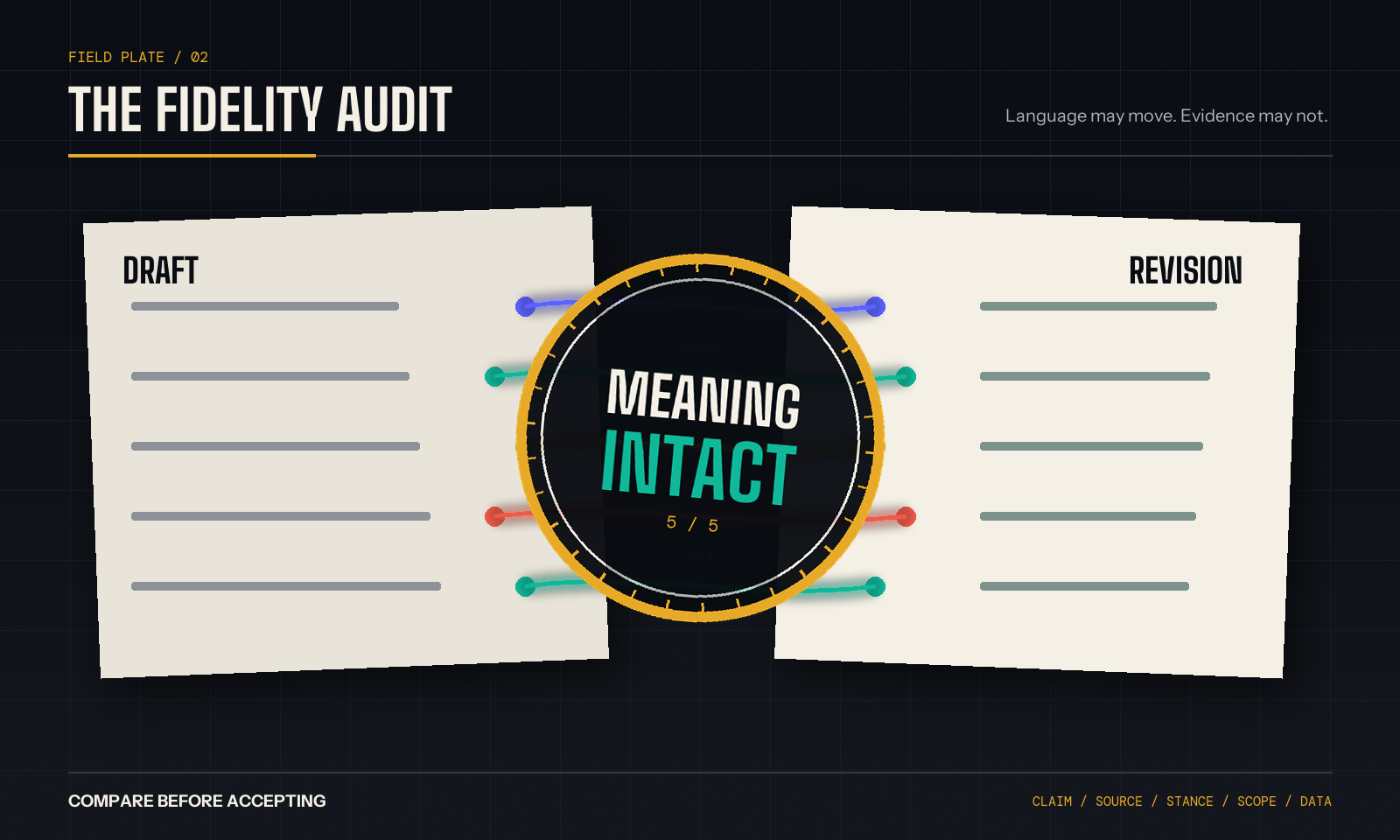
Accept a revision only when its claim, attribution, stance, scope, and data still match the source-backed draft.
5. Restore your disciplinary voice
Humanization should not erase the conventions of your field. Add back terminology your research community uses, transitions that reflect your own analytical structure, and course- or project-specific framing. This is also where you remove generic statements that could apply to any topic.
For a deeper explanation of tone choices, read Academic Writing Tones Explained.
6. Run a final citation audit
Use your original draft and reference manager as the source of truth. Check that:
- Every in-text citation has a matching reference entry
- No citation has moved to a sentence it does not support
- Multi-source citations still group the intended studies
- Page numbers and quotation marks remain correct
- Claims about methods, samples, and findings remain accurate
The research preservation guide provides a longer audit checklist for citations, numbers, terminology, and argument structure.
Before and after: improve rhythm without changing the synthesis
Overly uniform draft
Several studies have examined feedback in online learning environments. Furthermore, Lee (2022) found that immediate feedback improved task completion. Moreover, Patel and Wong (2023) found that explanatory feedback supported retention. Therefore, feedback is important for online learning.
More natural academic revision
Research on online learning points to more than one benefit of feedback. Immediate responses can improve task completion (Lee, 2022), while feedback that explains why an answer is correct appears more useful for longer-term retention (Patel & Wong, 2023). Taken together, these findings suggest that timing and explanatory depth serve different learning goals.
The revision varies sentence structure, but the important improvement is analytical: it names the different outcomes and explains how the findings relate. The citations remain attached to the claims they support.
Common mistakes to avoid
Rewriting before verifying the sources
Polishing an inaccurate summary makes the error harder to notice. Confirm each claim against the cited source before focusing on style.
Treating every citation as interchangeable
Two studies on the same topic may use different populations, measures, or definitions. Do not merge them into a single general claim unless the evidence supports that synthesis.
Removing all hedging
Terms such as "may," "appears," and "in this sample" often reflect the limits of a study. They are part of the finding, not weak writing.
Processing the bibliography
A reference list is structured metadata. Keep it outside the humanization workflow and manage it with Zotero, Mendeley, EndNote, or your required style guide.
Using detector scores as the only quality test
A literature review succeeds when it represents the evidence accurately and supports your research question. Readability matters, but source fidelity and intellectual ownership matter more.
Related academic writing guides
- Research Paper Humanizer
- AI Humanizer for Research Papers with Citations
- Humanize an Abstract Without Changing the Findings
- Revise AI-Assisted Academic Writing Responsibly
Frequently asked questions
Can PaperHumanizer preserve citations in a literature review?
PaperHumanizer is designed to retain common in-text citation patterns while revising the surrounding prose. You should still compare every citation and source attribution with the original before using the result.
Should I humanize the whole literature review at once?
Work in coherent sections organized around one theme or debate. Smaller sections make it easier to verify citations, compare claims, and preserve the relationship between sources.
Will humanizing a literature review fix weak research synthesis?
No. A humanizer can improve expression and sentence rhythm, but it cannot replace source evaluation, accurate synthesis, or your own scholarly judgment. Fix the evidence structure before revising the prose.
What should I exclude before processing?
Keep your reference list, direct quotations, tables, and long block quotes outside the editor. Revise the analytical prose around them, then restore and verify those elements in your working document.