
Solvely and PaperHumanizer both address academic rewriting. Choose between them by the workflow you need and the changes you can verify in your own paragraph. A broader study toolkit can be convenient; a focused revision workspace can make repeated paper editing easier to review. Neither a product name nor a detector-style percentage tells you whether a rewritten claim is still accurate.
This comparison is written by the PaperHumanizer team. Solvely's public humanizer page was checked on October 30, 2026. We have not conducted a controlled head-to-head detector benchmark. The example below is constructed to explain an evaluation method, not presented as output measured from either service.
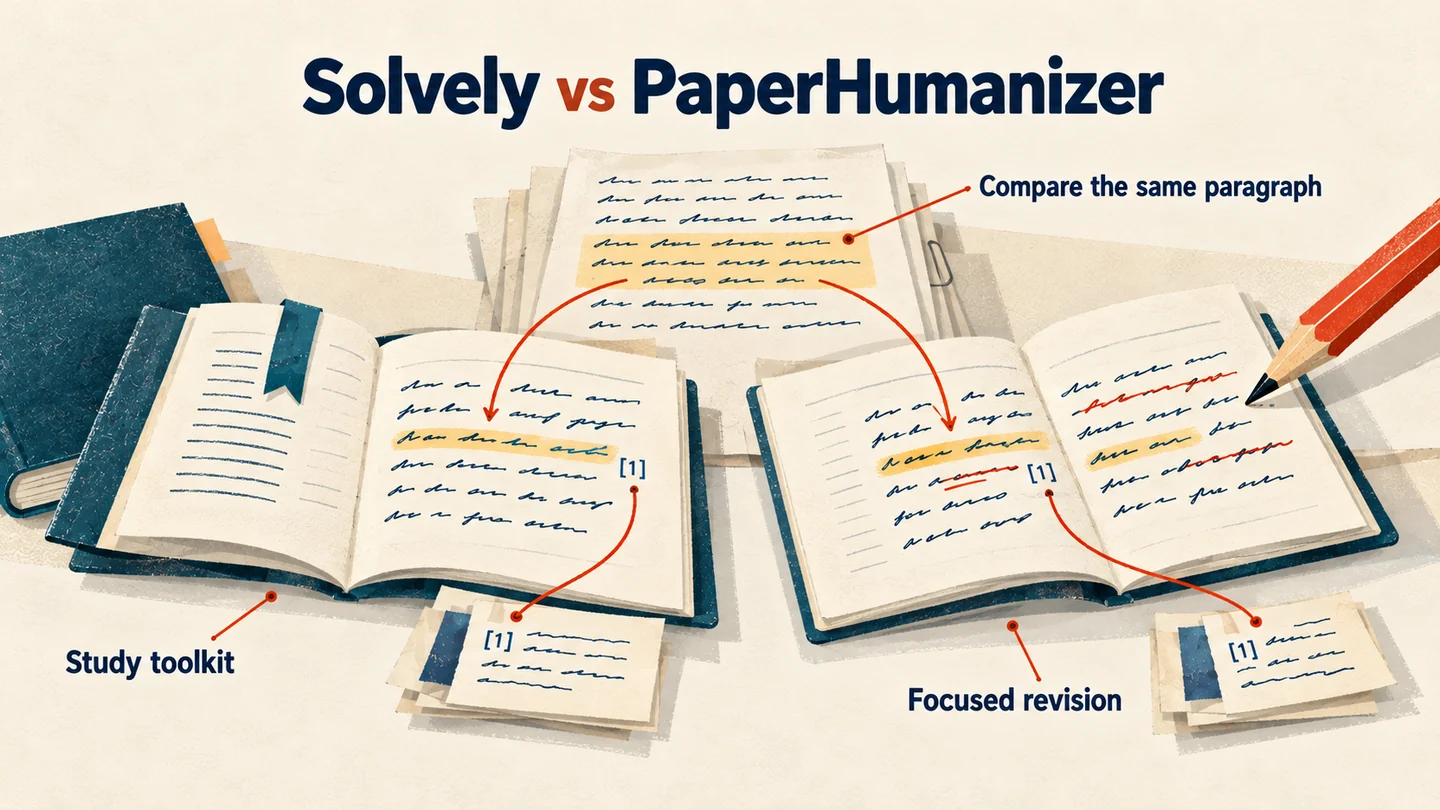
A schematic of the workflows to evaluate, not screenshots or a ranking of measured performance.
If you already have a draft and want to evaluate the paper-focused workflow, open PaperHumanizer. Start with one paragraph containing a citation, a specific claim, and a qualification you need to preserve.
Solvely vs PaperHumanizer: a practical comparison
The Solvely AI Humanizer page presents a humanizer within a wider writing toolkit, including research and citation tools. It also advertises academic editing. That overlap matters: this is a choice between workflows, rather than a claim that only one product can handle scholarly text.
| Decision point | Solvely's public page | PaperHumanizer |
|---|---|---|
| Working environment | Humanizer alongside other study and writing tools | A focused academic rewriting workspace |
| Starting a draft | Paste, upload, or sample input | Paste, supported document upload, or sample input |
| Academic positioning | Advertises an academic mode | Purpose choices and academic tone presets |
| Reviewing meaning | Check the returned text yourself | Review Input, Output, and Compare views |
| Access and cost | Verify current limits and checkout terms | Sign-in and available credits required; see current plans |
| Detector outcomes | Provider claims need separate verification | On-screen detector-style values are simulated, not external scans |
This table compares visible positioning and our existing product workflow. An advertised capability is not independent proof of accuracy. In particular, citation preservation requires more than keeping the same bracket or author name in a sentence.
When each workflow may suit you
Choose a broader toolkit when your task starts before the draft
Solvely may suit a writer who wants research, citation, and rewriting tools in one place. Check which features and allowances are actually included in the plan you are considering. A convenient menu does not remove the need to open and verify an original source.
For example, finding a relevant article, recording its bibliographic details, and revising your explanation are different tasks. Evaluate each tool against the task it performs. A good literature search does not establish that a generated summary accurately represents the paper; a fluent rewrite does not establish that the citation was formatted correctly.
Choose PaperHumanizer when you already have material to revise
PaperHumanizer is useful when the evidence and argument are in place but the expression is repetitive, overly generic, or inconsistent with your academic tone. Choose a purpose and tone, revise a coherent section, and compare the completed output against the original.
The tone choices include Standard Academic, Scholarly, and Technical/STEM. Standard and Deep controls are available to everyone. For a methods paragraph, precision may matter more than stylistic variety; for an introduction, the priority may be making the research question visible sooner. Use the settings to support that task, then inspect what changed.
If this describes your situation, try one section in the editor before deciding whether you need a paid plan. The academic example library shows the kinds of changes worth checking.
A fair test: use the same paragraph and the same criteria
A paragraph with nothing but generic statements is a weak evaluation input. Almost any rewrite can make it look different. A useful test contains details that a careless revision could damage:
- A study population, sample size, date, or unit.
- A citation linked to a particular claim.
- A defined term whose wording should stay stable.
- A limitation, comparison, or uncertainty statement.
- A recognizable writing problem, such as an empty opener or unnecessary repetition.
Use a non-sensitive excerpt you are authorized to process. Save the input and both outputs before editing either result. Record the settings and date so a later comparison does not mix different tests.
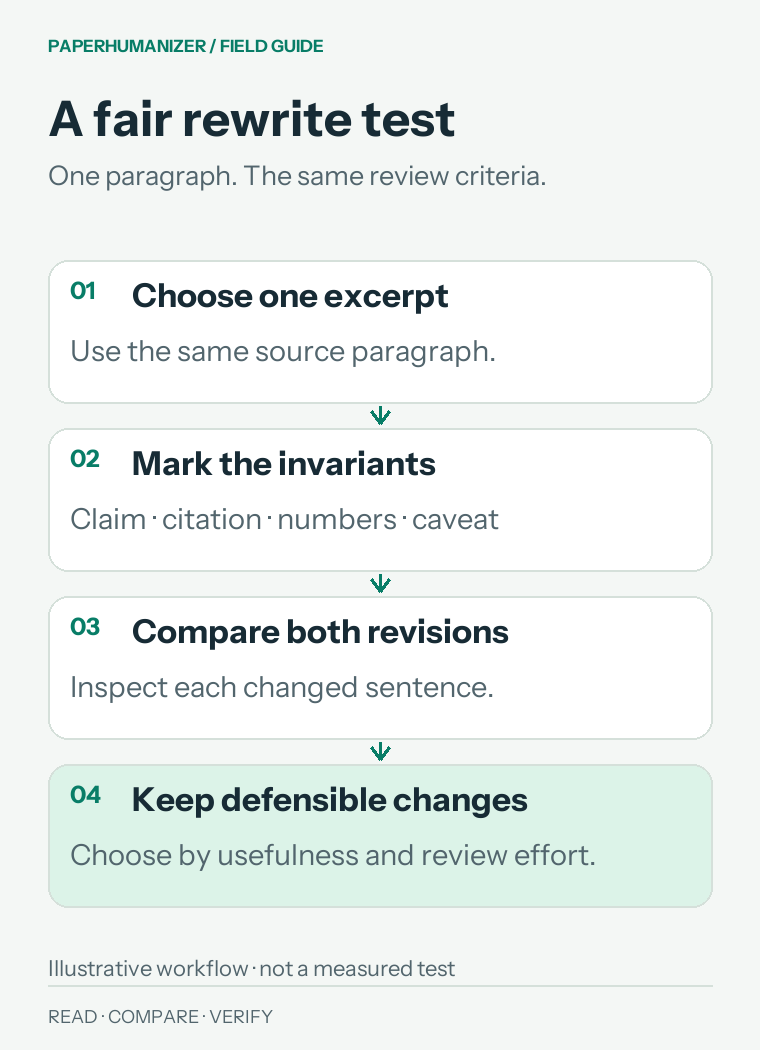
Judge the changed sentences using a shared checklist. This is a review method, not a claim about either product's test score.
A worked example with an important limitation
The following passage and citation are fictional teaching material. They have not been run through either product for this article.
Draft
It is important to note that, among the 42 postgraduate students in the survey, access to peer feedback was associated with more frequent revision of discussion sections (Chen, 2024). However, because the study was observational, it cannot demonstrate that feedback caused the change.
An illustrative revision to aim for
Among the 42 postgraduate students surveyed, access to peer feedback was associated with more frequent revision of discussion sections (Chen, 2024). The observational design does not establish that feedback caused the change.
The second version removes an empty opening and shortens the limitation without changing the sample, outcome, citation, or relationship. It is a concrete standard against which you can inspect a real output.
A fluent revision to reject
Peer feedback improved the writing quality of postgraduate students (Chen, 2024).
That sentence sounds direct, but it changes revision frequency into writing quality and association into causation. It also drops the sample boundary. The citation marker survives while the claim it accompanies changes. This is why a citation-preservation check must include the surrounding meaning.
Use a review sheet instead of an invented quality score
Copy this table into your notes. Fill in observations after trying the same excerpt in each editor; do not assign numbers before you have actual outputs.
| Check | What to record | Reason to reject a revision |
|---|---|---|
| Main claim | What the sentence now asserts | A different relationship, outcome, or conclusion |
| Citation attachment | Which claim each marker supports | A retained marker attached to a newly invented claim |
| Scope | Population, period, sample, units | Lost boundaries or changed quantities |
| Terminology | Required technical terms | A near-synonym with a different disciplinary meaning |
| Expression | A specific improvement you can identify | Extra complexity without clearer reasoning |
| Review effort | Corrections you had to make | Repeated repairs that cancel the convenience |
You can count required corrections or record approximate review time for your own task. Those are observations about your test, not universal product benchmarks. If you repeat the test, use more than one document section and retain the unsuccessful examples too.
For a fuller checklist, read how to revise a research paper while preserving citations.
File upload is only the start of the document workflow
PaperHumanizer accepts PDF, DOCX, DOC, and TXT input. Inspect the extracted text before generating a revision: columns, footnotes, mathematical notation, and reference lists can require attention when converted into plain text.
Keep the original document as the authoritative version. Review the prose in the humanizer, return accepted wording to your document editor, then check citation fields, tables, headings, and equations there. Do not assume that a text-based revision round-trips every document feature.
The Word document guide and PDF revision guide explain these checks in more detail.
Compare value against your actual editing workload
Check the current Solvely page and PaperHumanizer plans rather than relying on an old price quoted in a comparison. Confirm access duration, usage allowances, eligible features, currency, and the total amount at checkout.
For your own decision, estimate how often you revise, how long the sections are, and how much review each output needs. A research student editing a chapter every week has a different workload from someone polishing one short assignment. A lower advertised monthly equivalent is not automatically the smaller upfront payment.
A useful paid-plan decision follows an accepted sample: the rewrite improves your expression, preserves the evidence, and fits your permitted workflow. It should not depend on an unverified promise that a purchase will produce a particular detector result.
Frequently asked questions
Is Solvely AI Humanizer an alternative to PaperHumanizer?
Yes, the tools overlap in academic rewriting. Compare the surrounding workflow, the actual revision you receive, and the current access terms. This article does not establish a universal performance winner.
Which is better for a research paper with citations?
Use an excerpt with a real citation and a limitation. Check both marker retention and whether the revised claim remains supported by that source. PaperHumanizer offers a focused comparison workflow, but you still make the final source check.
Can I compare the products using their displayed AI scores?
Not as a controlled benchmark. Different reports can measure different things, and PaperHumanizer's detector-style values are simulated. Read the AI percentage explanation before treating any number as evidence.
Does rewriting make prohibited AI use acceptable?
No. Check the rules for the assignment or publication. A clearer rewrite does not change who developed the analysis or whether the assistance was permitted. Keep genuine drafts and disclose assistance where required.
Try the workflow on a paragraph you can verify
If you want a focused academic revision workspace, open PaperHumanizer, choose an appropriate purpose and tone, and review the result against the checklist above. Once an excerpt meets your criteria, compare plans for your workload. Choose based on the editing work you can evaluate, not a headline percentage.