
An “80% AI” result has no universal meaning. In Turnitin's AI Writing Report, the percentage refers to the share of qualifying prose its system identifies as likely AI-generated or AI-altered. In GPTZero, a percentage can express the model's estimated probability of a classification. Neither number, by itself, establishes who wrote the document. Before you edit anything, identify the detector, read its label, and inspect the highlighted passages.
If you have a flagged draft in front of you, use this guide to understand the report first. Then review the passage and revise its writing if it needs work.
The number becomes useful only after you know what the tool counted and where it found the signal.
What does an AI detection percentage measure?
It depends on the product. A document-share measure and a classification probability answer different questions:
| Report field | What the number describes | What it cannot prove |
|---|---|---|
| Turnitin AI writing percentage | The portion of qualifying prose identified as likely AI-generated or AI-altered | The writer's intent, authorship history, or the percentage of all document content written by AI |
| GPTZero class probability | The model's confidence in a document-level class such as human, mixed, or AI | The literal fraction of words written by a person or machine |
| Similarity percentage | Text matching sources in a comparison database | Whether AI produced the text or plagiarism occurred |
The Turnitin AI Writing Report guide explains its percentage and cautions that its prediction should not be the sole basis for adverse action. GPTZero's score explanation distinguishes its probability estimate from a word-by-word authorship percentage. The products may use different versions and display rules over time, so read the legend on the report you actually received.
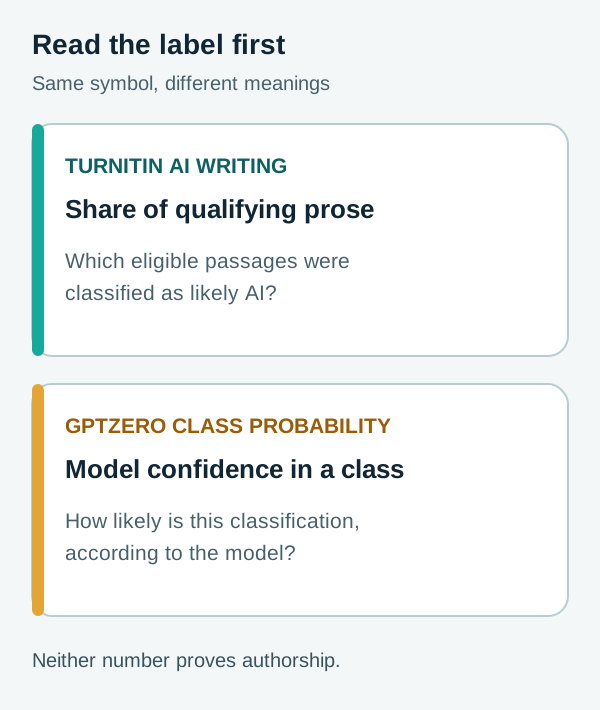
Same-looking percentages can have different denominators and meanings.
An 80% AI result is not an 80% plagiarism result
Turnitin's AI writing indicator and its similarity report are separate analyses. A passage can match a published source while being human-written; AI-generated prose can also have little textual overlap with any indexed source. If a student sees 80% on one report and 12% on the other, the numbers are not contradictory: they ask different questions. See our AI detector versus plagiarism checker guide for a fuller comparison.
Nor does “80% AI” automatically mean 80% of the entire submitted file was generated by a model. Eligible prose rules matter. Turnitin says its AI Writing Report focuses on qualifying long-form prose; formats such as lists and tables may not be evaluated in the same way. Check the report's own explanation before translating its percentage into a whole-document claim.
A denominator example you can check
Imagine a hypothetical 1,000-word submission. Suppose 800 words qualify for an AI-writing analysis and 400 of those words are flagged. The displayed share would be 400 ÷ 800 = 50% of qualifying prose. The flagged words would be 40% of the complete 1,000-word file. Neither calculation proves that a person or a model authored exactly that share. This is an arithmetic illustration, not a reconstruction of any detector's private method.
That distinction matters for essays with references, tables, quotations, equations, or appendices. The report may not use every visible word as its denominator.
Why can two detectors disagree on the same essay?
They use different training data, classification methods, thresholds, and document rules. A short, conventional paragraph may be difficult to classify; a long document can contain a mix of polished AI-assisted writing and distinctive original passages. Formatting and extractable text can also change what a tool evaluates.
Disagreement does not tell you which score is “right.” Start with the text itself. Which sentences are highlighted? Are they generic because the claim is vague? Is a technical description formulaic because the method requires exact terminology? Do you have drafts, notes, source annotations, or revision history that explain how the passage developed? Those records are more useful than treating a second number as an appeal.
The color legend also matters. Turnitin updated its AI Writing Report in August 2026 to combine the earlier separate blue and purple AI categories into one blue highlight. A screenshot from an older guide may therefore describe colors differently from a current report.
What to do with a high AI detection score
- Read the exact label. Record the tool name, report date, score type, and document version.
- Check the denominator and highlights. Find out whether the number covers qualifying prose, a model class, selected passages, or something else.
- Compare with your process. Open your outline, notes, drafts, source documents, and revision history. Identify passages that you can explain and support.
- Review the actual prose. Replace generic claims with the point you intended to make. Add evidence only if you have a real source. Retain necessary technical terms.
- Verify any rewrite. Compare citations, quotations, numbers, caveats, and claim strength line by line. Follow your institution's or publisher's AI-use policy.
Consider this illustrative passage:
Furthermore, the findings demonstrate that feedback plays a crucial role in student improvement.
It is grammatical, but “the findings,” “feedback,” and “improvement” are too vague to verify. A stronger revision uses the writer's real evidence:
In the peer-review exercise, students revised their thesis statements after receiving comments on the clarity of their central claim.
This second sentence is useful only if that event actually happened and the writer can substantiate it. The point is to restore a specific claim, not to manufacture detail to chase a score. For more help with a flagged essay, read why your essay may be flagged as AI.
Where a humanizer helps
If a draft contains your actual ideas but the expression is repetitive or uniformly generic, PaperHumanizer can help revise its phrasing and sentence structure. Work on a manageable section, choose the appropriate academic tone, and compare the output with your original. It cannot erase a prior report, certify authorship, or guarantee what an independent detector will say about the next version.
The best test is whether the revision communicates your argument accurately. Check every citation marker, numerical value, quotation, and qualification before submission. If your document is long, view the available plans before processing multiple sections.
Try a focused rewrite of one flagged paragraph →
Frequently asked questions
What does 0% AI detected mean?
It means the tool did not identify qualifying text above its displayed threshold in that analysis. It does not certify that no AI assistance was used. Check the report's eligibility rules and your local disclosure policy.
What does 100% AI detected mean?
Interpret it using that detector's definition. A Turnitin percentage and a GPTZero probability are different measures. Even a very high score should be reviewed alongside the text and writing history rather than treated as an authorship verdict.
Is there a “safe” AI detection percentage?
There is no universal number. Institutions and publishers set their own policies, and detectors can misclassify text. Prioritize truthful disclosure, traceable sources, and a draft you can explain.
Will a humanizer always lower the percentage?
No tool can guarantee an independent detector's result. A good revision should improve specificity, readability, and fidelity to your meaning; check the new draft yourself and consult the relevant policy.