
Scribbr AI Humanizer is an option for trying a short rewrite inside Scribbr's writing-tool collection. PaperHumanizer is a more focused option when your main task is revising an existing academic passage with purpose, tone, and side-by-side review controls. The right choice depends on the work you need to finish: changing a few stiff sentences, revising a research section, checking references, or proofreading a formatted document.
This comparison is written by the PaperHumanizer team. We reviewed the linked Scribbr pages on November 3, 2026 and checked PaperHumanizer's current editor. We did not run a controlled head-to-head detector benchmark. The examples below are constructed teaching examples, not either product's measured output.
Already have a paragraph that needs a more natural academic voice? Try it in PaperHumanizer, then compare the result with your original before choosing a plan.
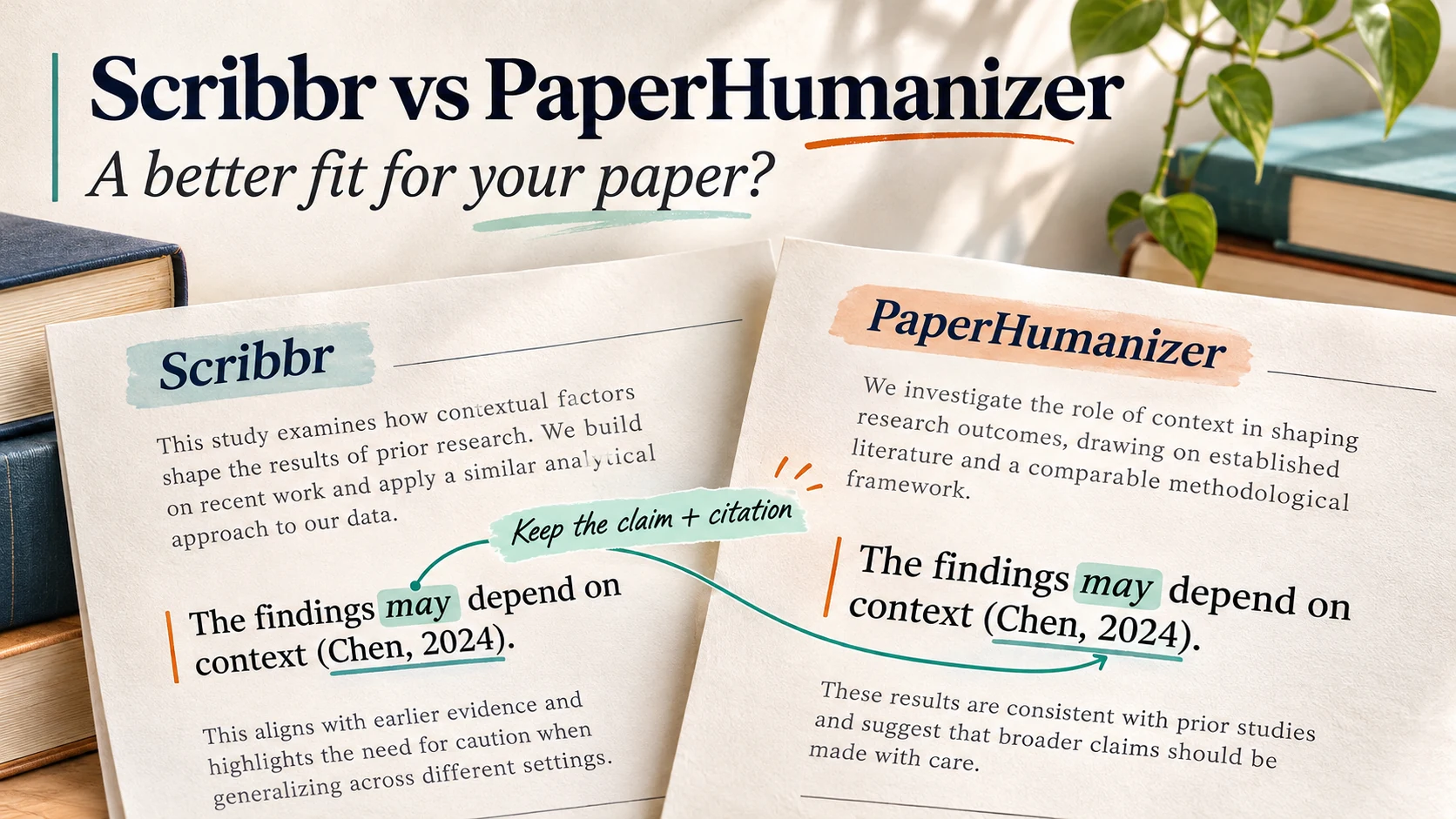
Compare how a rewrite handles the claim and its source, not just whether the vocabulary sounds different. Editorial illustration, not product output.
The short answer: which workflow fits your draft?
Start by naming the editing job. A humanizer can revise expression, but an incomplete argument still needs research, and an incorrect reference still needs correction.
| Your immediate task | A useful starting point | What to verify |
|---|---|---|
| Try a short passage with awkward or repetitive phrasing | Scribbr's public humanizer or PaperHumanizer | Meaning, clarity, and unnecessary changes |
| Revise a coherent section in a selected academic register | PaperHumanizer's purpose and tone settings | Whether the tone fits that section |
| Work through repeated research paragraphs | A repeatable original–rewrite–compare routine | Citations, qualifications, numbers, terminology |
| Correct grammar and citation formatting in a document | A dedicated proofreading or citation-checking service | The actual service selected and its scope |
| Answer a detector flag on work you wrote | Review the report and preserve writing-process evidence | What the indicator means and the institution's process |
Neither the name “humanizer” nor the number of tools on a website tells you how a particular paragraph will read. Choose an editing task, apply the same review criteria, and keep the revision that solves it.
What Scribbr's AI Humanizer currently offers
Scribbr's public humanizer page provides a paste-and-rewrite interface; the public version we reviewed displayed a 125-word input counter. That is a dated observation about that page, not a claim about every Scribbr account, plan, or connected product. Recheck the live interface if your passage is longer.
Scribbr's humanizer explanation describes improving natural phrasing while retaining the message. It distinguishes writing quality from evading detection. That is a sensible reason to test a tool: the output should be easier to read and still say what you intended.
Keep the product names separate. Scribbr also offers an AI Proofreader with document corrections and citation-related features. Those features should not automatically be attributed to the public humanizer. If you want a corrected Word document rather than rewritten prose, compare the relevant proofreading service instead.
Where PaperHumanizer fits academic rewriting
PaperHumanizer is built around a draft you already have. You paste text or extract it from a supported file, choose the document purpose and tone, and review the completed rewrite. That makes it useful when you want the language of a paper, essay, or report to read more naturally without rebuilding the surrounding argument.
The editor offers Academic Paper, Essay, Professional, and Blog purposes, plus Standard Academic, Scholarly, and Technical/STEM tone choices. You can review Output and Compare views before copying or downloading the result. PDF, DOCX, and TXT input support helps bring existing material into the editor; extraction does not promise to preserve a complex document's layout.
For academic work, the useful distinction is control over the editing context. A methods section calls for exact procedures and terminology. A discussion paragraph needs careful interpretation. An essay may need a more direct voice while retaining the student's argument. These are different revision targets even when all three paragraphs contain the same number of words.
If you want examples by research section, start with our academic rewrite example library. If your immediate concern is attribution, use the citation-preservation guide alongside the editor.
A comparison checklist that goes beyond different wording
Before trying either product, write a short acceptance sheet. It makes the decision more useful than choosing whichever output sounds most polished on first reading.
| Check | A revision you can accept | A reason to revise again |
|---|---|---|
| Claim strength | “May explain” remains a possibility | It becomes “proves” or “causes” |
| Evidence boundary | The result stays attached to the same setting | A single-course observation becomes a general finding |
| Citation attachment | The marker supports the same claim | The marker moves beside a new assertion |
| Terminology | Required terms retain their meaning | A technical outcome becomes a vague synonym |
| Paragraph purpose | The research question or interpretation becomes easier to follow | A result is turned into an unsupported recommendation |
| Voice | Less empty framing, suitable academic register | Casual expressions or inflated formality obscure the point |
This checklist is our review method, not a claim that either tool automatically passes every check. A citation marker can survive a rewrite while its relationship to the sentence changes. You need to inspect both.
A worked example: fluency is only one part of the decision
The following passage is fictional. Chen (2024) is a placeholder citation used to demonstrate editing, not a source to add to your references.
Original draft
Furthermore, the findings indicate that students who attended the optional feedback sessions submitted more revisions in one undergraduate writing course. This association may reflect differences in motivation rather than an effect of attendance itself (Chen, 2024).
A controlled editorial revision
Students attending optional feedback sessions submitted more revisions in one undergraduate writing course. Differences in motivation may explain the association, rather than attendance itself (Chen, 2024).
The revision removes the empty opening and brings the observation forward. It keeps the optional sessions, the single-course setting, the revision-count outcome, and the possible motivation explanation. It does not turn association into causation.
A fluent version you should reject
Feedback sessions improve undergraduate writing quality because they motivate students to revise more (Chen, 2024).
That sentence is shorter, but it changes the finding. More revisions are not the same as better writing quality. The original does not establish why the groups differed or show that attendance caused improvement.
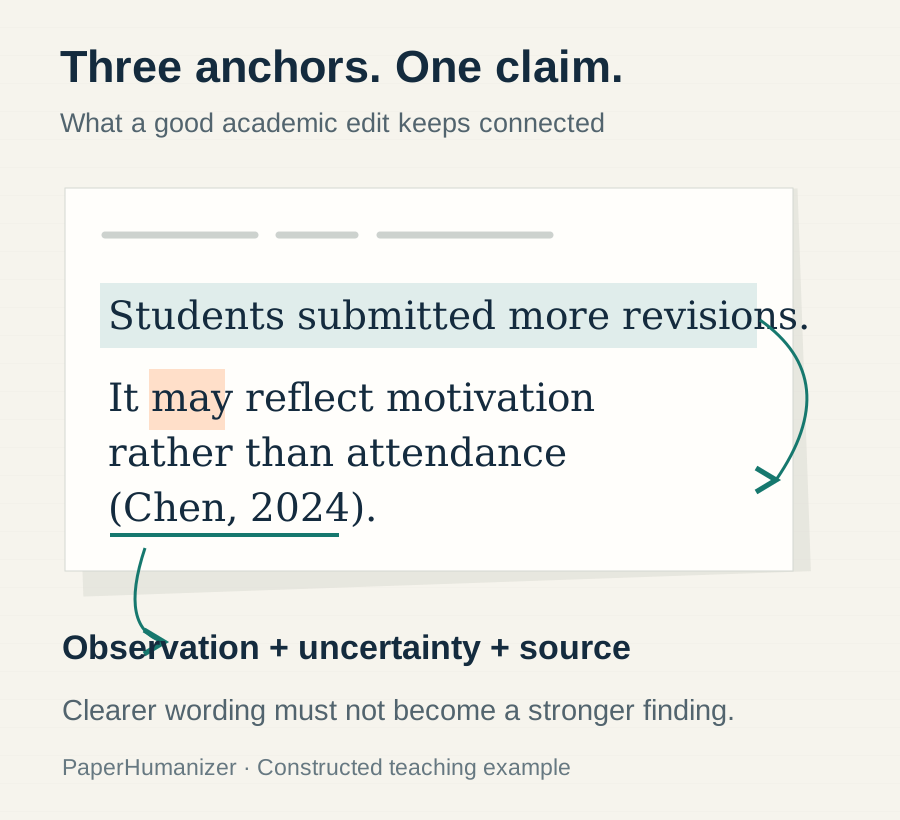
Keep three anchors connected: what was observed, how strongly it can be interpreted, and which source supports it.
How to run a useful paragraph test in either tool
Use one original passage you understand well. A short paragraph can be enough for an initial test, but avoid a fragment whose meaning depends on missing sentences. Remove personal or confidential material first.
- Save the original. Keep an untouched copy with its citations. Do not test one tool's output as the other tool's input.
- Name one problem. For example: a delayed main point, repetitive sentence openings, or wording that is too conversational for a results section.
- Choose comparable settings. Record the available options and keep the intended audience the same. Different controls need not have matching labels.
- Review the anchors. Compare claim strength, context, outcomes, numbers, and citation attachment before judging style.
- Record the remaining work. Count material corrections you actually need to make, rather than inventing a quality percentage.
- Make the final edit yourself. If the best sentence is already in your original, keep it.
A simple record might say: “The opening is clearer; two terminology changes need restoring; citation attachment is intact.” That is more actionable than “looks 90% human.” If you later compare detector results, keep that experiment separate from this language-quality assessment.
When Scribbr may be the more convenient choice
You may prefer trying Scribbr if you already use its writing resources and want a quick revision of a small passage. There is little value in moving a clear paragraph through multiple services simply because another button is available.
It may also be the more convenient starting point if your actual task belongs to a different service in its collection. For example, wanting document-level corrections is a reason to investigate its proofreading workflow. It is not evidence that a humanization pass will fix every aspect of the paper.
Do not turn a useful comparison into unnecessary editing. If your draft only needs two punctuation fixes, make those fixes. Choosing the smallest appropriate intervention protects the voice and detail you already got right.
When PaperHumanizer is worth trying
PaperHumanizer is a practical alternative when you regularly revise academic passages and want a focused place to set the purpose, choose an academic tone, and inspect the completed result against the input.
For example, you might use Technical/STEM for a methods passage where named procedures must stay exact, then Standard Academic for a discussion paragraph that needs a clearer explanation. The value to assess is whether the editor reduces repetitive manual phrasing work while leaving you with a manageable review, not whether it changes the largest number of words.
Try a coherent section in PaperHumanizer. Begin with a passage you can check, and use Compare to inspect the same anchors described above. A successful short test gives you a better basis for choosing an access period than a generic demo.
How to compare cost without buying the wrong service
Compare the unit of work, not just a price label. Ask how much text the current interface accepts, whether your task is rewriting or document proofreading, and what you need to do with the result afterward. A short free experiment and a longer document workflow may solve different problems.
PaperHumanizer's pricing page lists its current 30-day and annual access options. Choose based on expected writing frequency: a single assignment and recurring research drafts are different workloads. Use the displayed total charge and access period when comparing plans, rather than treating an annual monthly equivalent as a monthly payment.
We do not quote a competing subscription price here because Scribbr's humanizer and other editing services should not be treated as one interchangeable plan. Check the current page for the specific service you intend to use.
Frequently asked questions
Is PaperHumanizer a Scribbr AI Humanizer alternative?
Yes, for the shared task of revising existing prose to sound more natural. PaperHumanizer adds a focused academic editing workflow with purpose, tone, and comparison controls. It is not a replacement for every proofreading, citation, or plagiarism service in Scribbr's collection.
Does Scribbr AI Humanizer preserve citations?
Keeping the message is part of Scribbr's stated aim, but that is not a citation-verification result. Test your actual passage and check both the marker and the claim it supports. Apply the same check to PaperHumanizer.
Which one produces a lower Turnitin AI score?
This guide does not establish a winner on that measure. A comparison would require the same inputs, documented settings, actual external tests, and a disclosed sample. The teaching passages above are not such a benchmark. See what an AI-detection percentage means before treating a score as evidence about quality or authorship.
Can I rewrite a whole research paper in one pass?
Work in coherent sections and respect the current input limit of the selected tool. Preserve a separate formatted master document. Review technical sections especially carefully, and return approved text to the master rather than assuming extraction and rewriting retain its layout.
Which should I choose for a thesis?
Choose by the bottleneck. If it is recurring academic phrasing, try PaperHumanizer on one section. If it is reference accuracy, formatting, or substantive feedback, address that task directly. Our thesis humanizer guide explains how to organize section-by-section revision.
Make the decision on your own paragraph
Your best test passage is one with a clear purpose, a claim you can explain, and details you must preserve. Assess whether the rewrite improves a real weakness and how much correction remains.
Open PaperHumanizer to run that test. If the workflow fits your recurring writing, compare access options. If you are still comparing editing approaches, continue with QuillBot vs PaperHumanizer or humanizer vs paraphraser.