
A paraphraser changes how a passage is worded; an AI humanizer aims to make the passage read more naturally as a whole. The two jobs overlap, but they are not interchangeable. If your sentence is clear and you only need a different expression, a careful paraphrase may be enough. If an entire paragraph feels generic, repetitive, or detached from your argument, replacing synonyms is unlikely to fix it.
For academic work, neither tool can supply missing evidence or make an invented citation real. Your best workflow is to decide what is allowed to change, revise the prose, then compare the result with the source and assignment.
For a named-product comparison, see QuillBot versus PaperHumanizer for academic rewriting. QuillBot offers both Academic and Humanizer modes; the useful comparison is the actual workflow, not a rigid category label.
Try PaperHumanizer on one paragraph →
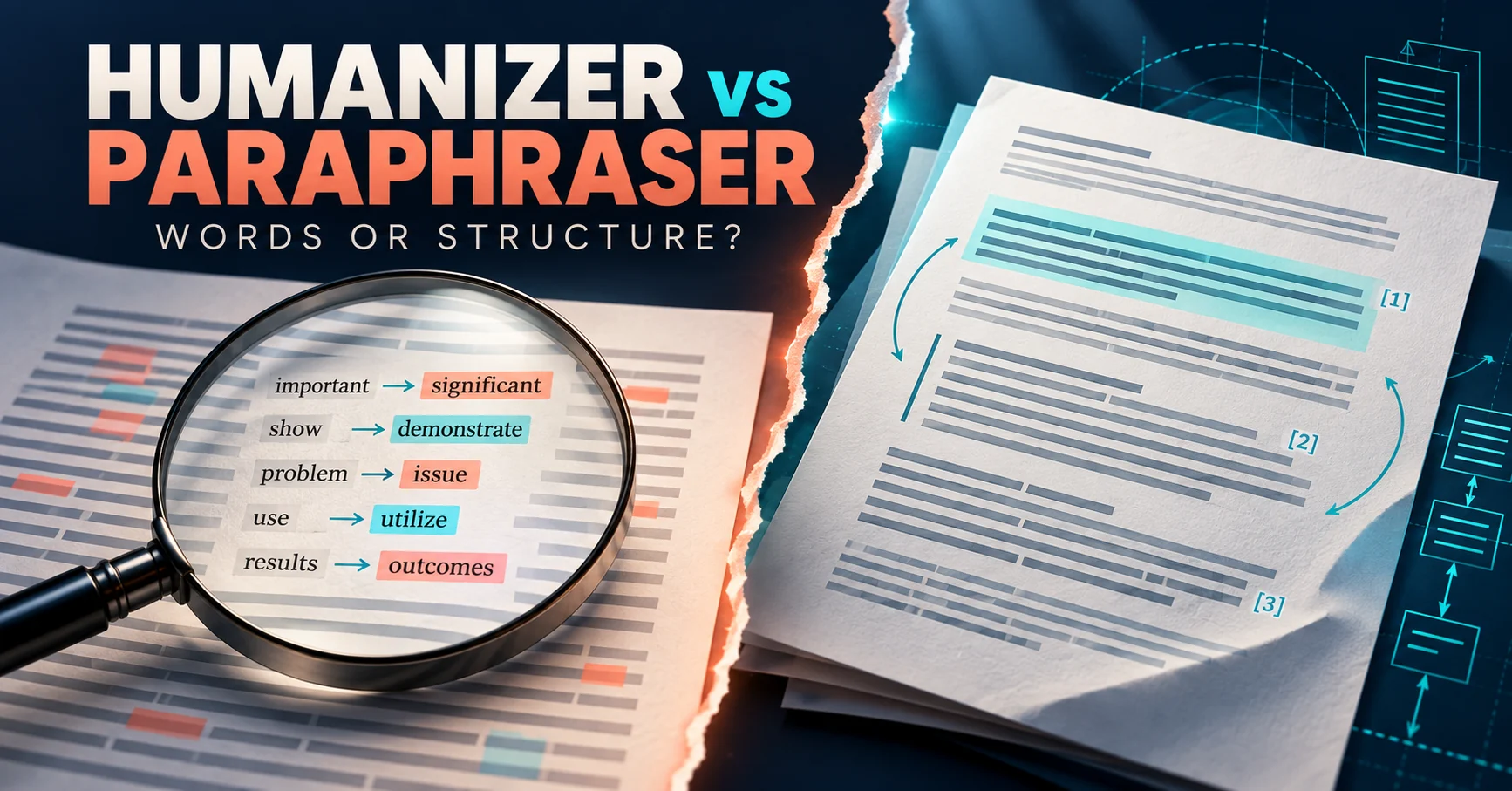
The useful distinction is not “which tool changes more words?” but “which writing problem are you trying to solve?”
The short answer: choose by the problem, not the label
| Your draft needs... | Start with... | Check afterward... |
|---|---|---|
| A clearer version of one awkward sentence | A focused paraphrase or manual edit | The claim, citation, and level of certainty |
| Less repetitive rhythm across a whole paragraph | A humanization pass | Sentence roles, transitions, and meaning |
| A fresh argument, example, or source | Your own research and drafting | Whether the new evidence actually supports the claim |
| A lower similarity score caused by close copying | Source review and independent writing | Attribution and quotation rules |
| A response to an AI-detector flag | Review of the passage and your writing process | Evidence, policy, and whether revision improves the work |
The names are marketing labels, not guaranteed technical categories. Some paraphrasers restructure sentences; some humanizers merely swap words. Evaluate the output, not the name on the button.
What does a paraphraser do?
A paraphraser produces another way of expressing existing text. It may replace vocabulary, change active and passive voice, combine clauses, or alter sentence order. That can help you clarify a sentence you wrote, but it becomes risky when you are paraphrasing a source: a new sentence still needs attribution, and changing a few words does not make another author's idea your own.
For example, suppose your draft says:
Furthermore, peer feedback plays a significant role in improving students' revision outcomes (Chen, 2024).
A surface paraphrase might say:
Moreover, feedback from peers is important for enhancing students' revision results (Chen, 2024).
It uses different words, but the stock opener, abstract phrasing, and sentence shape remain. This is not automatically wrong. It simply has not addressed why the sentence sounds generic.
Paraphrasing is useful when the idea and structure are already right and the wording needs precision. For a quoted passage, source idea, or technical definition, you still need to follow your institution's citation rules. See our guide to protecting citations while revising a research paper.
What does an AI humanizer aim to change?
An AI humanizer is usually chosen when generated or heavily AI-assisted prose is grammatical but reads as if every sentence were built from the same template. The useful work is broader than a thesaurus pass:
- Put the main claim before a generic introductory phrase.
- Vary how sentences begin and how long they run.
- Replace empty transitions with the actual relationship between ideas.
- Remove repeated explanations that do not advance the argument.
- Keep evidence visible instead of burying it under polished generalities.
- Match the level of formality to the assignment and discipline.
One possible revision of the example is:
In Chen's study, peer feedback helped students make more effective revisions (2024).
The sentence is shorter and more direct. But notice that “helped” and “more effective” still need to match what Chen actually reported. A humanizer can help with expression; the writer remains responsible for checking the source.
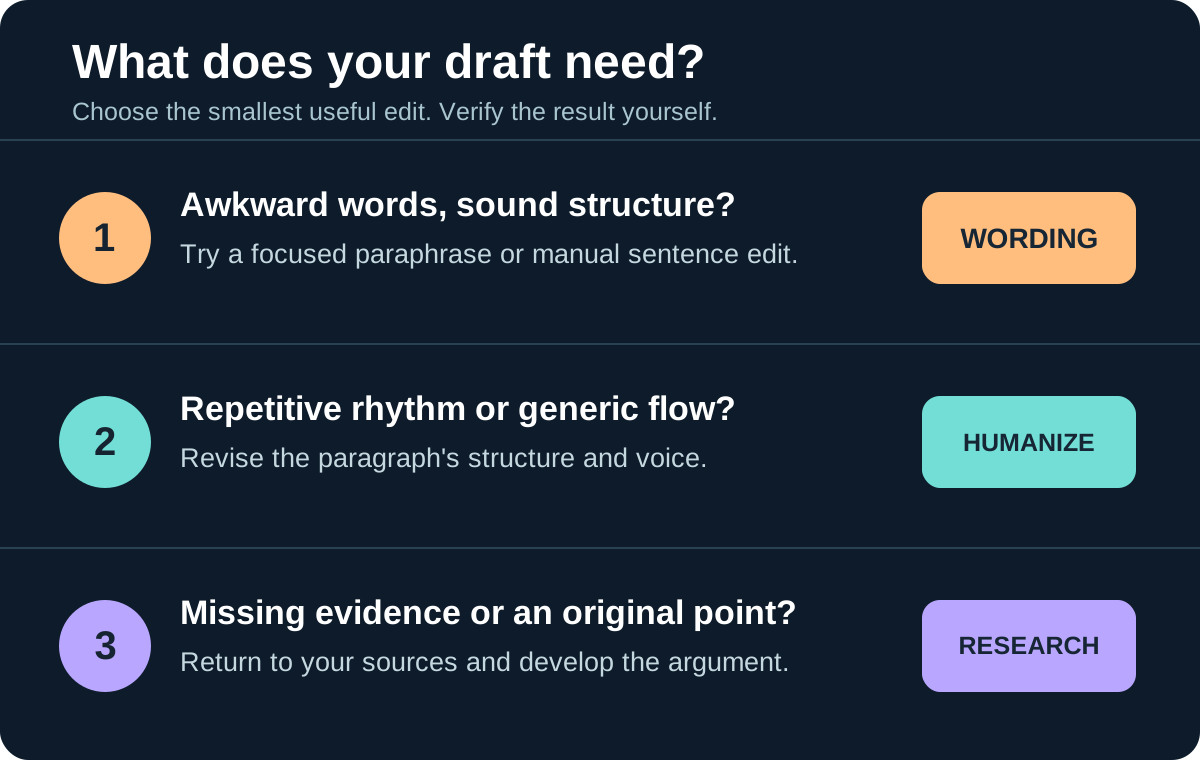
First identify the writing problem. If the evidence or argument is missing, neither rewriting tool is the right first step.
A paragraph-level comparison: words versus structure
Consider this illustrative, AI-assisted paragraph about online learning:
In today's rapidly evolving educational landscape, online learning has emerged as a transformative tool that offers numerous benefits. It provides flexibility and accessibility for students from diverse backgrounds. Furthermore, it enables learners to engage with course content at their own pace. Therefore, educators should leverage online learning to improve student outcomes.
The paragraph is fluent, but it makes four broad claims without explaining which learners, which course design, or which outcome. A synonym-focused paraphrase could change “transformative” to “powerful” and “leverage” to “use.” The problem would remain.
A more meaningful revision might read:
Online lessons help students who cannot attend at a fixed time, but flexibility alone does not improve learning. In a course with recorded lectures, students may be able to revisit a difficult explanation; they still need timely feedback and a clear way to ask questions. The more useful design question is not whether the course is online, but which parts of it students can actually use when they fall behind.
This example adds a specific situation and a clearer distinction. It is an editorial illustration, not a measured PaperHumanizer output or a claim about detector scores. In real coursework, you should add only examples and claims you can support.
| Review point | Original draft | Surface paraphrase | Substantive revision |
|---|---|---|---|
| Opening | Broad scene-setting | Different broad scene-setting | Specific condition and limitation |
| Evidence | None | Still none | A concrete, checkable example is proposed |
| Structure | Benefit list → recommendation | Same structure | Claim → qualification → practical question |
| Voice | Promotional | Promotional with synonyms | Direct academic explanation |
| Writer's work left to do | Verify every claim | Verify every claim | Verify the example and add a source if required |
This is why a sentence humanizer and a paragraph humanizer solve different scales of problem. A sentence can be made elegant while the paragraph still lacks a point.
When a paraphraser is the better choice
Do not use the heavier tool simply because it sounds more advanced. A narrow edit is preferable when:
- You have a precise sentence with an awkward repetition.
- The paragraph's logic and evidence are already sound.
- A technical term, legal term, or quotation must remain unchanged.
- You need a concise alternative heading or transition.
- Your instructor permits language assistance but expects the analysis to remain yours.
After paraphrasing a source, compare the new sentence with the original. Does it represent the author's meaning accurately? Is the citation still attached to the right claim? If the structure tracks the source closely, write again from your own understanding rather than rotating synonyms.
When humanization is the better choice
Choose a paragraph-level humanization pass when the whole passage has a pattern problem: five consecutive sentences start alike, every transition says “furthermore,” or the prose seems more polished than specific. This is especially common in AI-assisted essays, discussion posts, literature reviews, and research-paper introductions.
PaperHumanizer is built for academic rewriting. Paste a coherent passage into the AI humanizer, choose the tone appropriate to your assignment, and compare the completed result with your original. The output appears as a complete result for review; it should be treated as a draft, not as verified scholarship.
If you are working with a long paper, revise by section rather than placing the abstract, methods, results, and discussion in one undifferentiated pass. Those sections have different kinds of claims to protect. Our research-paper guide explains how to review them separately.
A five-minute review before you use either output
Keep this short checklist next to the source and the assignment:
- Meaning: Did a cautious “may” become a certain “does”?
- Evidence: Does every retained or new claim have support?
- Citations: Are author names, years, page numbers, and quotation marks still correct?
- Terms and numbers: Were technical labels, sample sizes, statistics, or dates changed?
- Voice: Would you say this in the context of this course or paper?
- Policy: Does the assignment allow this kind of AI-assisted revision, and is disclosure required?
Do not use a detector result as the only quality test. An AI detector and a plagiarism checker measure different things, and neither can certify that your reasoning is correct. Verify the actual submission requirements and your sources separately.
Revise a paragraph, then compare it with your original →
Frequently asked questions
Is an AI humanizer just a paraphraser?
Not necessarily. A basic paraphrase changes expression. A useful humanization pass also addresses repetitive structure, transitions, rhythm, and fit for a writing context. Products vary, so judge a sample output against your original text.
Can I humanize a paraphrased paragraph?
Yes, if the paragraph is your own authorized draft and still sounds mechanical. Do not assume that two passes improve it automatically. More rewriting can introduce factual drift, so compare each version with your sources.
Will either tool make copied material original?
No. If you copied a source or paraphrased it too closely, resolve the attribution and source-use problem first. Rewording cannot substitute for a correct citation or independent analysis.
Which is better for an academic essay?
Use the least extensive edit that solves the actual issue. A sentence may need a simple rewrite; an AI-assisted paragraph may need its structure reworked; a weak argument needs your own research and reasoning. For assignment-specific guidance, see our college essay humanizer guide.
Does humanizing guarantee a particular AI-detector score?
No. Detector outputs differ by product, document, and version. Focus on readable, accurate work that you can explain and support, then follow your institution's policy.
The practical choice
Use a paraphraser to improve wording when the underlying writing already works. Use an AI humanizer when the prose needs a more natural structure and academic voice. Use neither as a substitute for source checking, an original argument, or responsible authorship.
Ready to test the difference on your own draft? Open PaperHumanizer, start with one paragraph, and compare meaning, citations, and voice before moving on. If you need more capacity for ongoing coursework, review the plans after trying the workflow.