
If Pangram flags your essay, first separate three things: the share of text labeled AI-generated, the labels assigned to individual segments, and the confidence attached to those judgments. Then compare the highlighted passages with your drafts, sources, and assignment policy. Rewriting the entire essay immediately can destroy useful context without solving the underlying problem.
This guide is written by the PaperHumanizer team, not Pangram. Official product explanations were checked on October 22, 2026. The examples below are educational, not real student reports or a detector benchmark. Interfaces and definitions can change, so read the explanation accompanying your actual report.
A report is a starting point for review. Identify what each number and highlighted segment actually represents.
If you are here to improve a permitted draft rather than interpret a report, open PaperHumanizer for section-by-section academic editing. Keep the original version and verify evidence before accepting a rewrite.
What does a Pangram AI percentage mean?
Pangram's current guidance for reviewing student work explains that the percentage is the share of text, measured by character, labeled AI-generated. It is not the probability that the student used AI. The same guidance distinguishes segment labels from High, Medium, or Low confidence shown in the report details.
Here is a hypothetical calculation to make the distinction concrete: if a report's evaluated text contains 2,000 characters and 1,200 are labeled AI-generated, that share is 60%. This arithmetic is illustrative, not a Pangram scan. It does not mean the system is 60% certain that the author cheated, nor that exactly 60% of the words were generated.
Do not transfer the interpretation of one detector's number to another detector. Our AI detection percentage guide explains why a number needs its provider's definition before it can be interpreted.
Read the report in three layers
| Layer | Question to ask | What not to infer |
|---|---|---|
| Document percentage | How much of the evaluated text received this label? | A probability of misconduct |
| Segment classification | Which passage was labeled Human, AI-assisted, or AI-generated? | That every word in the passage has a known origin |
| Confidence | How strongly does the system support that segment judgment? | A substitute for the assignment rules or drafting evidence |
The table is a reading checklist, not a new scoring system. Preserve the report date, the exact input, and any explanation shown in its details. Screenshots without the evaluated text make later discussion harder.
Why the surrounding paragraph matters
Pangram's AI segment explanation describes dividing longer documents into passages for analysis. A segment is not a forensic record of individual keystrokes. Read the highlighted passage alongside the surrounding argument, rather than isolating one formal sentence and assuming its vocabulary explains the entire result.
For your own review, mark where the paragraph came from: an early outline, a lab notebook, your source notes, an allowed editing pass, or a later revision. That context is more useful than guessing which synonym might make a highlight disappear.
What does “AI-assisted” mean in Pangram?
Pangram's AI-assisted writing explanation distinguishes lighter assistance, such as surface editing, from more substantial rewriting or additions. It also acknowledges that co-authorship is a spectrum rather than a perfectly sharp boundary.
For a student, the practical question is therefore what assistance the course permits and what you actually used. A label is not the policy. A course may permit spelling correction but restrict generative rewriting; another may permit disclosed editing but prohibit generated analysis.
Before changing anything, answer these questions in plain language:
- Did I develop the argument and select the evidence myself?
- Which tools, if any, changed the wording, structure, or content?
- Does the assignment allow those uses, and does it require disclosure?
- Can I show the earlier draft and explain the final reasoning?
Do not describe a substantial rewrite as “just spellcheck.” Equally, do not infer a specific tool history from a report alone. Record what actually happened.
If your essay is flagged: a practical response workflow
Step 1: Preserve the original and the report
Save the submitted file, the evaluated text, and the report before making revisions. Keep any genuine version history, source notes, outlines, and feedback. Do not manufacture a drafting history or overwrite an earlier document to make it look different.
A simple folder can separate submitted draft, report, source notes, and revised draft. The purpose is traceability, not collecting a large quantity of irrelevant files.
Step 2: Check the assignment policy
Read the instructions for this particular assessment. General advice about AI tools cannot overrule a course requirement. If the boundary is unclear, ask whether the proposed use—proofreading, translation, restructuring, or paragraph rewriting—is allowed before using it.
For a disputed submission, follow the institution's review procedure. A private rescan or a newly rewritten paragraph is not automatically an accepted response to an academic integrity concern.
Step 3: Locate the passages that need attention
Read the marked sections and distinguish different problems. A correct but repetitive introduction needs a different response from an unsupported claim. A quotation needs accurate attribution, not a more original-looking paraphrase. An explanation copied from a source needs source correction, not just stylistic variation.
Create a short passage log: where it appears, what it claims, which source supports it, what permitted assistance was used, and whether it needs revision. This turns a stressful report into a manageable editing task.
Step 4: Revise for a defensible reason
If editing is permitted, improve clarity, specificity, and structure. Replace generic framing with the actual research point. Retain qualifications and technical terms. Explain the evidence in your own reasoning rather than adding elaborate vocabulary.
For repeated academic editing, PaperHumanizer offers purpose and tone settings plus original-versus-output comparison. Use it on a coherent section you understand, and inspect the completed result before moving on. It is a rewriting workspace, not a substitute for Pangram's report or your institution's decision.
Step 5: Verify the revision and retain both versions
Check every number, citation, quotation, and limitation against the source. Return approved prose to the original document, preserve reference fields and formatting there, and keep a record of assistance where required.
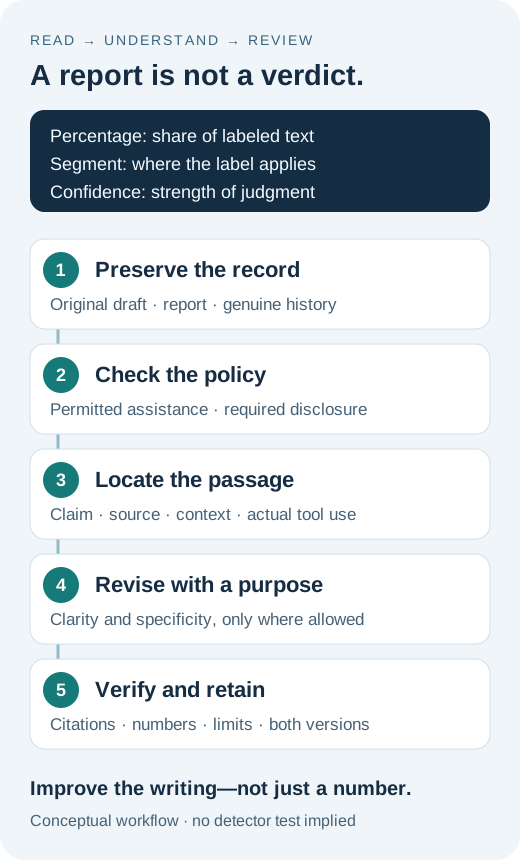
Improve the draft for an identifiable reason; do not use a changing percentage as your only acceptance criterion.
Worked example: improve expression without changing the evidence
This is a fictional teaching example, not text tested in Pangram. The citation is invented for illustration.
Draft
It is important to note that the survey findings indicate that access to peer feedback was associated with more frequent revision among the postgraduate students in the sample (Lee, 2025). However, it cannot be concluded that peer feedback caused the change.
An illustrative academic edit
Among the postgraduate students surveyed, access to peer feedback was associated with more frequent revision (Lee, 2025). The study does not establish that feedback caused the change.
The edit removes an empty opening and reduces repetition while retaining the population, observational relationship, citation, and causal limitation.
Do not accept: “Peer feedback makes students better writers.” That version adds an outcome the draft did not measure, generalizes beyond the sample, and asserts causation. Its shorter length is not evidence of quality.
Use the same test on your own highlighted passage: what becomes clearer, and what must remain unchanged? The academic rewrite example library and citation-preservation checklist provide more detailed review patterns.
Can Pangram detect humanized text?
Pangram's education page describes detection of AI-assisted and humanized writing. That is the provider's product claim, not an independent benchmark performed for this guide. There is no universal guarantee that a rewrite will receive a particular external classification.
PaperHumanizer's detector-style on-screen values are simulated presentation values, not live Pangram, Turnitin, or GPTZero scans. A displayed value should not be used as evidence that an external detector has cleared a submission.
The useful target is a draft with accurate evidence, natural expression, and permitted authorship—not a promise to erase a tool's involvement. Repeatedly rewriting the same paragraph can introduce drift and make your reasoning harder to trace. Keep the source, make a purposeful editing pass, compare, and stop when the writing meets your real criteria.
A final review checklist before submission
Use this checklist independently of any detector result:
- Argument: I can explain every claim without relying on generated phrasing.
- Evidence: Each source supports the specific statement beside it.
- Scope: Samples, dates, units, and uncertainty remain correct.
- Quotations: Quoted language is exact and attributed.
- Assistance: Tool use and disclosure follow this assessment's rules.
- Document: Citations, tables, equations, and reference fields survive the return to Word or another editor.
- History: The original and revised drafts are retained honestly.
For uploaded files, inspect text extraction before editing. Our Word revision guide explains why a text-based rewriting workflow does not preserve every document feature automatically.
Frequently asked questions
Is a high Pangram percentage proof that I cheated?
A percentage alone does not establish what happened during drafting or whether a policy was breached. Read its definition, the segment details, the relevant rules, and the genuine drafting evidence. Follow your institution's process for a disputed result.
Does “AI-assisted” mean the whole essay was generated?
No. Do not collapse assistance and full generation into the same claim. Inspect the report's segment labels and document the actual tools and editing steps you used.
Can grammar correction or translation matter?
Editing and translation are forms of assistance that may be treated differently across courses. Ask about your specific use rather than assuming every grammar or translation tool is automatically allowed.
Should I keep rescanning until the score falls?
Not as an editing strategy. A changing classification does not tell you whether your citation is accurate or your argument improved. Use a report where required, but review the writing against substantive acceptance criteria.
Is AI detection the same as plagiarism checking?
No. A text-origin classification and a source-similarity report answer different questions. Neither removes the need for attribution. See AI detectors versus plagiarism checkers for examples.
Turn a report into a better revision process
If rewriting is permitted and your paragraph needs a clearer academic voice, try PaperHumanizer on one section. Compare the rewrite against the source, keep only defensible improvements, and retain the original. For recurring coursework or research drafts, compare the available access plans after testing the workflow—not on the assumption that any plan guarantees a detector outcome.