
An AI detector and a plagiarism checker answer different questions. A plagiarism or similarity checker looks for wording that matches existing sources. An AI detector estimates whether the writing contains patterns associated with generated text. One score cannot explain, confirm, or cancel the other.
That means a paper can have a low similarity score and still receive a high AI-writing indication. It can also contain extensive source matches while looking fully human-written. Understanding the difference helps you fix the actual problem instead of rewriting the wrong parts of your paper.
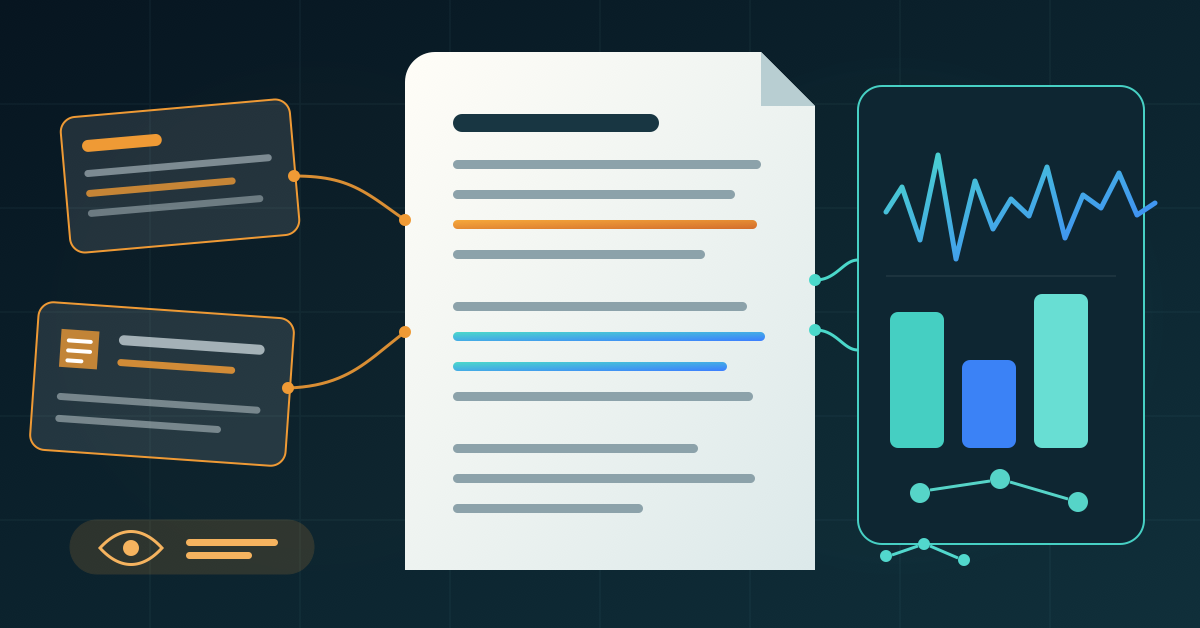
Source matching and writing-pattern analysis can examine the same paper, but they produce independent evidence.
AI detector vs plagiarism checker: the quick comparison
| Question | Plagiarism or similarity checker | AI detector |
|---|---|---|
| What does it look for? | Wording that matches or closely resembles indexed sources | Language patterns associated with generated writing |
| What is the text compared with? | Web pages, publications, repositories, and prior submissions available to the system | A detection model's learned representation of human and generated text |
| Typical output | Similarity percentage, highlighted passages, and possible sources | AI-writing indicator, probability, or highlighted passages |
| Can a result prove misconduct? | No; a match may be quoted and cited correctly | No; the result is probabilistic and can be wrong |
| Best next action | Inspect each source match and correct quotation or citation problems | Review highlighted prose, writing process, accuracy, and policy compliance |
| Can it replace the other check? | No | No |
Turnitin's own guidance makes the separation explicit: its AI-writing percentage is independent of the similarity score, and its detection model should not be the sole basis for adverse action against a student. Its similarity guidance also says that the similarity percentage measures matching material rather than deciding whether plagiarism occurred. See the official explanations of the AI Writing Report and Similarity Report.
What does a plagiarism checker measure?
A plagiarism checker compares submitted writing with material in the databases it can search. When it finds matching or highly similar wording, it highlights the passage and may show one or more possible sources.
The result is often called a similarity score, which is more accurate than calling it a plagiarism percentage. Similarity is evidence of textual overlap. Whether that overlap is acceptable depends on context.
A match may come from:
- A quotation that is correctly marked and cited
- A quotation missing quotation marks or attribution
- A close paraphrase that follows the source too closely
- A title, reference entry, or common technical phrase
- A template supplied to the whole class
- A student's earlier submission stored in a repository
- Unattributed copied material
The percentage alone cannot tell these cases apart. Turnitin states directly that it does not determine whether a student plagiarized; the instructor must interpret the matches using academic judgment. Its official similarity-score guidance also notes that correctly cited material may appear as a match.
What does an AI detector measure?
An AI detector does not need to find the same sentence on another website. It analyzes characteristics of the submitted prose and estimates whether they resemble patterns associated with generated writing.
Different products use different models and report formats, but the signals may include relationships among:
- Word and phrase predictability
- Repetition across sentences or paragraphs
- Sentence-length and structural variation
- Formulaic transitions and openings
- Consistency of register
- Patterns learned from human and model-generated samples
The output is an estimate, not a verified account of how the text was produced. Human writing can be flagged, AI writing can go unflagged, and two detectors can disagree. For a deeper explanation, read how AI detectors evaluate academic writing.
Turnitin's current documentation says its model may misidentify human-written, AI-generated, and AI-paraphrased text. It also suppresses exact results below its lower reporting threshold because false positives are more likely in that range. Those product-specific details can change, which is another reason not to treat a detector number as permanent proof.
Why the two scores can disagree
Think of the reports as two independent axes rather than two slices of one score.
Low similarity, high AI indication
The wording does not closely match indexed sources, but its style resembles generated prose. This can happen with newly generated text because the sentences may be original in the source-matching sense.
It can also happen when human writing is unusually uniform or when extensive editing has flattened the writer's normal variation. The appropriate response is not to add citations randomly. Review how the text was produced, compare it with drafts, verify every claim, and revise generic sections only when revision is genuinely needed.
High similarity, low AI indication
The prose does not appear generated, but substantial wording matches one or more sources. A human can copy text, quote extensively, reuse a previous paper, or paraphrase too closely.
Humanizing the sentences does not solve the source problem. Inspect the matches, add missing quotation marks and citations, rewrite close paraphrases from your own understanding, or remove material that the assignment does not permit.
High similarity, high AI indication
The paper raises two separate questions. Some wording overlaps sources, and some qualifying prose resembles generated writing. Handle the reports independently: resolve source use first, then review the writing process and any highlighted AI-like passages.
Do not average the scores or assume one caused the other.
Low similarity, low AI indication
Neither system found much within its scope. That still does not prove the argument is accurate, the sources are reliable, the citations are complete, or the work follows the assignment. These tools do not grade reasoning.
A worked example: one paragraph, two reports
Consider this paragraph:
Furthermore, digital platforms have significantly transformed higher education by providing flexible and accessible learning opportunities. These tools play a crucial role in helping students engage with course content regardless of geographical location.
A plagiarism checker may find little overlap if those exact sentences are not in its database. An AI detector may still react to the predictable transition, broad claims, uniform rhythm, and stock phrases such as “significantly transformed” and “play a crucial role.”
Now consider a direct quotation:
“Transactional distance is a psychological and communications space to be crossed” (Moore, 1993, p. 22).
A similarity checker may highlight the quotation because it matches the source. That is expected. If the quotation marks, citation, and use comply with the assignment, the match is not automatically a problem. Rewriting the quotation merely to reduce the similarity percentage could make the scholarship less transparent.
The correct action depends on what the highlighted text represents.
Which report should you review first?
For an academic paper, review source matches first. Accurate attribution provides a stable foundation for any later language revision.
Step 1: inspect every meaningful source match
Ask:
- Is this a quotation, paraphrase, reference entry, template, or unintended overlap?
- Does the citation identify the right source?
- Are quotation marks and page numbers present where required?
- Is the paraphrase genuinely independent in structure as well as vocabulary?
- Does the assignment allow reuse of earlier work?
Step 2: preserve legitimate matches
Do not change a correctly quoted sentence simply to chase a lower score. Technical terminology, titles, and reference entries may also need to remain exact.
Step 3: review any AI-writing indication separately
Look at the highlighted passage in context. Compare it with your notes, document history, outline, and earlier drafts. Check whether the language is generic, repetitive, overpolished, or inconsistent with the surrounding paper.
Step 4: revise the prose for quality and ownership
If the content is genuinely yours but the expression is mechanical, revise sentence structure, specificity, transitions, and rhythm. Keep the argument, evidence, citations, numbers, and degree of certainty stable.
PaperHumanizer is designed for this language-revision stage. It is not a plagiarism checker and cannot decide whether a source has been attributed correctly.
Revise one AI-flagged paragraph while preserving its citations →
Step 5: document your process
Keep notes, source files, outlines, draft history, and feedback. If a result is questioned, process evidence is more informative than a screenshot from another detector.
How to respond to each type of problem
| Report finding | Do this | Do not do this |
|---|---|---|
| Correctly cited quotation match | Check formatting and keep it if relevant | Paraphrase only to reduce the percentage |
| Missing quotation marks | Add quotation marks and accurate citation | Run the copied sentence through a humanizer |
| Close paraphrase | Return to the source, understand it, and write independently | Swap synonyms while keeping the source structure |
| Generic AI-like prose | Add specific evidence and revise structure and rhythm | Insert random errors or awkward vocabulary |
| Possible false positive | Gather drafts and discuss the context with the instructor | Treat another detector as definitive proof |
| Invented citation from an AI draft | Remove or replace it with a verified source | Preserve it because it looks academic |
If a human-written essay has been flagged, use the false-positive review guide before changing the language. If the text is AI-assisted and needs a controlled revision, the AI detection remover guide explains how to protect meaning while changing detectable patterns.
Can a plagiarism checker detect AI writing?
A traditional similarity checker cannot infer AI authorship merely because text is new. Some platforms bundle a similarity report and a separate AI-writing report in the same interface, which makes the tools look like one system. The underlying questions and outputs remain different.
Likewise, an AI detector cannot tell whether a sentence was copied from a journal. A sentence may look fully human while matching a source word for word.
Is a similarity score a plagiarism score?
No. A similarity score describes how much text matched the sources available to the system under the selected settings. The score does not automatically distinguish a properly cited quotation from an unattributed copy.
There is also no universal “safe” percentage. A bibliography-heavy research paper, a template-based lab assignment, and an original reflective essay can produce different kinds of legitimate overlap. Inspect the matches rather than chasing a target number.
Is an AI score proof that ChatGPT wrote the paper?
No. An AI-writing result is probabilistic, and even detector providers warn that it can be inaccurate. It should be interpreted with the actual prose, drafts, writing process, assignment policy, and human judgment.
The result also cannot normally identify the exact model, prompt, or sequence of edits that produced the text.
Frequently asked questions
Why is my similarity score low but my AI score high?
The wording may be original relative to the checker's databases while still showing patterns an AI detector associates with generated prose. Review the writing process and highlighted passages; adding citations will not fix a style-based indication unless sources were actually missing.
Can I have plagiarism without AI-generated text?
Yes. A person can copy or closely paraphrase a source without using AI. Source overlap and AI-writing patterns are independent.
Can AI-generated text pass a plagiarism checker?
Yes. Newly generated wording may not match an indexed source. A low similarity result does not establish human authorship or factual accuracy.
Should I humanize text that appears in the similarity report?
Not automatically. First determine why it matched. Correct quotations, titles, reference entries, and required terminology may need to stay exact. If wording was copied or paraphrased too closely, return to the source and repair the attribution rather than hiding the match.
Does PaperHumanizer check plagiarism?
No. PaperHumanizer revises writing style while aiming to preserve meaning and citation markers. Use a source-matching service for similarity review and verify every citation yourself.
Can a humanizer guarantee a lower AI score?
No responsible tool can guarantee a fixed result across detectors, versions, document lengths, and subjects. Evaluate the revised prose itself and comply with the applicable AI-use policy.
Fix the problem the report actually found
If the issue is source overlap, repair the quotation, paraphrase, or citation. If the issue is generic AI-assisted expression, revise the prose while protecting the underlying evidence. Treating the reports separately leads to a more accurate paper—and avoids damaging valid citations just to change a number.
Try PaperHumanizer on one verified paragraph →
For longer papers, review the citation-preservation workflow before processing multiple sections.