
One of the most common mistakes students make when humanizing their papers is choosing the wrong tone mode. Using Technical for a sociology essay produces overly stiff prose. Using Standard for a doctoral thesis makes it sound like undergraduate coursework.
PaperHumanizer's three tone modes are calibrated to match the actual writing conventions of different academic contexts. Here's how to choose correctly.
Why Tone Matters in Academic Writing
Academic writing isn't monolithic. A biology lab report sounds nothing like a philosophy dissertation, and a business school case study has a very different voice from a linguistics journal article.
When AI text gets humanized without considering discipline and context, the result can feel "off" — technically human-sounding, but not quite right for the venue. Reviewers, instructors, and committee members notice this mismatch, even if they can't articulate exactly why.
The three tone modes address this by producing output calibrated to the conventions of different academic registers.
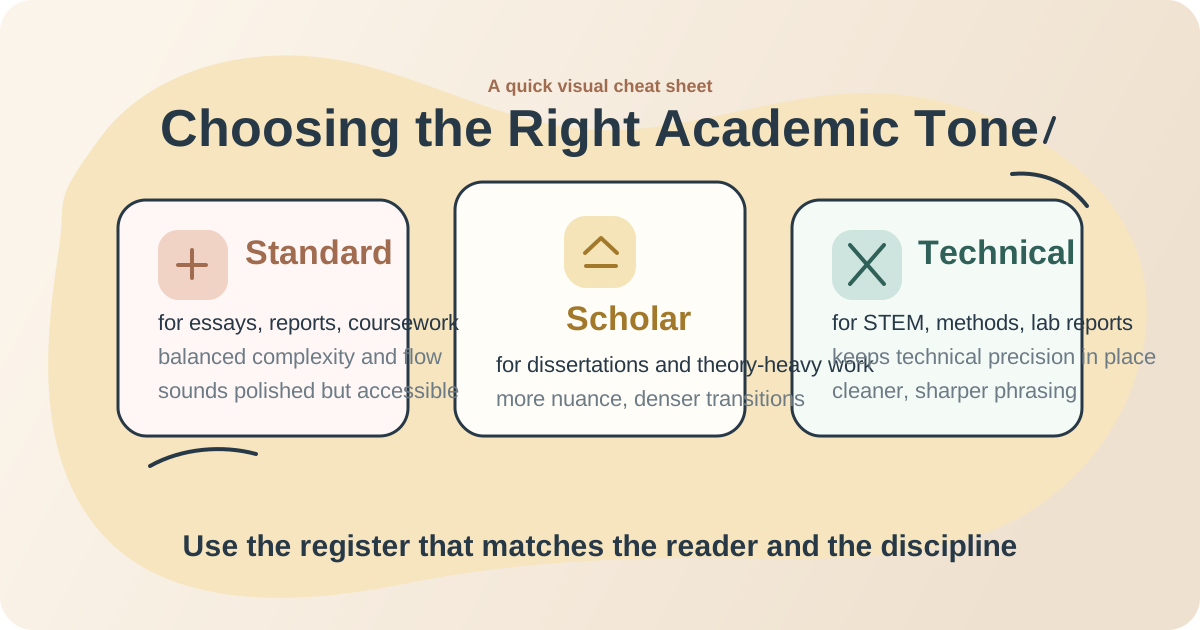
The Three Tone Modes
🎓 Standard — Balanced Academic Prose
Best for: Undergraduate essays, coursework reports, book reviews, reflective assignments, class papers
What it does: Standard mode produces clear, well-structured academic prose without excessive formality. Sentences are complex but accessible. Vocabulary is academic but not rarified. The register is appropriate for a course assignment submitted to an instructor.
Example transformation:
AI original: "Climate change has a significant impact on biodiversity. Many species are affected by rising temperatures. This creates serious problems for ecosystems globally."
Standard tone output: "Rising global temperatures are reshaping biodiversity at an alarming rate, placing mounting pressure on species whose ecological niches are highly temperature-dependent. The cascading effects ripple through interconnected ecosystems worldwide."
Notice how the sentence structure varies, the vocabulary elevates appropriately, and the three monotone sentences merge into two with better analytical depth — without sounding like a journal article.
Disciplines that work best with Standard:
- Social sciences (undergraduate)
- Humanities coursework
- Business reports
- Education assignments
- Political science essays
📚 Scholar — Deep Academic Register
Best for: Master's theses, doctoral dissertations, journal article submissions, conference papers, academic book chapters
What it does: Scholar mode replicates the elevated register of peer-reviewed academic publishing. It uses sophisticated subordination, disciplinary hedging language ("the data suggest," "preliminary findings indicate"), complex nominal phrases, and the kind of nuanced qualifications that mark expert academic argumentation.
Example transformation:
AI original: "The results show that students who use active learning methods perform better. This is because active learning helps them understand material more deeply."
Scholar tone output: "The findings corroborate a growing body of evidence suggesting that active pedagogical approaches are associated with substantively improved academic outcomes, a relationship plausibly mediated by the deeper cognitive processing that such methods necessitate relative to passive instructional formats."
This is the register of published social science research — hedged, nuanced, nominalized, and syntactically complex in ways that feel entirely natural to scholars in the field.
Disciplines that work best with Scholar:
- Humanities (graduate level)
- Social sciences (journal submissions)
- Education research
- Law review articles
- Psychology and behavioral sciences
⚗️ Technical — Precision-Focused Prose
Best for: STEM papers, laboratory reports, engineering case studies, medical research, computer science papers
What it does: Technical mode prioritizes precision, concision, and methodological clarity over rhetorical sophistication. It produces the characteristic style of STEM writing: direct, measurement-driven, passive-voice-appropriate, and rich in discipline-specific terminology.
Example transformation:
AI original: "We tested the new algorithm and it was faster. The results showed it was better than the old method in most cases."
Technical tone output: "Comparative benchmarking demonstrated a 34% reduction in computational latency relative to the baseline algorithm (p < 0.001, n = 150 trials), with performance advantages observed across 87% of experimental conditions."
Notice the precision: quantified comparisons, statistical significance notation, passive voice appropriately deployed, and measurement-forward phrasing — exactly how methods and results sections are written in engineering and science journals.
Disciplines that work best with Technical:
- Computer science and software engineering
- Biomedical research
- Physics, chemistry, materials science
- Environmental engineering
- Nursing and clinical studies
How to Choose the Right Tone
Use this quick decision framework:
Is this for a journal or dissertation?
  → YES: Is it a STEM/science paper?
      → YES: Technical
      → NO: Scholar
  → NO: Is it for a graduate course?
      → YES: Scholar (usually safer)
      → NO: Standard
When in doubt, Scholar mode is the safest default for anything above undergraduate level. It produces writing that reads as appropriately formal without sounding like a lab report.
Comparing the Same Passage Across All Three Tones
To make the difference concrete, here's the same AI-generated passage run through each mode:
Original AI text:
"Social media has changed how young people communicate. They use it all the time and it affects their mental health. Research has studied this in various ways."
Standard:
"Social media has fundamentally altered how younger generations communicate, integrating digital interaction so thoroughly into daily life that its psychological effects have become a pressing area of academic inquiry."
Scholar:
"The proliferation of social media platforms has precipitated a paradigmatic shift in adolescent communicative practices, generating concomitant concerns regarding psychosocial wellbeing that have attracted substantial scholarly attention across disciplines including developmental psychology, sociology, and public health."
Technical:
"Social media use among adolescent cohorts (ages 13–18) has been associated with measurable shifts in interpersonal communication patterns and self-reported psychological well-being indicators, prompting systematic investigation across multiple disciplinary domains."
All three successfully humanize the text. The right one depends entirely on where the paper is going.
Advanced Tips
Mix tones within a document. For a thesis with both a literature review and a quantitative methods section, consider using Scholar for the theoretical chapters and Technical for the methods and results. You can humanize each section separately.
Match your institution's style guide. Some programs have explicit guidance about preferred academic register. If your advisor writes in a very particular style, Scholar mode gives you the closest approximation to published academic prose.
Re-read the output aloud. After humanizing, reading the text aloud is the fastest way to catch phrasing that sounds off for your discipline. If it sounds like something you'd encounter in a peer-reviewed paper from your field, you're good.
Try It Now
All three tone modes are available directly in the PaperHumanizer tool. Paste a paragraph, toggle between tones, and compare the outputs to find what works best for your paper.
No account needed to test — start humanizing immediately.