
A research introduction does more than introduce a topic. It narrows a broad field into a specific unresolved problem, shows why that problem matters, and defines the question the study can actually answer. If revision changes any link in that sequence, the paper may begin with a different argument from the one the research was designed to support.
An introduction section humanizer should improve the movement from context to research question without inventing a gap, exaggerating novelty, detaching claims from citations, or broadening the study's scope. The language can become more natural; the evidence architecture must remain intact.
This guide provides a controlled workflow for humanizing a research introduction while protecting its sources, rationale, and research aims.
Why research introductions often sound repetitive
Introductions are built from familiar rhetorical moves. Writers establish importance, summarize what is known, identify what remains uncertain, and state the purpose of the study. AI-assisted drafts often make those moves with predictable signals:
- “In recent years, there has been growing interest in...”
- “It is important to note that...”
- “However, there remains a significant gap in the literature...”
- “Therefore, this study aims to...”
- “The findings of this study will contribute to...”
The problem is not that these moves exist. A reader needs them. The problem is that generic framing can hide the precise relationship between the literature and the study.
Humanizing an introduction should replace generic transitions with substantive logic. It should not manufacture novelty merely to make the opening sound more confident.
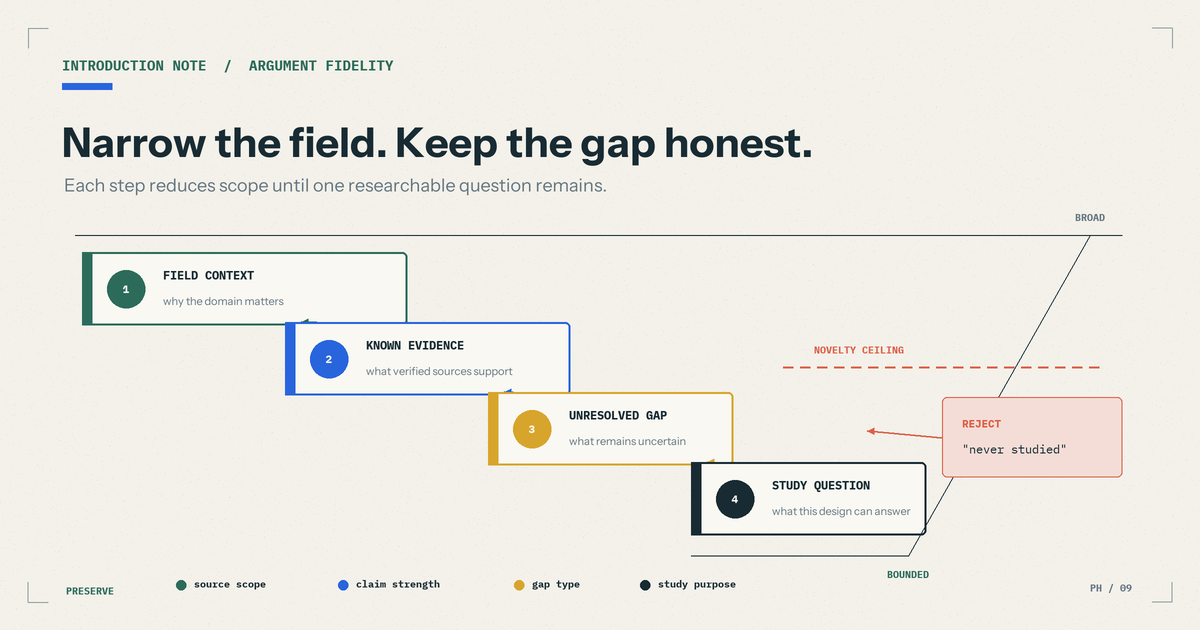
A strong introduction narrows deliberately: context becomes evidence, evidence defines a gap, and the gap justifies one bounded question.
The five functions an introduction must preserve
Before rewriting, identify the function of each paragraph.
- Context: establishes the field, setting, or practical problem
- Current knowledge: summarizes what verified research already supports
- Research gap: identifies a specific limitation, contradiction, or unknown
- Rationale: explains why resolving that gap is worthwhile
- Study purpose: states the question, objective, or hypothesis addressed here
These functions form a dependency chain. If the revised gap no longer follows from the cited evidence, the rationale becomes unsupported. If the purpose becomes broader than the gap, the study appears to promise more than its design can deliver.
What to protect before humanizing an introduction
Create an introduction control sheet before editing.
| Control point | Details to record |
|---|---|
| Key literature claim | Exact proposition, strength, population, setting, and supporting source |
| Source relationship | Agreement, disagreement, extension, limitation, or methodological difference |
| Research gap | What is unknown and what is not being claimed as unknown |
| Significance | Why the gap matters theoretically, methodologically, or practically |
| Study scope | Population, context, variables, intervention, period, or material examined |
| Research purpose | Objective, question, hypothesis, or contribution stated in the protocol |
| Boundary | Claims the study is not designed to test |
This sheet prevents a fluent rewrite from changing “few studies have tested X in setting Y” into “X has never been studied.” The second sentence sounds decisive but makes a much larger and often indefensible claim.
How to humanize a research introduction step by step
1. Rebuild the argument without looking at the prose
Write one sentence for each of the five introduction functions. Use your verified sources, proposal, protocol, or research plan rather than the wording of the draft.
Ask:
- What exact problem opens the paper?
- Which findings are necessary for understanding that problem?
- What uncertainty follows from those findings?
- Why does that uncertainty matter?
- What does this study do about it?
If you cannot answer these questions concisely, the introduction has a reasoning problem that stylistic editing will not solve.
2. Audit every citation before rewriting
Check each source against the claim attached to it. Confirm the population, method, outcome, and degree of certainty. A source that reports an association cannot support a causal statement; a review of adults may not support a claim about children; one study cannot establish that a finding is universally accepted.
Keep citation groups visible during revision. Do not allow several references to migrate to the end of a paragraph if they support different propositions.
For a deeper source audit, use the literature review humanization workflow. It explains how to preserve agreement, contrast, scope, and synthesis across cited studies.
3. Mark the exact boundaries of the research gap
Most defensible gaps fall into recognizable categories:
- Population gap: evidence is limited for a defined group
- Context gap: a relationship has not been examined in a particular setting
- Method gap: prior work relies on a measurement or design with known limits
- Evidence gap: findings are inconsistent, sparse, or uncertain
- Theory gap: existing explanations do not account for an observed pattern
- Implementation gap: an approach works under controlled conditions but is insufficiently tested in practice
Label the gap type and preserve its qualifiers. “Limited longitudinal evidence” must not become “no evidence.” “Mixed results in small clinical samples” must not become “researchers disagree about whether the effect exists.”
4. Revise one rhetorical unit at a time
Process a coherent group of paragraphs in PaperHumanizer, such as the opening context, one literature synthesis, or the gap-and-purpose sequence. Avoid isolated sentences because their function depends on what comes before and after them.
Use Scholarly tone for theory-heavy framing and literature synthesis. Technical / STEM works well when the introduction depends on mechanisms, systems, clinical definitions, or engineering constraints. Standard Academic suits direct empirical reports and coursework.
Choose the lightest revision depth that resolves the problem. A deeper restructure may improve a repetitive introduction, but it also increases the need to verify citation placement and logical order. The academic tone guide explains how the modes differ.
5. Trace revised claims to their sources
Use Compare view to examine the original and revised passage side by side. Every external claim should still lead to the source that supports it; every study-specific statement should lead to the protocol or design.
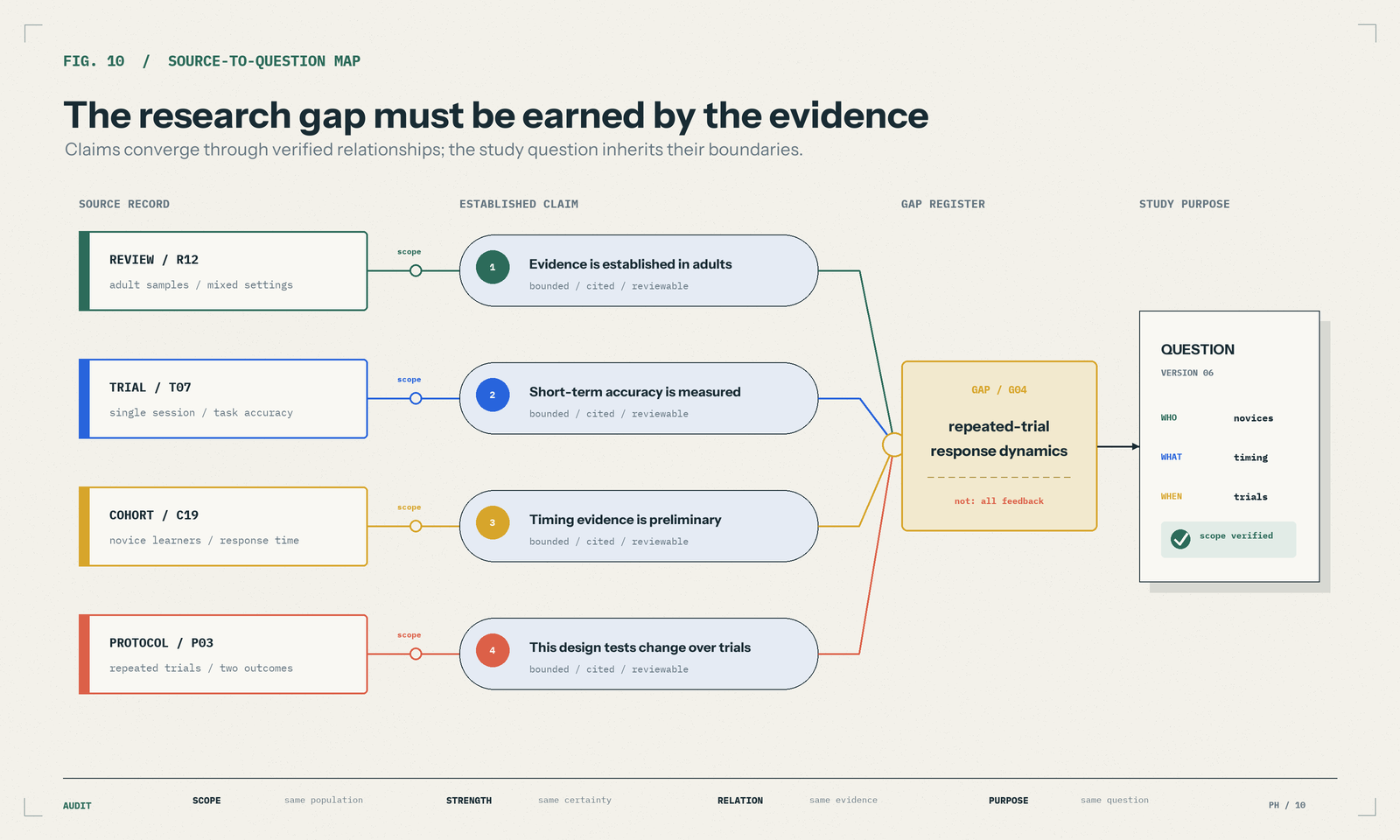
Approve the revision only when source scope, claim strength, gap type, and study purpose remain connected.
For each revised claim, verify:
- The same source still supports the same proposition
- Causal and correlational language has not changed
- Population and context qualifiers remain visible
- Conflicting or null findings have not disappeared
- The gap is no larger than the literature justifies
- The study objective still answers the stated gap
6. Replace empty transitions with reasoning
Do not vary transition words mechanically. Improve the connection itself.
Instead of adding “Furthermore,” state whether the next evidence confirms, narrows, or challenges the previous claim. Instead of “Despite these advancements,” identify the specific limitation that remains. Instead of “Therefore,” show why the gap leads to this particular question.
Natural academic flow comes from meaningful relationships between sentences, not from a larger inventory of connectors.
7. Protect the purpose statement and research questions
Keep formal research questions, hypotheses, and registered objectives outside the automated pass when exact wording matters. If they must be revised, compare them against the approved protocol word by word.
Check variables, directionality, population, comparison, and outcome. A rewrite must not change an exploratory question into a directional hypothesis or add an outcome that the methods do not measure.
The final paragraph of the introduction should align with the methodology section workflow. Every promised analysis, population, and construct needs a corresponding method.
8. Check the introduction against the whole paper
Read the revised introduction beside the abstract, methods, results, discussion, and conclusion.
Confirm that:
- The abstract describes the same problem and purpose
- The methods operationalize the introduced constructs
- The results answer the stated questions
- The discussion does not claim a different contribution
- The conclusion stays within the significance established at the beginning
An elegant introduction is still defective if it frames a study that the rest of the paper did not conduct.
Before and after: sharpen the gap without enlarging it
Generic draft
In recent years, structured feedback has become increasingly important in learning environments. Many studies have examined feedback and performance. However, there is a significant gap in the literature regarding structured feedback. Therefore, this study aims to investigate the effects of structured feedback on students.
Controlled revision
Research on structured feedback has largely measured performance after a task is complete. Less is known about how feedback changes decision time during repeated trials, particularly among novice learners. This study therefore examines whether structured feedback is associated with response time and accuracy across successive trials in an undergraduate sample.
The revision identifies a methodological and population boundary instead of declaring a vague “significant gap.” It also defines the outcomes and setting without claiming that feedback research as a whole is missing. In a real paper, each literature claim must retain its verified citation.
Special cases in introduction humanization
Systematic reviews
Preserve the review question, eligibility boundaries, and reason the synthesis is needed. Do not describe a field as inconsistent until the search and included evidence justify that characterization.
Qualitative studies
Keep the phenomenon, interpretive perspective, and context precise. Humanization must not convert an exploratory aim into a hypothesis-testing frame.
Replication studies
Do not invent novelty to make the introduction more dramatic. The value may lie in testing robustness, boundary conditions, or generalizability. State that contribution directly.
Interdisciplinary papers
Retain the meaning of technical terms in each field. Similar words may represent different constructs, and a smoother paraphrase can erase an important disciplinary distinction.
Thesis and dissertation chapters
Long introductions often contain several nested funnels at chapter and study level. Process them separately, then verify that the central problem remains consistent across the document.
Common introduction-rewrite errors
Reject or correct a revision if it:
- Claims that a topic has never been studied without proof
- Changes “limited,” “mixed,” or “emerging” evidence into “no evidence”
- Detaches a citation from the claim it supports
- Turns an association into a causal relationship
- Removes an important population or setting qualifier
- Adds significance language unsupported by the literature
- Changes a research question, hypothesis, variable, or outcome
- Promises a contribution the study design cannot deliver
- Introduces a source you have not read and verified
- Makes the introduction inconsistent with the methods
Final introduction-section checklist
- The broad context narrows toward one defined problem
- Every literature claim has the correct supporting source
- Source relationships and conflicting evidence remain accurate
- The research gap has the same type, size, and scope
- The rationale follows logically from the gap
- Novelty and significance are not overstated
- The purpose statement matches the protocol
- Questions and hypotheses retain their exact variables and direction
- The introduction aligns with the abstract and methods
- The final voice reflects the researcher's own judgment
Frequently asked questions
Can I use an AI humanizer for a research introduction?
Yes, when your institution or publisher permits language editing and you verify every source-dependent claim. Use it to improve flow and paragraph structure, not to generate evidence, citations, or a research gap.
How do I make a research introduction sound more human?
Replace generic importance statements with specific context, organize literature by relationship, name the exact uncertainty, and explain why that uncertainty leads to your question. Specific reasoning sounds more natural than varied transition phrases alone.
Can a humanizer rewrite an introduction without changing citations?
It can revise the surrounding prose, but citation verification remains your responsibility. Keep citations in the passage, compare their position afterward, and return to the original sources before approval.
What is the best tone for an academic introduction?
Scholarly tone usually fits literature synthesis and theoretical framing. Technical / STEM is appropriate for mechanism-focused or highly specialized introductions, while Standard Academic works for direct empirical reports.
How long should an introduction passage be when humanizing it?
Use one rhetorical unit at a time, usually two to four connected paragraphs. The passage should contain enough context to preserve the argument but remain short enough for a complete source-by-source review.
Should the research gap be rewritten?
Only with close verification. You may make the wording more precise, but the type, scope, population, context, and certainty of the gap must remain supported by the literature.
When the source map and gap statement are verified, open the research paper humanizer and revise one introduction unit whose evidence chain you can inspect from beginning to end.