
The best ChatGPT humanizer prompt tells the model what to preserve before it says what to change. Name the audience and purpose, protect the claims and citations, ask for specific changes to sentence structure, and require a short change log. “Make this sound human” leaves too much to guess. The five copyable prompts below give you a practical starting point for common academic tasks.
If you already have a draft and would rather work in a focused rewrite tool, try PaperHumanizer on one paragraph. You can compare its output with your original before using it.
A useful prompt gives the rewrite a job, protects what matters, and makes the result easy to review.
Copy this general ChatGPT humanizer prompt first
Replace the bracketed fields, then paste a manageable section below the prompt. Use the text as an editable instruction, not a guarantee of any detector result.
Act as an editor for [audience and assignment type].
Purpose of this passage: [one-sentence purpose].
Improve clarity, natural sentence rhythm, and the connection between ideas.
Keep my central claim, level of certainty, factual details, numbers,
quotations, citation markers, and technical terms intact.
Do not add research findings, personal experiences, sources, or citations.
Avoid stock transitions and vague claims. Vary sentence openings only where
the meaning stays the same.
Return:
1. A revised passage.
2. A brief list of material changes.
3. Any sentence where you could not preserve the original meaning confidently.

Passage:
[paste text]
The final line is as useful as the rewrite. It asks the model to show uncertainty instead of silently replacing a cautious finding with a stronger claim. Still, inspect the revision yourself; a change log can miss mistakes.
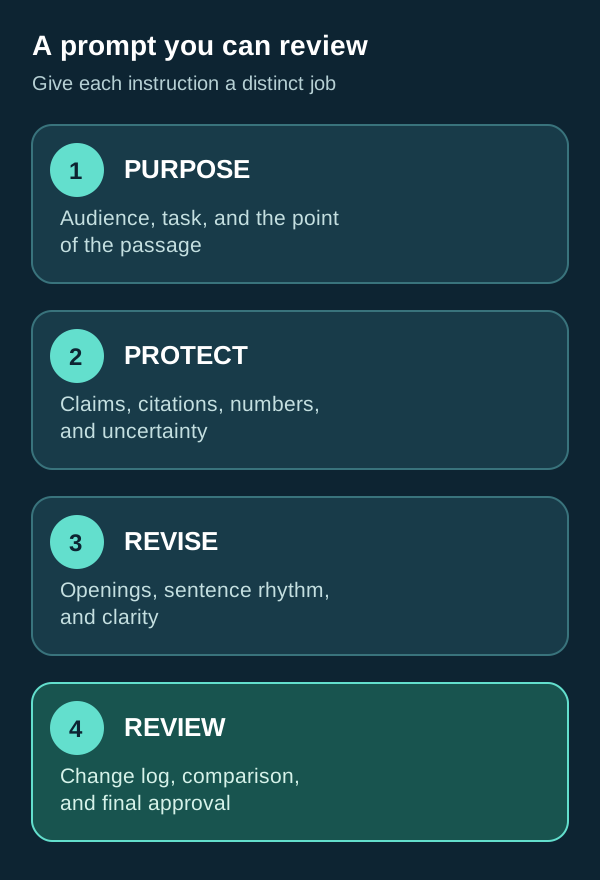
Four instructions make a rewrite prompt easier to use and easier to audit.
Five prompts for different writing tasks
Each template changes the editing target. A personal reflection needs an authentic first-person voice; a methods paragraph needs precision and restrained claims. Do not paste confidential work into a service unless your institution or organization permits it.
1. College essay paragraph: retain the student's argument
Edit this college essay paragraph for a reader who expects a clear argument
supported by my evidence. Keep my thesis, examples, citation markers, and
degree of certainty. Remove generic openers and repetitive transitions.
Use a natural academic voice without adding facts or sounding casual.
After the rewrite, identify every sentence whose claim changed.

My thesis: [insert thesis]
Paragraph: [paste paragraph]
This works best when you supply the thesis and surrounding paragraph. Without context, a model may make the sentence sound smoother while weakening its role in the argument. For a full assignment workflow, see how to make a ChatGPT essay sound human.
2. Research paper: protect citations and limitations
Revise the following research-paper passage for clarity and flow.
Keep every in-text citation, quoted phrase, number, study limitation, and
discipline-specific term. Do not invent references or turn "may suggest"
into "proves." Put the finding or claim before generic framing where possible.
Return the rewrite plus a checklist showing whether citations, numbers,
and limitations were retained.

Section role: [literature review / methods / results / discussion]
Passage: [paste passage]
The section role matters. A discussion can interpret a result; a results section should report what the data show without adding unsupported implications. Compare the output against the actual source, especially when a citation is attached to a rewritten clause. Our citation-preservation guide goes deeper.
3. Technical or STEM writing: protect exact terminology
Edit this technical paragraph for readability without changing its
scientific or engineering meaning. Preserve all variables, units, equations,
method names, thresholds, numerical values, and uncertainty language.
Shorten overly dense sentences where that improves comprehension.
Do not replace precise terminology with a simpler but less accurate synonym.
List any technical term you changed so I can verify it.

Audience: [specialist / interdisciplinary reader]
Paragraph: [paste paragraph]
In STEM writing, “natural” does not mean informal. A good revision makes the logic easier to follow while leaving the method reproducible.
4. Personal statement or reflection: preserve lived experience
Edit this personal statement for clarity and a believable first-person voice.
Keep the events, chronology, motivations, and details exactly as I wrote them.
Remove generic inspirational phrases and replace abstraction only with
details already present in my draft. Do not invent a scene, emotion,
achievement, or hardship. Flag any place where you need a detail from me.

Audience: [admissions committee / instructor]
Draft: [paste text]
A model can smooth an autobiographical passage into a template. If a specific memory is missing, you must supply it. The personal statement guide shows what to check before sending an application.
5. Discussion post: sound engaged without adding a fake opinion
Revise this course discussion post so it sounds like a thoughtful response
to the question and my classmate's point. Keep my actual position, examples,
and any source references. Cut repeated praise and generic agreement.
Do not fabricate a reading, personal experience, or quote.
End with one genuine question based on the ideas already in my draft;
if the draft does not support one, say so.

Discussion question: [paste question]
My draft: [paste text]
The last instruction prevents a polished but empty “great point” reply. For a repeatable discussion-board workflow, see the discussion post humanizer guide.
What changes when the prompt is specific?
Here is a deliberately generic illustrative draft. The named course activity below is fictional and is not presented as a real study or testimonial.
Furthermore, peer feedback plays a crucial role in enhancing the overall quality of student writing. It is important to note that students can benefit in several ways.
“Make this sound more human” might only replace furthermore with moreover and crucial role with important part. A focused prompt would ask for the actual point the writer can support:
In the workshop, peer comments helped me see that my opening claim was too broad. I narrowed it before revising the rest of the essay.
The second version works only if the workshop and revision are true. Its strength is specificity and a visible writer's decision. A model cannot infer those details reliably from the original two sentences. When the source lacks evidence, the correct move is to ask the writer for it.
| Instruction you add | What it helps you inspect |
|---|---|
| “Keep citation markers and qualifications” | Whether evidence and certainty survived |
| “Remove stock transitions” | Whether the paragraph opens with a real claim |
| “Do not add experiences or sources” | Whether the model invented support |
| “List material changes” | Where manual comparison should begin |
Why a prompt can still fall short
Even a detailed ChatGPT prompt is only an instruction to a general assistant. It may follow constraints unevenly across a long document, overlook a citation, or produce uniformly polished prose again. A prompt also cannot tell you whether a detector will classify the new text differently. If your concern began with a report, first understand what its AI percentage means.
For short passages, prompting is often enough. For repeated academic rewriting, PaperHumanizer offers a more focused workflow: choose the writing context, revise the passage, then use Input, Output, and Compare views to check the result. Our ChatGPT humanizer guide explains the writing patterns to watch for; the PaperHumanizer versus ChatGPT and Gemini comparison discusses where each approach is useful.
Compare your next rewrite in PaperHumanizer →
If you are revising multiple sections, check pricing and credit options before you begin. Work section by section so the introduction, evidence, methods, and conclusion keep their distinct roles.
A final review checklist
- Does the revised claim mean exactly what the original claim meant?
- Are all quotations, citation markers, numbers, units, and names present?
- Did “may,” “could,” or “suggests” become a stronger assertion?
- Did the tool introduce an event, source, or experience you did not provide?
- Does the paragraph still answer the assignment's actual question?
- Can you explain every sentence as your own work under your institution's policy?
If a rewrite fails one of these checks, edit it or return to your notes. A natural voice comes from a precise point of view and evidence the writer understands.
Frequently asked questions
What is the best prompt to make ChatGPT text sound human?
There is no single best prompt for every document. Start with the general template above, then add the assignment, audience, protected facts, and the specific writing problem you see. Review the resulting text against your source.
Can I ask ChatGPT to humanize a whole essay at once?
You can, but section-by-section review makes it easier to spot changed claims and missing citations. Give each section its role and keep the original beside the rewrite.
Will these prompts bypass Turnitin or GPTZero?
No prompt can guarantee a third-party score. Use prompts to improve the writing while protecting meaning and attribution. Follow the rules that apply to your assignment or publication.