An AI rewriter for students is most useful after the student has already decided what the assignment should say. The draft may need clearer structure, more natural academic language, or a tone that fits the course, but the prompt response, evidence, citations, and intellectual decisions must remain under the student's control.
That distinction matters in college writing. Rewriting is not a substitute for reading the assigned material, building an argument, or following an instructor's AI policy. It is a language-revision step that should make existing work clearer without introducing unsupported content.
This guide explains how U.S. college students can revise AI-assisted writing responsibly across essays, discussion posts, research assignments, and lab reports.
Revise one college assignment section with PaperHumanizer
What students search for in an AI rewriter
Common searches include ChatGPT rewriter for students, rewrite AI text for college, and make AI writing sound human for school. Behind those phrases are several practical needs:
- A ChatGPT-assisted draft sounds generic or overly polished
- The paper uses vocabulary that does not match the student's course level
- Every paragraph follows the same predictable structure
- An assignment needs a more scholarly or more technical tone
- Citations must remain attached to the correct source claims
- A discussion post sounds like a formal essay rather than a class response
- The writing needs revision without changing the thesis or prompt response
A useful academic rewriter must support control and verification. A fluent output is not enough if it changes what the student argues or invents evidence.
Students moving from coursework into applications can use the same evidence-first principle in a personal statement or an AI-assisted cover letter, where invented experience creates an even more immediate risk.
What an AI rewriter can and cannot do
Appropriate language-revision tasks
- Improve sentence flow and paragraph transitions
- Reduce repetitive or generic framing
- Adjust tone to fit the assignment type
- Clarify the student's existing argument
- Vary sentence structure when the draft is mechanically uniform
- Make relationships among claim, evidence, and analysis easier to follow
Tasks that remain the student's responsibility
- Reading and understanding assigned sources
- Choosing a thesis or position
- Verifying facts, quotations, and citations
- Providing personal experiences and reflections
- Completing calculations, analysis, or research
- Deciding whether AI use is permitted and whether disclosure is required
The boundary is simple: the tool can help revise language, but it cannot assume ownership of the academic work.
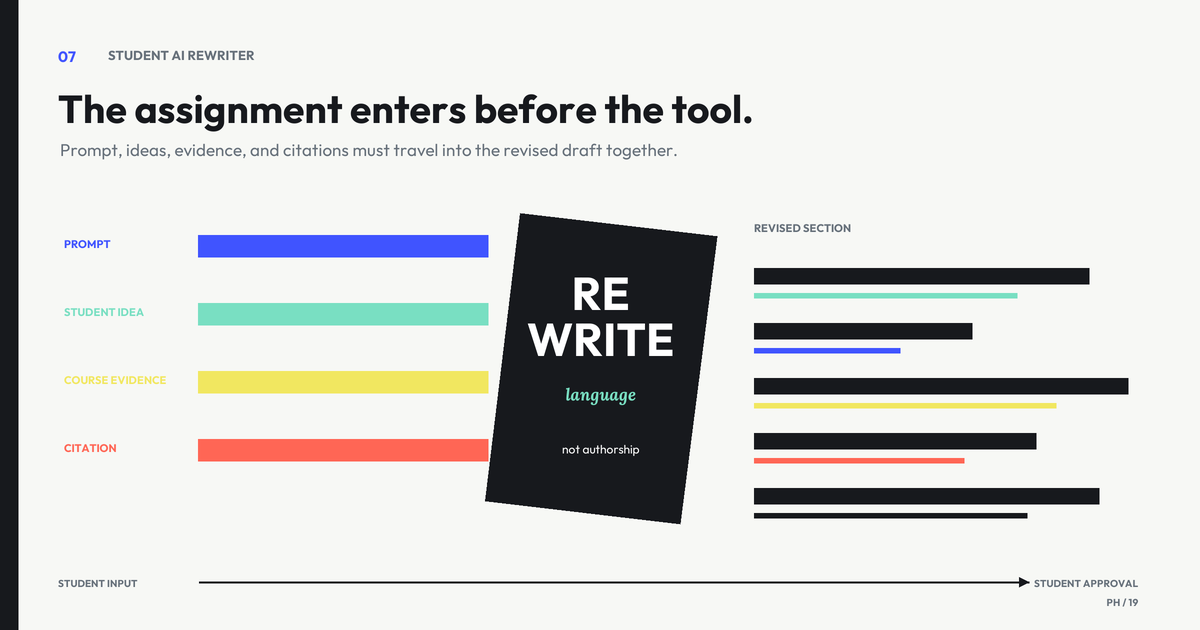
The assignment, student ideas, evidence, and citations enter the revision together; none can be replaced by smoother wording.
Before using an AI rewriter for college work
Create a short assignment control sheet.
| Control point | Questions to answer |
|---|---|
| Prompt | What exact action does the instructor require? |
| Course material | Which readings, lectures, cases, or data must appear? |
| Thesis or answer | What position or conclusion does the student defend? |
| Evidence | Which quotation, example, result, or detail supports each point? |
| Citation style | Does the assignment require MLA, APA, Chicago, or another format? |
| Student contribution | Which interpretation, choice, or experience belongs to the student? |
| AI policy | Is editing allowed, prohibited, or subject to disclosure? |
If any answer is missing, complete that academic work before language revision. A rewriter should not fill the gap with generic content.
How to use an AI rewriter for students step by step
1. Read the AI policy first
AI policies vary across universities, departments, courses, and individual assignments. One instructor may allow grammar and style assistance; another may prohibit all generative tools; a third may permit them with disclosure.
Check the syllabus, assignment page, academic integrity guidance, and any statement from the instructor. When the boundary remains unclear, ask before using the tool.
2. Confirm the draft is factually usable
Review the draft before improving its style. Check:
- Whether quotations exist in the cited source
- Whether page numbers and publication details are accurate
- Whether a study actually supports the claim
- Whether names, dates, formulas, and data are correct
- Whether the response addresses the assigned question
- Whether examples come from the course or the student's own work
Do not humanize fabricated citations or unsupported claims into more convincing prose.
3. Map the assignment structure
Write one line for each section or paragraph. For an essay, the map might include introduction, three analytical moves, counterargument, and conclusion. For a lab report, it might include purpose, method, results, and interpretation.
The map helps detect structural drift. If a revised paragraph stops serving its assigned purpose, return to the original function before editing the style.
4. Process one coherent section at a time
Paste a meaningful unit into PaperHumanizer: one developed paragraph, a connected paragraph pair, an introduction, a conclusion, or one technical subsection.
Small passages are easier to verify than an entire long paper. Avoid isolated sentences when context determines pronouns, citations, or transitions. The paragraph humanizer guide and sentence humanizer guide explain how to choose the right unit.
5. Match the tone to the class
Use Standard tone for first-year composition, general education assignments, and direct discussion posts. Scholarly tone fits upper-level humanities, theory, and research synthesis. Technical / STEM is designed for lab reports, engineering, quantitative methods, and measurement-focused prose.
Tone should remain consistent across the paper. A highly polished scholarly paragraph inside an otherwise direct first-year essay may sound less authentic, not more.
6. Compare the result with the control sheet
Review the original and rewritten passage side by side. Check in this order:
- Prompt response
- Thesis or central answer
- Paragraph function
- Evidence and factual details
- Citation relationship
- Course terminology
- Qualification and uncertainty
- Student voice and natural flow
If an earlier item changes, fix it before judging the style.
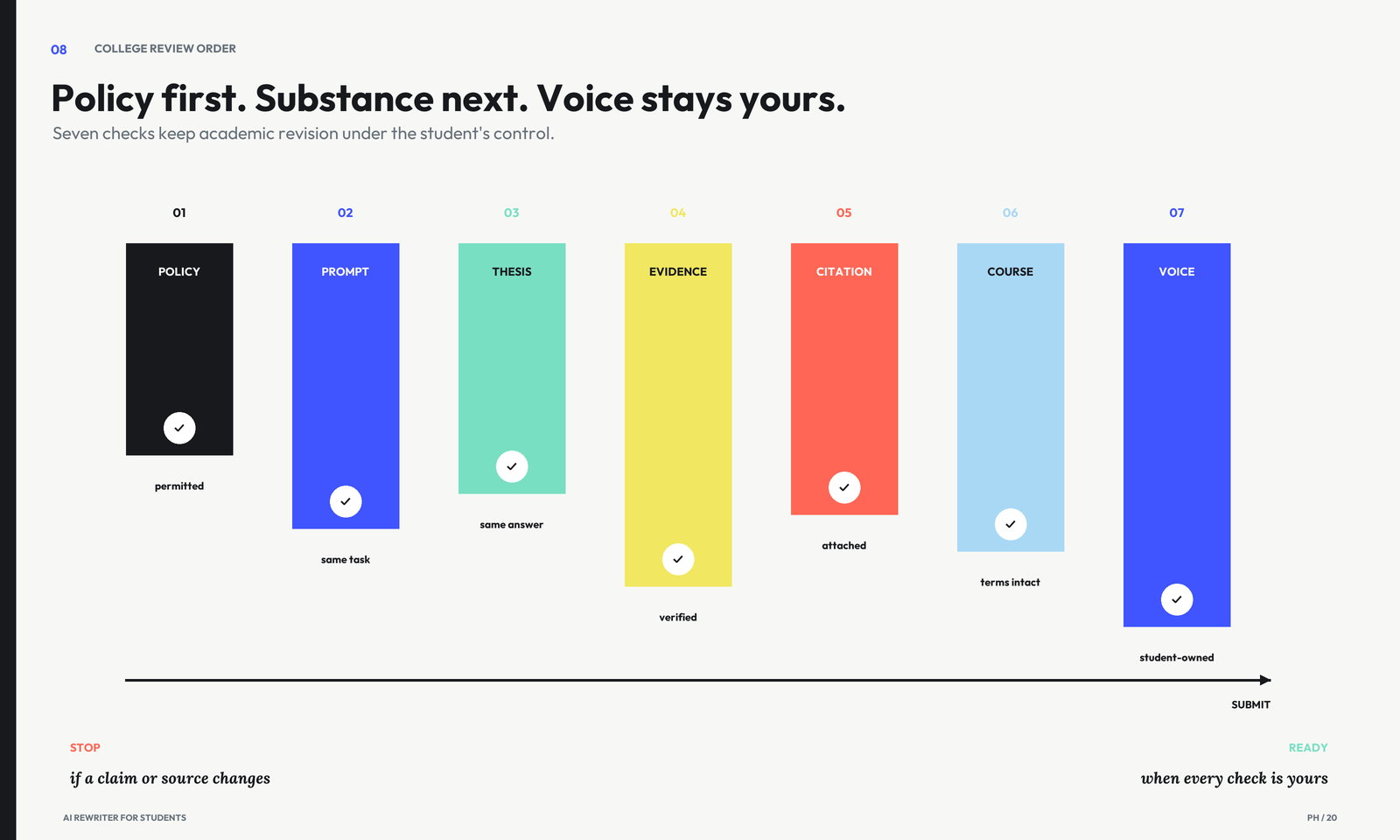
Confirm policy first, review academic substance next, and keep the student's voice in control throughout the process.
7. Restore course-specific detail
Generic AI prose becomes more useful when the student reconnects it to the course:
- Name the relevant concept from the lecture
- Refer to the assigned passage or case
- Explain why one example matters more than another
- Add a limitation discussed in class
- Connect the analysis directly to the prompt
- Use vocabulary the course defines precisely
Do not insert random personal details merely to appear human. Add only information that is true, relevant, and genuinely part of the student's work.
8. Run a final source and citation check
Open every source used in the revised passage. Confirm that the citation supports the revised wording and that quotations remain exact.
Review formatting separately:
- MLA author and page references
- APA author-year pairs and quotation page numbers
- Chicago footnote or endnote order
- Reference-list entries
- Links or access dates when required
Use the citation-preservation workflow for research-intensive papers.
9. Read the final assignment aloud
A read-aloud pass reveals abrupt tone shifts, overly long sentences, repeated transitions, and language that the student would not naturally use.
Ask:
- Would I explain the idea this way in class?
- Can I define every technical term I used?
- Does the paragraph sound like the same writer as the rest of the paper?
- Could I defend every claim if the instructor asked about it?
If the answer is no, revise before submission.
Before and after: rewrite AI text for college
Generic AI-assisted version
The concept of the hidden curriculum plays a significant role in shaping the educational experiences of college students. Furthermore, it encompasses the unwritten norms and expectations that students must navigate in order to achieve academic success. This demonstrates that educational outcomes are influenced by a wide variety of factors beyond formal instruction.
Controlled student revision
The hidden curriculum includes expectations that colleges rarely state directly, such as knowing when to visit office hours or how to ask for an extension. Students who already understand these practices may appear more prepared even when their academic ability is similar to that of their classmates. The concept therefore helps explain why access to information about college routines can shape performance alongside formal instruction.
The revision keeps the course concept but replaces generic importance language with specific institutional practices and a clearer analytical relationship. A student should retain only examples that fit the assigned reading and class discussion.
Using an AI rewriter for different assignment types
College essays
Protect the thesis, evidence, counterargument, assignment genre, and word-count range. Process body sections separately when the paper contains several sources.
Discussion posts
Use direct language and respond to the actual question. Retain references to the reading and, when required, engage substantively with classmates rather than producing a generic mini-essay. The discussion post humanizer guide includes a complete initial-post example, a peer-reply example, and a prompt-evidence-response checklist.
Research papers
Map every source to a claim. Preserve population, method, uncertainty, and differences among studies. Verify citations after every revision pass.
Lab reports
Keep procedures, values, units, statistical notation, table references, and result direction exact. Standardized reporting may legitimately sound repetitive and should not be varied at the expense of accuracy.
Personal statements and reflective assignments
The experience, motivation, and perspective must come from the student. A rewriter may clarify existing language but should never create a personal story or emotion.
Group projects
Agree on terminology and tone before combining sections. Do not use rewriting to conceal inconsistent claims or sources among contributors.
AI rewriter versus essay generator
An essay generator creates content from a prompt. An AI rewriter works with text and reasoning the student already has. The second use allows more control, but it still requires careful review and compliance with course policy.
A responsible workflow looks like this:
Student reasoning and evidence → language revision → comparison → student approval
It should not become:
Assignment prompt → generated submission
The student's ability to explain and defend the final work remains essential.
AI rewriter versus paraphrasing tool
A paraphrasing tool usually focuses on restating wording. An academic AI rewriter may also improve organization, cadence, tone, and transitions. Neither removes the need to cite ideas from a source or to use quotation marks around exact language.
The humanizer versus paraphraser guide shows the difference with a paragraph-level example. For an assignment built around a specific record and recommendation, use the case study humanizer workflow to keep facts separate from interpretation.
Do not use rewriting to evade plagiarism review. Source attribution and originality of thought remain separate from whether a sentence sounds natural.
Common mistakes students should avoid
Reject or correct a revision if it:
- Changes the answer to the assignment prompt
- Adds a source, quotation, example, or fact that was not verified
- Makes a claim more certain than the evidence allows
- Removes a counterargument or limitation
- Replaces a required course term with generic language
- Moves a citation to a different claim
- Invents a personal experience or reflection
- Makes the tone substantially more advanced than the student's understanding
- Introduces formatting that conflicts with the assignment
- Violates the instructor's stated AI policy
Final college-assignment checklist
- The draft answers the exact prompt
- The thesis and paragraph functions remain unchanged
- Every fact, quotation, number, and source is verified
- Citations still support the same claims
- Course concepts are used accurately
- The student can explain every sentence and term
- Personal details are true and student-authored
- Tone is consistent with the assignment and course level
- Formatting and word count meet the instructions
- AI use complies with policy and disclosure requirements
Frequently asked questions
What is the best AI rewriter for students?
The best option for academic work should preserve meaning, support passage-level revision, offer appropriate academic tones, and make comparison easy. Students still need to verify sources, citations, and policy compliance.
Can an AI rewriter make ChatGPT writing sound more natural?
It can improve repetitive structure, generic transitions, cadence, and tone. The student should then restore course-specific analysis and verify that the argument and evidence remain accurate.
Can I use an AI rewriter for a college assignment?
Only when the applicable instructor or institutional policy permits it. Some courses allow language editing, while others restrict or require disclosure of AI assistance.
Will an academic AI rewriter preserve citations?
It can retain citation text and placement, but the student must confirm that the rewritten claim is still supported by the source and formatted correctly.
Should students rewrite an entire paper at once?
Short assignments may be manageable in one pass. For longer or sourced work, revise one coherent section at a time so meaning, citations, and paragraph function can be reviewed closely.
How is an AI rewriter different from a grammar checker?
A grammar checker focuses on mechanical correctness. A rewriter can change syntax, cadence, tone, and organization, which creates a larger need for meaning verification.
Open the academic AI rewriter and begin with one assignment section whose prompt, evidence, and citations you can fully check.