
Sometimes one sentence makes an otherwise natural college paper sound machine-written. It may be too balanced, overly formal, packed with generic transitions, or noticeably different from the student's surrounding prose. A sentence humanizer helps revise that local problem without requiring a rewrite of the entire paragraph.
The task sounds simple, but a sentence can carry a claim, qualification, citation, technical term, and logical relationship at the same time. Changing its structure safely means preserving all of those functions while improving its cadence and clarity.
This guide explains how to humanize a sentence without changing its meaning, when sentence-level editing is appropriate, and when more paragraph context is necessary.
Humanize an academic sentence with PaperHumanizer
What students expect from a sentence humanizer
Students searching for an AI sentence humanizer usually have a specific problem rather than a completely unusable draft:
- A sentence sounds more formal than the rest of the assignment
- ChatGPT produced a predictable “not only...but also” construction
- The same transition appears in several consecutive paragraphs
- A sentence is long, abstract, and difficult to read aloud
- An instructor marked the wording as vague or awkward
- The meaning is correct, but the sentence does not sound like the student
- A citation or technical term must remain exactly where it belongs
The goal is not merely to substitute synonyms. Natural revision changes how information arrives: which detail comes first, where the emphasis falls, whether two ideas belong in one sentence, and how the sentence connects to what surrounds it.
Why individual AI sentences sound generated
AI-assisted sentences often use grammatically correct but highly predictable structures. Common examples include:
- “It is important to note that...”
- “This highlights the significance of...”
- “By examining X, it becomes evident that Y...”
- “Not only does X affect Y, but it also influences Z...”
- “This multifaceted issue underscores the need for...”
- “In today's rapidly evolving society...”
These expressions are not automatically wrong. They become noticeable when they replace a direct claim or appear repeatedly across a paper.
Other patterns occur below the phrase level:
- Several clauses with equal length and weight
- Abstract nouns replacing concrete actions
- A general opening followed by a predictable conclusion
- Unnecessary restatement of the previous sentence
- Hedging that obscures rather than calibrates the claim
- A polished rhythm that does not match nearby student writing
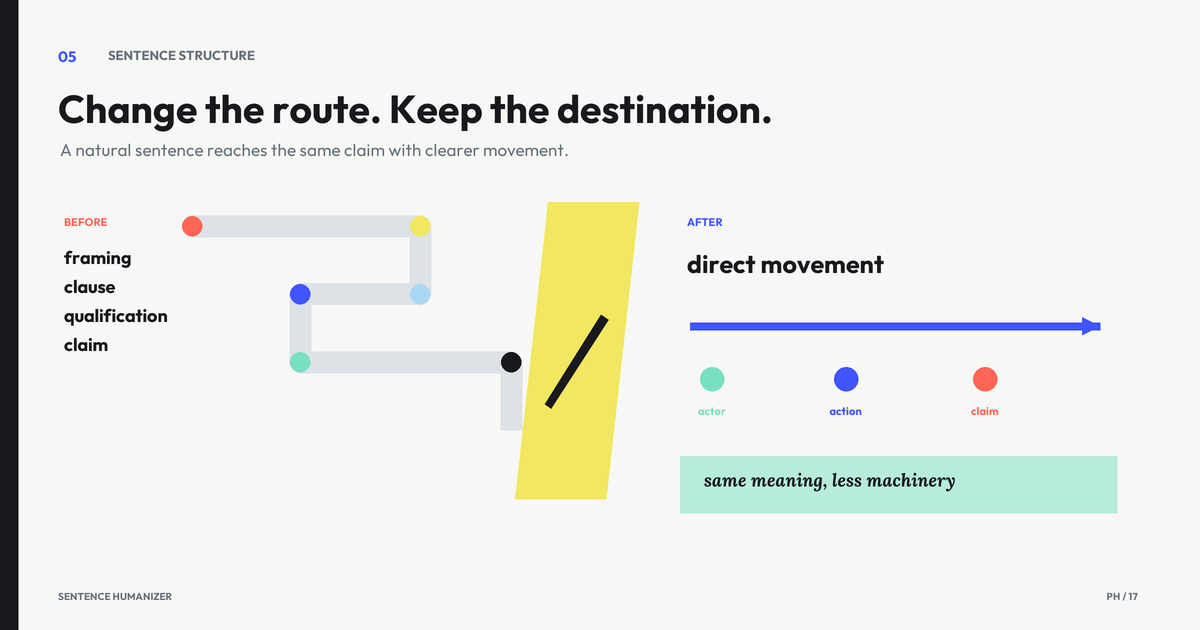
Sentence structure can change while the claim, scope, and logical relationship remain fixed.
What must remain unchanged when humanizing a sentence
Before revising, identify the sentence's protected content.
| Protected element | What to verify |
|---|---|
| Core proposition | Who or what does what, and under which conditions |
| Claim strength | Whether the sentence states, suggests, associates, or causes |
| Scope | Population, period, setting, text, case, or measured outcome |
| Logical relationship | Contrast, cause, comparison, qualification, sequence, or example |
| Evidence | Numbers, names, dates, quotations, and factual details |
| Citation | Source, placement, page number, and supported proposition |
| Technical language | Required terminology, variables, units, and course concepts |
A revision that keeps the topic but changes “may be associated with” to “causes” does not preserve meaning. Neither does replacing “participants in one introductory course” with “college students.”
How to humanize a sentence step by step
1. Identify what the sentence is doing
Label its function before editing:
- Making a claim
- Reporting evidence
- Interpreting a source
- Defining a term
- Qualifying an earlier point
- Comparing two cases
- Connecting paragraphs
The revision must perform the same job. A sentence that originally qualifies a claim should not become a stronger summary simply because the stronger version sounds cleaner.
2. Reduce the sentence to a meaning statement
Write the protected meaning in plain language. For example:
The study found an association in one sample, but it did not test causation.
This note does not need to sound polished. It gives you a reference point for evaluating the rewritten sentence.
3. Include enough surrounding context
An isolated sentence may contain pronouns, transitions, or repeated terms that make sense only inside the paragraph. When using PaperHumanizer, include the sentence before and after the target when context affects meaning.
Process the whole paragraph when:
- The sentence contains “this,” “these findings,” or “however”
- Its citation supports a claim developed across two sentences
- Splitting the sentence would change paragraph emphasis
- The problem is repeated rhythm rather than one awkward construction
Use the paragraph humanizer workflow for these broader cases.
4. Choose the tone that matches the assignment
Use Standard tone for first-year writing, general college essays, discussion posts, and direct explanations. Choose Scholarly for advanced interpretation and literature-based work. Use Technical / STEM for lab reports, methods, results, and sentences containing measurement language.
Do not make one sentence substantially more formal than the rest of the paper. The academic tone guide explains how to keep modes consistent.
5. Compare structure and meaning separately
First confirm the protected content. Then assess whether the new structure is better.
Check content in this order:
- Actor or subject
- Action or relationship
- Object or outcome
- Conditions and qualifiers
- Evidence and citation
- Connection to surrounding sentences
Only after these pass should you evaluate rhythm, readability, and voice.
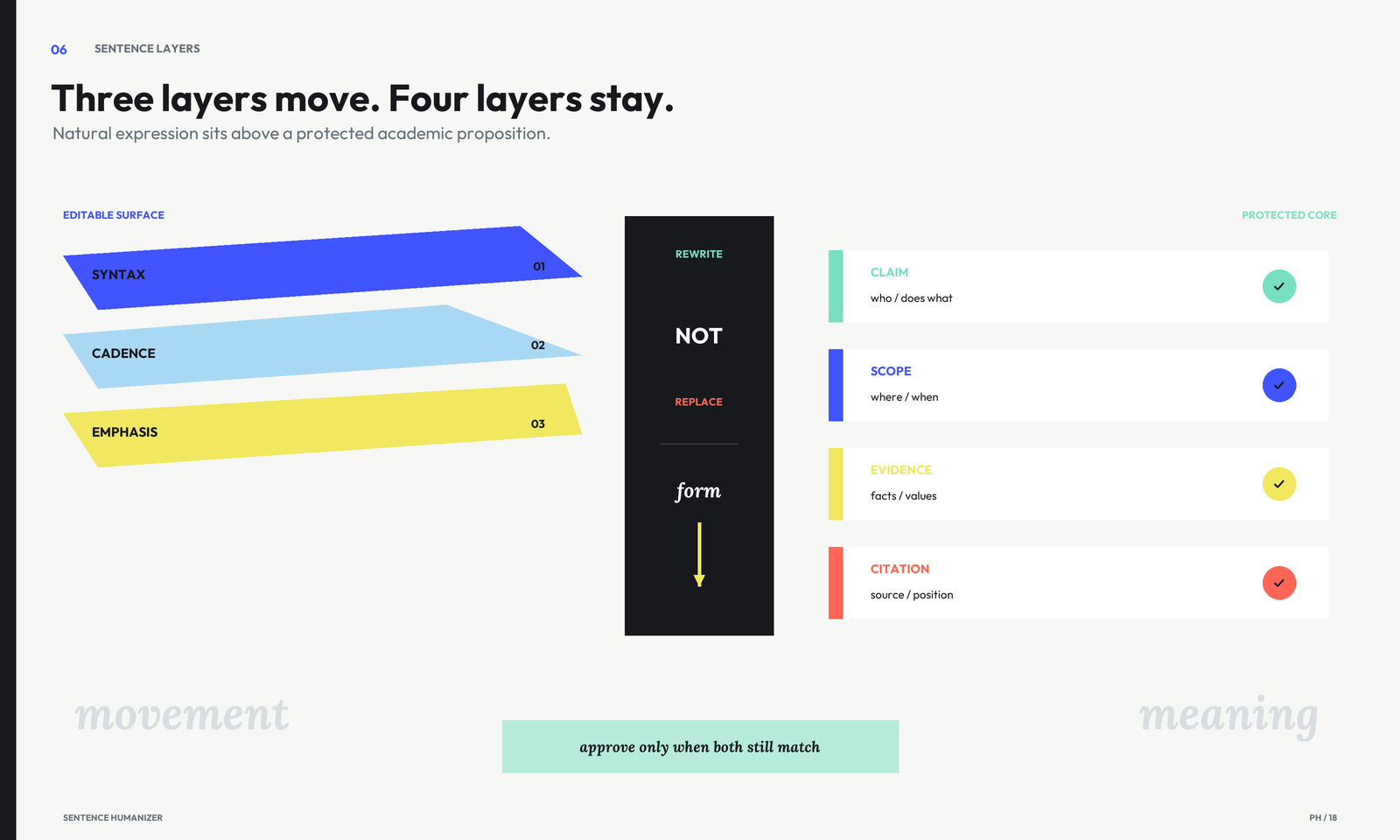
Claim, scope, evidence, and citation are fixed layers; syntax, cadence, and emphasis are the editable surface.
6. Read the sentence aloud inside the paragraph
Do not judge the rewritten sentence alone. Read the previous sentence, the revision, and the following sentence aloud.
Listen for:
- An abrupt change in vocabulary or formality
- A repeated sentence opening
- A transition that announces an obvious relationship
- Too many long sentences in sequence
- A short sentence that creates useful emphasis or an accidental interruption
- Repetition that the sentence-level view did not reveal
The most natural version is the one that belongs in the paragraph, not necessarily the most impressive sentence by itself.
7. Restore the student's specific judgment
Generic AI sentences often conceal the student's actual decision. Replace a broad phrase such as “This highlights the importance of the issue” with the precise reason the example matters to the argument.
Useful questions include:
- What exactly does this evidence change?
- Why is this example included here?
- What limitation should the reader notice?
- Which course concept explains the relationship?
- How does this sentence advance the thesis?
Specific judgment improves both naturalness and academic value.
Before and after: rewrite a sentence without changing meaning
AI-sounding sentence
It is important to note that the implementation of flexible deadlines can significantly contribute to the enhancement of student well-being by providing individuals with additional opportunities to manage their academic responsibilities effectively.
Controlled revision
Flexible deadlines may support student well-being by giving students more control over when they complete competing academic responsibilities.
The revision removes framing and nominalized language while preserving the cautious relationship: deadlines may support well-being. It does not claim that flexible deadlines guarantee better outcomes.
When to split one sentence into two
Splitting is useful when a sentence performs two distinct jobs, contains several layers of qualification, or buries its main point inside an introductory clause.
Before
Although online courses can expand access for students whose schedules prevent regular campus attendance, their reliance on independent planning, which is not equally familiar to all learners, may create additional barriers that institutions need to address.
After
Online courses can expand access for students whose schedules prevent regular campus attendance. However, the same courses may create barriers for learners who have had fewer opportunities to develop independent planning strategies.
The split makes the contrast visible. It must retain “may” and the defined group rather than generalizing the limitation to every online learner.
When two sentences should become one
Combining can remove artificial repetition when two short sentences state one relationship.
Before
The narrator avoids naming the event directly. This avoidance shows that the memory remains difficult to confront.
After
By avoiding a direct name for the event, the narrator suggests that the memory remains difficult to confront.
The combined sentence preserves the interpretation and makes the evidence-to-analysis relationship more explicit.
Sentence humanizer versus grammar checker
A grammar checker focuses on correctness: agreement, punctuation, spelling, usage, and sometimes clarity. A sentence humanizer addresses expression patterns such as uniform structure, generic framing, predictable emphasis, and mismatch with the surrounding voice.
Both can be useful, but they answer different questions:
- Grammar checker: Is the sentence mechanically correct?
- Sentence humanizer: Does the sentence express this student's meaning naturally in context?
Run the final draft through the required spelling and grammar review after humanization, especially if your course expects a particular style guide.
Sentence humanizer versus paraphraser
A paraphraser is often used to restate a passage. A humanizer should preserve the student's own meaning while improving cadence, directness, emphasis, and fit with the document.
Neither tool should be used to disguise copied language. Cite ideas that come from a source, retain quotation marks around exact wording, and follow the academic integrity rules for the course.
Using a sentence humanizer across college assignments
Essays
Protect thesis language, textual evidence, counterarguments, and source attribution. Match the sentence to the student's established voice.
Discussion posts
Prefer direct, conversational academic language. Retain specific references to the assigned reading and the question posed by the instructor.
Research papers
Preserve source relationships, population, uncertainty, and technical terminology. Keep citations attached to the same propositions.
Lab reports
Verify every number, unit, variable, condition, and outcome direction. Use Technical / STEM tone and avoid changing conventional reporting language solely for variety.
Personal and reflective writing
Do not allow a rewrite to invent an experience, emotion, motivation, or biographical detail. The content must remain the student's own.
Common sentence-humanization mistakes
Reject or correct a revision if it:
- Changes the actor, action, outcome, or condition
- Makes a cautious claim more certain
- Removes a limitation or exception
- Replaces a technical or course term with a loose synonym
- Alters a number, quotation, name, date, or unit
- Moves a citation away from the claim it supports
- Creates a sentence that sounds unlike the surrounding paper
- Adds a new example or interpretation
- Fixes rhythm while making the sentence less precise
- Uses complexity as a substitute for real analysis
Final sentence checklist
- The sentence performs the same academic function
- The proposition and logical relationship are unchanged
- Scope and certainty remain accurate
- Evidence, quotations, and technical details are exact
- Citations still support the revised wording
- The sentence connects naturally to its neighbors
- Vocabulary matches the course and the rest of the paper
- The revision is clearer when read aloud
- No source material has been disguised as original writing
- The final use follows the instructor's AI policy
Frequently asked questions
What is a sentence humanizer?
A sentence humanizer revises mechanical or AI-assisted wording to improve syntax, cadence, directness, and natural flow while preserving the original proposition and context.
Can I humanize a sentence without changing its meaning?
Yes, when you explicitly protect the actor, action, relationship, scope, evidence, and degree of certainty. Compare these elements before accepting the revision.
How do I make a ChatGPT sentence sound human?
Remove generic framing, identify the sentence's actual job, use more direct verbs, vary the information order, and restore a specific connection to the assignment or source.
Should I humanize one sentence or the whole paragraph?
Use one sentence when the problem is truly local. Include the paragraph when pronouns, transitions, citations, or repeated rhythm depend on surrounding context.
Can a sentence humanizer preserve citations?
It can retain citation text, but the student must confirm that the revised claim is still supported by the cited source and that the citation remains correctly placed.
Is sentence humanization allowed for college work?
Policies vary. Some instructors permit language editing but not content generation; others require disclosure or prohibit AI assistance. Follow the policy for the assignment and ask when uncertain.
Open the academic sentence humanizer and begin with a sentence whose meaning and surrounding context you can verify.