
A case study humanizer should change the way your analysis reads without changing what happened in the case. The timeline, numbers, stakeholder positions, source details, and recommendation logic are the load-bearing parts of the assignment. Rewrite the prose around them; do not let smoother language quietly create a new case.
AI-assisted case-study drafts often sound generic because they summarize a situation, list “pros and cons,” and offer a recommendation that could fit almost any organization. Good revision makes the causal chain visible: this fact matters because it changes this decision. PaperHumanizer can help make that explanation less formulaic, while you remain responsible for the facts and judgment.
Revise a case-study passage with PaperHumanizer →

A useful case analysis connects evidence to interpretation and then to a decision; those connections must survive any rewrite.
What makes a case study different from a generic essay?
An essay may develop an argument through outside research. A case study starts with a bounded situation: a particular company, patient, classroom, policy decision, or technical failure. Your reader expects you to distinguish three layers:
| Layer | Typical content | What a rewrite must protect |
|---|---|---|
| Case record | Dates, participants, constraints, events, figures, quoted statements | Exact facts and their source |
| Analysis | Why the events matter; plausible causes; trade-offs | Degree of certainty and competing explanations |
| Recommendation | A justified action under the case constraints | Decision criteria, feasibility, and limitations |
Blurring these layers is a common AI-writing problem. A generated draft may present a possible explanation as an established fact, or propose a sensible-sounding solution without showing how the case evidence supports it. A fluent rewrite can make this worse if it removes uncertainty words such as “might,” “appears,” or “based on the available record.”
The case-study rewrite map
Before using any rewriting tool, make a small evidence map. You do not need a complicated spreadsheet; three columns in a notebook are enough.
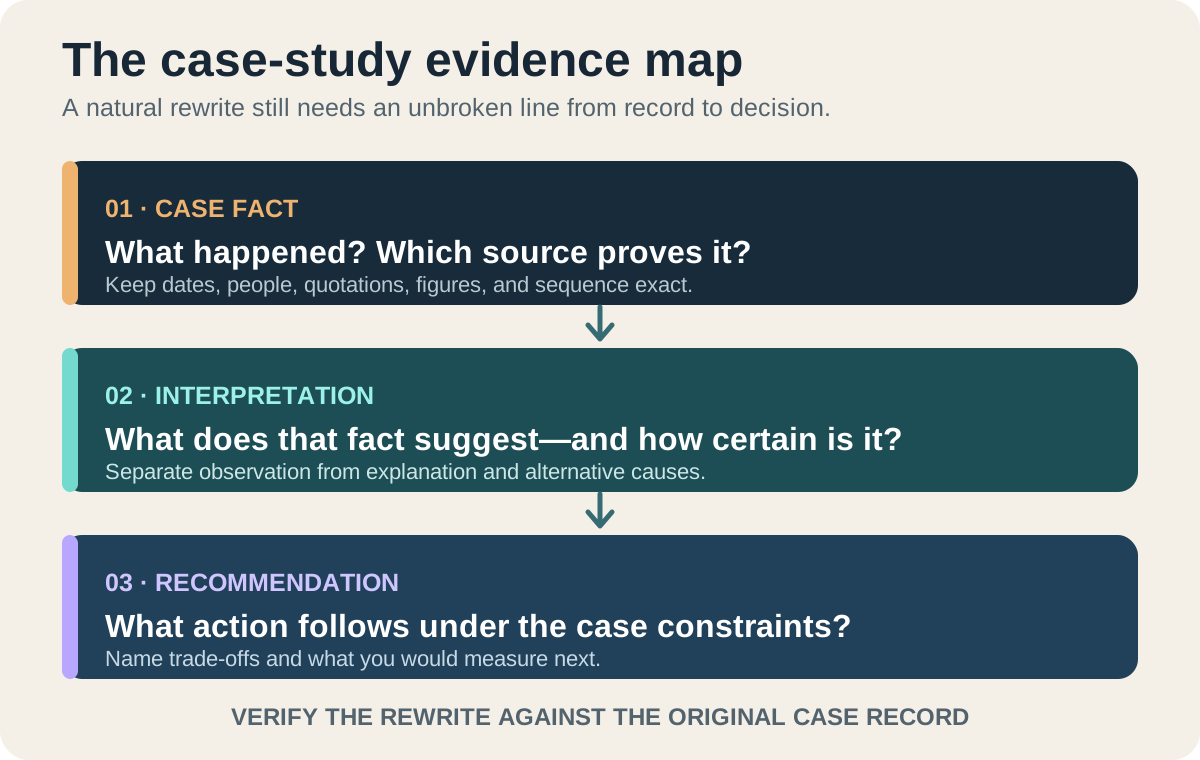
The case record is the anchor. Interpretations and recommendations can be rephrased, but they still need a visible route back to evidence.
For each paragraph, write down:
- The fact: Which event, quotation, measurement, or case document is being used?
- The inference: What do you think the fact suggests? Is that certain or only plausible?
- The decision: What action follows, and under which constraints?
- The citation: Where will a reader verify the claim?
This map lets you judge the output by something stronger than “it sounds better.” It also makes it easier to spot a rewrite that silently substitutes a different actor, date, or outcome.
Before and after: a case-study paragraph
Imagine a fictional university help desk that introduced a chatbot. The case record says that average first-response time fell from 18 hours to 6 hours, while unresolved complex tickets increased. These figures are invented solely for this writing example; they are not a real case or a PaperHumanizer performance result.
Generic AI-assisted draft
The implementation of the chatbot had a significant impact on the university's support operations. It improved efficiency and enhanced the student experience by providing rapid responses. However, challenges remained, and the university should adopt a balanced strategy to optimize its support services.
The paragraph could describe almost any chatbot pilot. It says “student experience” improved without evidence, does not identify the trade-off, and ends with a recommendation too vague to assess.
More useful case-specific revision
The chatbot shortened the average first response from 18 hours to 6, but the case does not show that students received better solutions. Complex tickets were more likely to remain unresolved. The help desk should keep the chatbot for routine questions and route exceptions to staff sooner, then measure resolution time—not just first-response time—during the next trial.
The revision separates an observed fact from an inference, names the unresolved-ticket problem, and proposes a testable action. In a real assignment, the writer must verify the numbers, define “complex,” cite the case, and check whether the recommendation fits the budget and staffing constraints.
| Check | Generic draft | Revised draft |
|---|---|---|
| Case fact | Hidden | Response-time change stated |
| Unsupported leap | “Enhanced student experience” | Says that outcome is not established |
| Trade-off | “Challenges remained” | Unresolved complex tickets named |
| Recommendation | “Balanced strategy” | Routine automation plus staff escalation |
| Remaining work | Most claims need support | Metrics, citation, and feasibility still need checking |
The goal is not to make every sentence shorter. It is to make each sentence do a clear job.
How to humanize a case study step by step
1. Mark the facts that cannot move
Highlight names, dates, numbers, sequence of events, quotations, and source references. Include negative facts too: “the pilot did not include graduate students” is just as important as a positive outcome. If you are working from a PDF, our PDF humanization guide explains why extraction and formatting need a separate review.
2. Identify the assignment's question
Is the task asking you to diagnose a failure, compare options, recommend a policy, or apply a theory? A rewrite should make the response to that question clearer. It should not turn a diagnostic analysis into a promotional success story or a recommendation into a neutral summary.
3. Divide the draft by writing function
Keep the case summary, diagnosis, alternatives, and recommendation as separate passes when possible. Each has a different risk:
- Summary: a date, person, or event may be altered.
- Diagnosis: a hypothesis may become a fact.
- Alternatives: a cost or constraint may disappear.
- Recommendation: a broad promise may replace a qualified decision.
A short passage can be revised as one unit, but do not paste unrelated case notes and expect a tool to infer which statements are evidence and which are your interpretation.
4. Revise for natural academic voice
Use the PaperHumanizer writing tool on a section that already has your argument and evidence. Choose a tone that fits the discipline. Business cases often benefit from direct, decision-oriented prose; healthcare or social-work cases may require more cautious language; technical cases need precise terminology.
PaperHumanizer returns a completed rewrite that you can review side by side with the original. Quality here means a clearer, defensible case analysis, not just a more polished sentence or a particular score.
5. Perform a fact-by-fact comparison
Read the original and the rewrite together. Check not only the nouns and numbers but the relationships:
- Did an action occur before or after the outcome?
- Did one stakeholder's view become the whole organization's position?
- Did a correlation become a causal claim?
- Did “could,” “may,” or “appears” become “will” or “proves”?
- Does the proposed action still address the problem identified by the evidence?
If the rewrite fails one check, edit that sentence manually. A humanizer is a drafting aid, not an authority on the case record.
Try the workflow on one case paragraph →
Four patterns that make AI case studies sound generic
The case is described with no decision pressure
“Organizations face many challenges in the modern era” says nothing about this case. Replace the scene-setting with the constraint that matters: a deadline, an understaffed team, a disputed finding, or a limited budget.
The analysis repeats the facts without interpreting them
A timeline is necessary, but it is not an analysis. After a fact, ask: “What does this rule out or make more likely?” If the answer is uncertain, state the uncertainty.
Every alternative is equally attractive
Generated prose often praises every option. A case recommendation has to choose. Explain the criteria—cost, risk, speed, equity, evidence quality—and show why one option wins under the stated constraints.
The conclusion promises too much
Avoid “this solution will ensure success.” A credible conclusion identifies what should be done, why, and what would need monitoring. In an academic assignment, a limitation can strengthen rather than weaken the recommendation.
Different disciplines need different checks
| Case type | Details to protect | Common overstatement to catch |
|---|---|---|
| Business or management | Financial figures, stakeholder incentives, sequence of decisions | “The strategy caused growth” without isolating other factors |
| Healthcare or social work | Symptoms, observations, consent, chronology, anonymization | Treating a possibility as a diagnosis |
| Education | Classroom context, student groups, assessment design | Claiming an intervention worked for all learners |
| Engineering or computing | System constraints, measurements, failure conditions | Turning a proposed fix into a proven result |
| Law or public policy | Jurisdiction, rule text, procedural history, competing interests | Omitting exceptions or uncertainty |
For scientific cases, the lab-report humanizer guide covers a related but more measurement-heavy workflow. For an ordinary argumentative assignment, the AI rewriter for students guide may be a better fit.
What not to ask a humanizer to do
Do not ask it to invent interviews, citations, quotes, patient observations, outcomes, or stakeholder reactions. Do not use it to hide a copied case analysis. A language rewrite cannot repair missing attribution; our AI detector versus plagiarism checker guide explains the distinction.
Also do not chase a particular detector percentage at the expense of accuracy. Detection systems are probabilistic, and assignments differ in how AI assistance may be used. Follow the policy for your course or workplace and keep your notes and version history.
Frequently asked questions
Can I use PaperHumanizer for a business case study?
Yes, for revising the prose of an analysis you are permitted to edit with AI assistance. Supply the facts and decision logic yourself, then verify figures, stakeholders, and recommendations against the case.
Will a humanizer preserve every number and citation automatically?
Do not assume that any rewriting tool will. Compare the output with the original and the case record. Exact data, quotations, and references require your review.
Should I humanize the whole case study at once?
Usually it is easier to check sections separately: summary, analysis, alternatives, and recommendation. That keeps each pass focused and makes factual drift easier to notice.
What if the draft is too generic but factually correct?
Add the missing case-specific interpretation first. Then use a humanization pass to improve rhythm, transitions, and voice. A rewrite cannot know which detail your instructor considers decisive unless you supply it.
Can a humanizer guarantee that a case study passes AI detection?
No. It can help improve prose, but detector outcomes vary. The stronger goal is a case analysis whose evidence, reasoning, and authorship you can defend.
Make the next revision testable
Start with the paragraph where your draft moves from facts to recommendation. Mark its evidence, rewrite the language, and check whether the decision still follows. Open PaperHumanizer to test one passage. If you revise case analyses regularly, compare available plans after you have tried the review workflow.