
College students often do not need to rewrite an entire essay. They have one paragraph that sounds too formal, too repetitive, or unlike the rest of the paper. Searching for a paragraph humanizer usually means the ideas are already there, but the language needs to sound more natural without changing the point.
That is a narrower task than general paraphrasing. A good revision must preserve the topic sentence, evidence, citations, course terminology, and connection to the next paragraph. It should change how the paragraph moves, not what it argues.
This guide explains how to humanize a paragraph safely, what to protect, and how to review the result before using it in a college essay.
Humanize one paragraph with PaperHumanizer
What students mean by “paragraph humanizer”
Students use this search in several situations:
- A ChatGPT-assisted paragraph sounds noticeably different from their own writing
- Every sentence has the same length and structure
- Transitions such as “Furthermore” and “Moreover” feel repetitive
- The paragraph is grammatically correct but vague
- An analytical point sounds more like a textbook summary than a student argument
- A professor has asked for clearer or more direct prose
- A paragraph has citations that must stay connected to the same claims
The goal is not to make polished writing deliberately messy. Natural academic writing can be precise and well organized. What makes it sound human is the presence of real decisions: one idea receives emphasis, evidence is interpreted for a reason, and sentence length changes according to the work each sentence performs.
Why AI-written paragraphs sound unnatural
AI-assisted paragraphs often follow a stable pattern:
- A broad topic sentence introduces the subject
- A transition adds a general supporting point
- Another sentence restates the same idea in different words
- A final sentence announces that the issue is important
The structure is easy to generate because it works for almost any topic. That is also why it feels generic.
Other common signals include:
- Three or four sentences with nearly identical length
- Repeated subject-verb openings
- Abstract nouns where a concrete action would be clearer
- Evidence introduced but not interpreted
- A final sentence that summarizes instead of advancing the argument
- Smooth transitions that do not explain the relationship between ideas
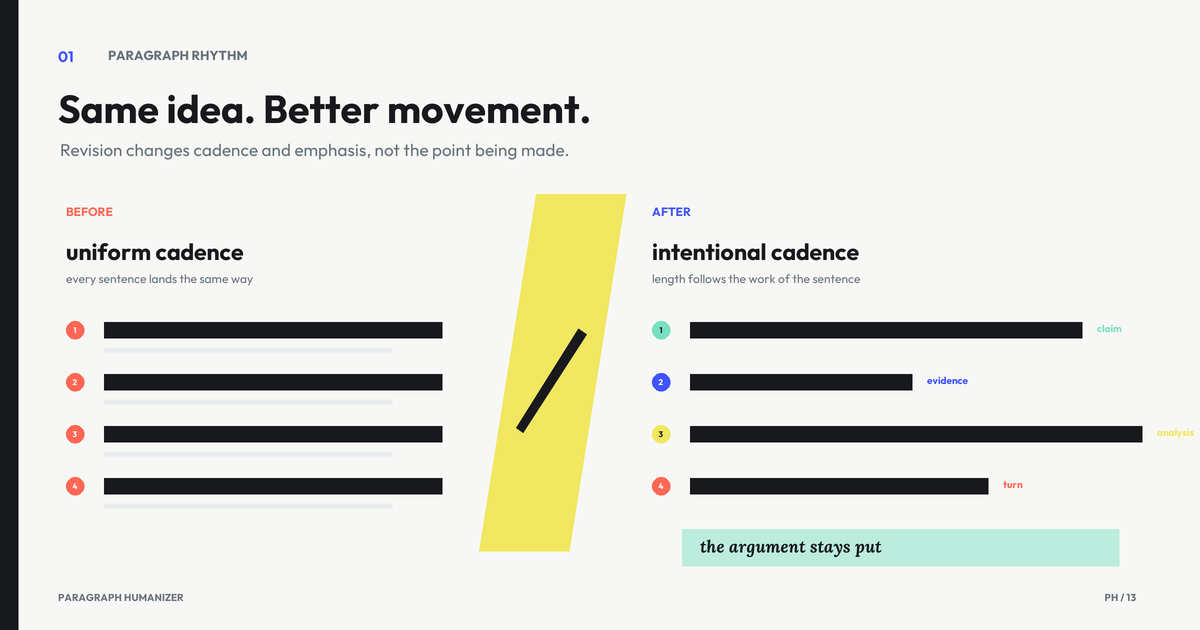
Natural revision changes cadence and emphasis while keeping the paragraph's central claim intact.
What a paragraph humanizer should preserve
Before revising, mark the elements that carry meaning.
| Paragraph element | What must remain unchanged |
|---|---|
| Topic sentence | The paragraph's main claim and its relationship to the thesis |
| Evidence | Facts, examples, quotations, data, and details from the source |
| Citation | Author, year, page number, placement, and citation style |
| Interpretation | What the evidence demonstrates or complicates |
| Course terminology | Required concepts, technical terms, and vocabulary from the reading |
| Logical relationship | Cause, contrast, comparison, qualification, sequence, or limitation |
| Scope | The people, period, text, case, or conditions covered by the claim |
Copy these elements into a short note before using an AI paragraph humanizer. This gives you a concrete standard for comparing the output.
Direct quotations should normally remain outside the rewriting pass. Revise the sentences around a quotation, then restore and verify the quoted wording and citation exactly.
How to humanize a paragraph step by step
1. Identify the paragraph's single job
Ask what the paragraph contributes to the essay. Does it establish context, present evidence, interpret a reading, compare two positions, address a counterargument, or apply a concept?
If the paragraph has no clear job, humanizing the wording will not fix it. Write the job in one sentence first:
This paragraph explains why the example complicates the essay's main claim.
That sentence becomes the revision boundary.
2. Label each sentence by function
Use simple labels:
- Claim: states the point
- Evidence: provides support
- Analysis: explains why the evidence matters
- Connection: links the point to the thesis or next paragraph
Many weak AI paragraphs contain two claims and no real analysis. Combine duplicated claims and spend the recovered space interpreting the evidence.
3. Protect citations and quoted material
Keep citation markers in the paragraph while revising, but compare them with the source afterward. Confirm that the revised sentence still makes the same claim the source supports.
For MLA citations, verify author names and page numbers. For APA, check author-year relationships and page numbers for direct quotations. For Chicago notes, preserve note placement and numbering. A fluent sentence is not acceptable if the citation now appears to support a different proposition.
The research paper citation guide provides a fuller citation review workflow.
4. Process enough context
Paste the paragraph into PaperHumanizer with its topic sentence and complete evidence. If the opening depends heavily on the previous paragraph, include the final sentence before it as context, then revise only the target paragraph.
Avoid processing a single sentence unless it is genuinely independent. Natural paragraph flow depends on the relationship among sentences.
For most undergraduate essays, use Standard tone. Choose Scholarly for upper-level theory, literary criticism, or research synthesis. Technical / STEM is appropriate for lab reports and measurement-focused explanations. The academic tone guide explains the differences.
5. Compare meaning before style
Use Compare view to check the original and revised paragraph. Verify meaning in this order:
- Topic sentence
- Evidence and numerical details
- Citation relationship
- Interpretation
- Scope and degree of certainty
- Transition to the next point
Only after these checks should you decide whether the paragraph sounds better.
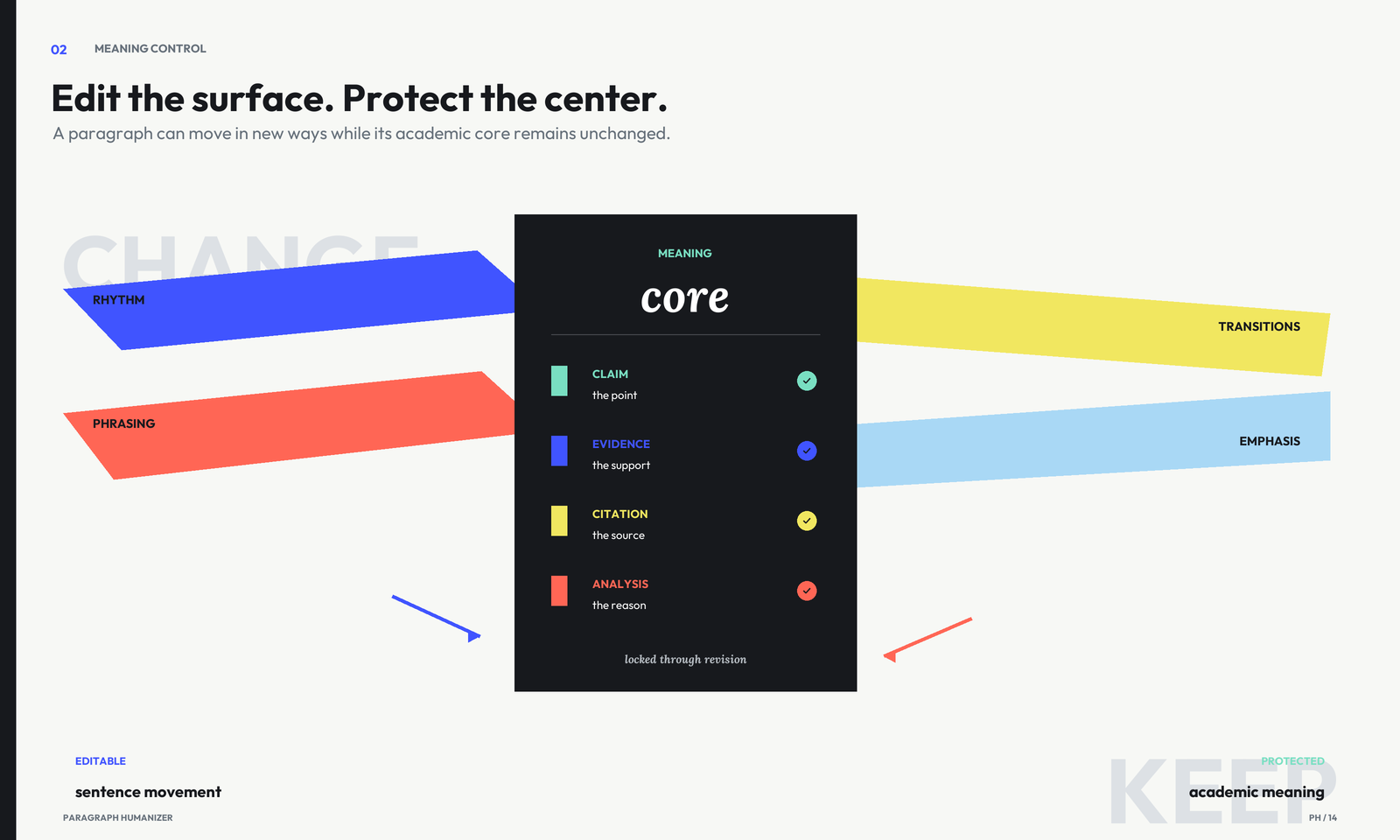
Claim, evidence, citation, and interpretation form the stable core; phrasing and rhythm remain editable.
6. Restore your course-specific voice
Add details that belong to your class and your thinking:
- A concept used by your instructor
- A connection to the assigned reading
- A precise description of the example
- Your reason for emphasizing one piece of evidence
- A limitation or alternative interpretation
These details do more than make writing sound human. They make the paragraph responsive to the actual assignment.
7. Read the paragraph in its original location
Put the revised paragraph back into the essay and read the paragraph before it, the revision, and the paragraph after it.
Check whether:
- The pronouns still have clear references
- The transition reflects the real relationship
- The paragraph uses the same terms as the thesis
- The tone matches the surrounding writing
- The conclusion does not repeat the next topic sentence
A paragraph can sound natural by itself and still disrupt the essay.
Before and after: humanize the rhythm, not the claim
AI-sounding paragraph
Online discussion boards provide students with valuable opportunities to participate in academic conversations. Furthermore, they allow students to express their ideas in a thoughtful manner. Additionally, discussion boards enable students who may not speak in class to contribute to the learning process. Therefore, online discussion boards are an important component of modern education.
Controlled revision
Online discussion boards give students more time to form a response before entering a class conversation. That delay can be especially useful for students who rarely speak during a live session but have a clear interpretation to contribute. The format does not automatically produce meaningful discussion, however; its value depends on whether prompts require students to respond to one another rather than post isolated answers.
The revision keeps the topic but makes three real decisions. It explains why additional time matters, identifies a specific student experience, and adds a condition that limits the broad claim. It does not simply replace transition words.
Paragraph humanizer versus paragraph rewriter
These terms are often used interchangeably, but the search intent can differ.
A basic paragraph rewriter may reorganize or paraphrase text. It is useful when the original wording is unclear or too close to another passage. A paragraph humanizer focuses on the patterns that make prose feel generated: uniform rhythm, generic transitions, repeated framing, and impersonal analysis.
Neither tool replaces authorship. You remain responsible for the claim, source use, interpretation, and compliance with your course's AI policy.
How much text should you humanize at once?
One developed paragraph is usually the best unit. For a short response paper, two closely connected paragraphs may be appropriate. Avoid pasting an entire long essay when you need control over citations and paragraph functions.
Useful passage sizes include:
- 100–250 words for a body paragraph
- 150–350 words for a paragraph pair built around one source
- One introduction or conclusion at a time
- One results or methods unit for technical assignments
Processing smaller, coherent passages makes comparison faster and reduces the chance that evidence moves between claims.
Using a paragraph humanizer for different classes
First-year composition
Protect the thesis connection, assignment prompt, and source integration. Standard tone usually works best.
Humanities courses
Keep textual evidence, interpretive terms, and distinctions among narrator, author, character, and reader. Scholarly tone can help with complex analysis, but do not let it make the paragraph more abstract.
Social science courses
Preserve population, context, causal limits, and citation relationships. Do not generalize a finding beyond the study being discussed.
STEM and lab courses
Keep units, variable names, statistical values, and technical terminology exact. Use Technical / STEM tone and compare every quantitative detail.
Discussion posts
Use a direct tone and retain references to the assigned material. A discussion post should sound like a genuine contribution to a class conversation, not a miniature journal article.
Common paragraph-humanization mistakes
Reject or correct a revision if it:
- Changes the topic sentence's position on the issue
- Removes a qualification such as “may,” “in this case,” or “for some students”
- Replaces a course term with a vague synonym
- Moves a citation away from the supported claim
- Alters a quotation, number, name, or date
- Adds evidence or a source that was not in the draft
- Makes the paragraph more formal than the surrounding essay
- Uses varied sentence lengths but still repeats the same idea
- Introduces a transition that misrepresents the logic
Final paragraph checklist
- The paragraph still performs the same job in the essay
- The topic sentence supports the original thesis
- Evidence, quotations, and details are accurate
- Every citation remains attached to the correct claim
- Analysis explains why the evidence matters
- Scope and uncertainty have not changed
- Sentence rhythm varies for a reason
- Course-specific language and personal judgment remain visible
- The transition works in the full essay
- The final version follows the applicable AI-use policy
Frequently asked questions
What is a paragraph humanizer?
A paragraph humanizer revises AI-assisted or mechanical prose to improve sentence rhythm, transitions, specificity, and natural flow. It should preserve the paragraph's meaning, evidence, and role in the larger essay.
Can I humanize a paragraph without changing its meaning?
Yes, but verification is required. Mark the claim, evidence, citations, and scope before revision, then compare those elements with the output.
Can a paragraph humanizer preserve citations?
It can retain citation text and placement, but you must verify that each revised claim is still supported by the cited source. Keep direct quotations outside the rewriting pass when possible.
How do I make a ChatGPT paragraph sound human?
Identify the paragraph's purpose, remove duplicated framing, interpret evidence more specifically, vary sentence structure, and restore details from your class or reading. Do not rely on synonym replacement alone.
Is a paragraph humanizer the same as a paraphraser?
Not exactly. A paraphraser primarily changes wording. A humanizer should also address cadence, emphasis, transitions, and generic analytical patterns while preserving the underlying claim.
Can I use a paragraph humanizer for college assignments?
Use it only when your instructor or institution permits AI-assisted language editing. Review every change and ensure the final paragraph represents your own reasoning and source use.
Open the academic paragraph humanizer and begin with one paragraph whose claim, evidence, and citation you can verify completely.