
A research proposal humanizer should improve the expression of a plan you have already developed—not invent the plan, promise findings, or change the proposed methods. Work section by section, protect the question and design, and check whether each revised paragraph still describes the project you can actually carry out.
This guide applies only where your course, funding body, or application rules permit AI-assisted editing. If they prohibit it, revise manually or seek authorized feedback. A more natural writing style does not make prohibited assistance acceptable.
When the rules permit it and your draft is ready, try PaperHumanizer on one proposal paragraph. Use the review matrix below before replacing any text in your master document.

Conceptual research-planning illustration: improve the prose without disconnecting the parts of the plan.
A proposal is not a shortened completed paper
A research article explains what a study did and found. A proposal explains what you plan to investigate, why the question matters, how you intend to study it, and whether the work is achievable. A rewrite that changes future plans into completed findings can make the document misleading.
For example, “The study will explore how participants describe feedback” must not become “The study demonstrates that feedback improves performance.” The change invents both a result and a different outcome.
Requirements vary by program. Oxford's graduate research-proposal guidance directs applicants to their course-specific requirements and emphasizes an achievable project. It also sets expectations about original work and points to its AI-use guidance. Read your own program's current rules rather than treating a general online template as permission or a universal structure.
What should a proposal humanizer improve?
Look for unnecessary framing, inflated claims of importance, unclear relationships between paragraphs, and descriptions that hide the practical research decision.
An opening such as “In the rapidly evolving landscape of higher education, feedback is of paramount importance” announces significance without defining the problem. A more useful paragraph identifies what is unknown about feedback, which setting matters, and why the question is worth studying.
Editing can make those elements clearer only when they are present in your draft. If the research gap is missing, you need more reading and reasoning—not a more elaborate introduction.
Protect these six elements before rewriting
| Element | What must remain stable |
|---|---|
| Research question | The problem, population, context, and intended scope |
| Literature and gap | What each source supports and what remains unresolved |
| Method | Design, sampling, collection, and analysis choices |
| Feasibility | Access, resources, skills, timetable, and dependencies |
| Ethics | Consent, approval status, privacy, and participant safeguards |
| Contribution | The possible value of the work, without invented findings |
Write these details in a short control note before using the academic humanizer. After rewriting, check against the note rather than relying on memory.
For citations, preserve the source-to-claim relationship as well as the visible marker. Our research-paper citation checklist covers that distinction.
A section-by-section proposal revision matrix
Research problem and question
Make the question easy to locate. Remove vague introductions, but do not broaden the population or replace a descriptive question with a causal one.
“How do first-year students describe their use of written feedback?” asks about accounts of experience. “Does written feedback improve grades?” asks a different question and needs a different design. A style rewrite must not silently move between them.
Literature review and research gap
Group evidence around the issue your project addresses. Keep contrasting findings separate where the studies differ in setting, measurement, or method.
Be cautious with phrases such as “no research exists” or “the first study.” Unless your literature search supports that claim, describe the specific limitation you have actually identified. See our literature-review humanization guide for source synthesis.
Proposed methodology
Keep procedural choices precise. An interview study must not become a survey; purposive sampling must not become random sampling. Protect intended eligibility criteria, recruitment route, interview format, and analysis approach.
Use future or conditional language that accurately describes the project's stage. Do not imply that recruitment, data collection, or ethics approval has already occurred when it has not. Our methods revision guide explains why terminology stability matters.
Feasibility and timeline
Replace vague confidence with concrete dependencies. “The project is feasible” is less informative than a supported explanation of access, timing, and the planned scope of the work.
Do not let a tool add supervisor support, institutional permission, software access, or participant commitments you have not secured. If an action depends on approval, keep that condition visible.
Expected contribution
Explain what the project may help clarify, not what it will certainly prove. A proposal can offer a strong rationale without predicting a favorable result.
Distinguish an intended contribution from an expected finding. “The project will examine how students interpret feedback” describes an aim. “The project will show that feedback raises attainment” predicts an outcome that the study has not established.
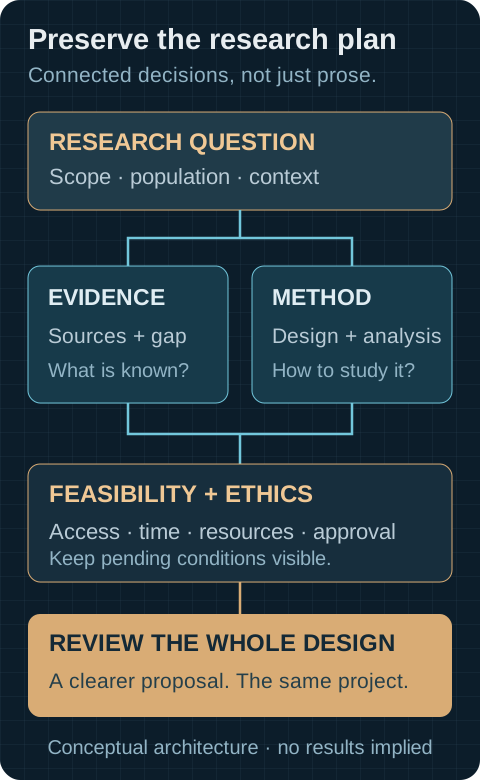
The parts of the proposal form one design. A wording change should not alter the connections between them.
Before and after: a methods paragraph
The following is a constructed teaching example, not a real applicant's proposal or a measured PaperHumanizer output. The project details are fictional.
Draft
This project aims to undertake an investigation into how first-year students interpret written feedback. It is proposed that approximately 15 volunteers from one department will participate in semi-structured interviews, subject to ethics approval and departmental permission. The analysis will use reflexive thematic analysis.
Illustrative revision
This project will investigate how first-year students interpret written feedback. Subject to ethics approval and departmental permission, it will recruit approximately 15 volunteers from one department for semi-structured interviews. The interviews will be analyzed using reflexive thematic analysis.
The revision makes the planned actions clearer. It preserves the population, approximate sample, volunteer recruitment, single-department scope, interview format, analysis approach, and approval dependencies.
Reject: “The project surveyed 15 randomly selected students and confirmed that feedback improves understanding.” It changes the stage of the work, design, sampling, and finding. A smoother sentence cannot justify those changes.
Use our academic before-and-after examples for additional evidence-preservation checks across section types.
Before and after: an expected contribution
Draft
It is anticipated that the proposed research may contribute to a better understanding of the ways in which students decide what to revise after receiving written feedback.
Illustrative revision
The proposed research may clarify how students decide what to revise after receiving written feedback.
The shorter version retains the tentative contribution and the actual focus. It does not add a policy recommendation, establish effectiveness, or claim a general result for every university.
Reject: “The research will establish the most effective feedback strategy.” The original proposal does not promise a comparison of effectiveness, so the rewrite should not introduce one.
How to humanize your proposal in a controlled workflow
- Check the applicable rules and brief. Record the permitted assistance, required sections, assessment criteria, and word limit.
- Keep the original document. Save a working copy and preserve references, tables, and comments in the master file.
- Write the control note. List the question, design, sampling, analysis, approval dependencies, and scope.
- Revise one coherent section. In PaperHumanizer, use Academic Paper and a tone suitable for the material: Standard Academic for clear formal prose, Scholarly for interpretive context, or Technical / STEM for technical methods.
- Check the protected details. Compare the rewrite with the original and the control note before judging style.
- Review the full proposal. Confirm that the question, methods, timeline, and contribution still fit together.
The current editing limit is 10,000 characters per input. Long uploads may be truncated, so inspect the extracted text and use deliberate section boundaries. Keep formatting and live reference fields in Word or your authoring tool; our DOCX guide explains that workflow.
Copy this review note before accepting a rewrite
Proposal section:
What this section must accomplish:
Research question and scope:
Method, sampling, and analysis that must not change:
Sources and citation relationships to preserve:
Approvals or permissions still pending:
Feasibility dependencies and timetable:
Changes I accepted:
Details I restored or still need to verify:
This note makes the review concrete. If a polished sentence cannot be reconciled with the plan, restore the original detail or revise it yourself. Do not use repeated rewriting to hide an unresolved design problem.
Frequently asked questions
Can a research proposal humanizer write my PhD project for me?
That is not the purpose of this workflow. You need to develop the research question, engage with the literature, and justify the design yourself. Editing support, when permitted, should improve expression rather than invent intellectual work or evidence of preparation.
Can I make my proposal more persuasive without overstating it?
Yes: explain the gap specifically, connect the method to the question, and make feasibility visible. Those changes are persuasive because they clarify a real plan, not because they guarantee positive findings or exaggerate novelty.
Should I use past tense in the methods section?
Use wording that matches the actual stage of each activity. Proposed data collection should not be described as completed. If you have genuinely completed preliminary work, distinguish it explicitly from the work you are proposing.
Will humanizing guarantee acceptance or a detector pass?
No. Admissions and funding decisions depend on factors beyond prose, and a detector result is not established by this guide. PaperHumanizer's detector-style UI scores are simulated, not external scans. Follow the relevant rules and retain your draft history.
Test the workflow on one paragraph
If AI-assisted editing is permitted, choose a non-sensitive paragraph with a plan detail you can verify. Try PaperHumanizer, compare the rewrite, and check it against your control note. If it proves useful for your ongoing writing process, review our available plans.
A stronger proposal reads more clearly while remaining the same defensible, achievable project.