
An AI humanizer for non-native English writers should improve how an academic draft reads without replacing the writer's reasoning or voice. Start with an English passage you understand, identify what must stay, revise the awkward expression, and compare the result with the original. Natural English does not require simpler ideas, invented personal details, or the removal of every formal phrase.
If you already have a paragraph ready, try PaperHumanizer's academic editor. Choose a tone for the assignment, then check whether the revision keeps your position, sources, and technical vocabulary intact. This guide explains what to look for before accepting that rewrite.

Conceptual illustration: clearer English should carry the same research, not erase the author's perspective.
What does “natural academic English” actually mean?
Natural academic English is wording that lets the reader follow your argument without unnecessary effort. It uses expressions appropriate to the discipline, gives sentences clear jobs, and shows how evidence supports an interpretation. It does not mean informal English, a particular national accent, or an imitation of a native speaker's personality.
A dense theoretical paragraph may need technical terminology. A methods section may appropriately use passive voice. A discussion may need repeated qualifications. Those features are not defects merely because they are formal.
The University of Manchester's Academic Phrasebank guidance on cautious language explains why scholarly claims often avoid absolute certainty. When an editor removes “may,” “under these conditions,” or “in this sample,” it can change the evidence rather than improve the English.
Diagnose the writing problem before rewriting
International students may receive broad feedback such as “awkward,” “too wordy,” or “needs a more academic tone.” Translate that feedback into a specific editing task.
| What you notice | A focused revision task |
|---|---|
| Several abstract nouns hide the action | Make the subject and action clearer |
| A sentence follows the word order of another language | Reorganize the English clause while preserving its logic |
| Every paragraph begins with “Furthermore” | State the actual connection: contrast, consequence, or example |
| Technical terms have several English versions | Choose the correct term and use it consistently |
| The draft is grammatical but sounds inflated | Remove empty framing, not necessary qualifications |
| The argument itself is unclear | Return to the source and your outline before style editing |
Grammar correction and humanization overlap, but they do different amounts of work. If only an article or preposition is wrong, a small manual correction may be sufficient. Use broader rewriting when the sentence structure or paragraph flow genuinely needs attention.
Example 1: replace noun-heavy phrasing with a clear action
The examples in this article are constructed teaching examples, not captured product outputs or findings from real studies. The sample details and numerical values are illustrative.
Draft
The implementation of weekly feedback made a contribution to the improvement of the clarity of the students' revision plans.
Illustrative revision
Weekly feedback helped students develop clearer revision plans.
The revised version makes the action easier to see. Before accepting “helped,” however, ask whether your actual evidence supports that relationship. If the source only reports students' opinions, a more accurate sentence might be: “Students reported that weekly feedback helped them develop clearer revision plans.”
Why that distinction matters: fluent English is not the same as faithful reporting. An edit must preserve who made the observation and how it was measured.
Example 2: preserve caution rather than making the result impressive
Draft
In our sample, students with more frequent use of the planning checklist reported lower deadline stress. This relation cannot be interpreted as a cause because the data were collected at one time.
Illustrative revision
In our sample, more frequent checklist use was associated with lower self-reported deadline stress. Because the data were collected at a single time point, this association does not establish causality.
This version improves the collocation and the explanation while retaining the sample boundary, self-reported measure, and causal limitation. It does not turn the observation into proof that a checklist reduces stress.
Reject: “The checklist effectively reduces deadline stress for all students.” That is more confident, but it is not the same claim.
For more examples by section type, see the academic humanizer before-and-after library.
How to use an academic humanizer without losing your voice
1. Write down the point in your own words
Before editing, explain what the paragraph is trying to say. You may draft that explanation in your strongest language, but keep a verified English version of the passage for the actual English revision.
Do not ask a tool to invent the explanation for you. If you cannot tell whether the output means the same thing, use a trusted reader or authorized language-support service before accepting it.
2. Make a protected-detail list
Record the terms and facts that must remain: citations, sample size, units, names of methods, defined constructs, and limitations. Also note which part of the paragraph reflects your own interpretation rather than a source's finding.
A useful mini-glossary might contain “self-regulated learning,” “semi-structured interview,” and “thematic analysis.” These are not phrases to vary simply to avoid repetition. See our citation-preservation guide for a fuller evidence check.
3. Choose the tone for the reader
In PaperHumanizer, select Essay / Assignment for coursework or Academic Paper for a manuscript. Then choose:
- Standard Academic for clear formal prose and most coursework.
- Scholarly for nuanced theoretical discussion and literature synthesis.
- Technical / STEM for precise procedural or scientific passages.
Do not choose the most formal tone merely because English is not your first language. The best tone is the one appropriate to the section. Our academic tone guide shows how those choices differ.
4. Revise one coherent section
Paste a paragraph or connected passage so that you can check every change. The current input limit is 10,000 characters, and supported document uploads extract text rather than edit the formatted file directly.
If you start from Word, keep the original DOCX and return only approved prose to it. Follow the Word-document workflow for citation fields, notes, and formatting.
5. Compare meaning, then readability
First check the protected details. Then ask whether the revision expresses the point more clearly and whether it still sounds like something you would write and defend.
Keep useful revisions, restore mistakes, and make a final personal edit. You do not have to accept every new phrase to benefit from the tool.
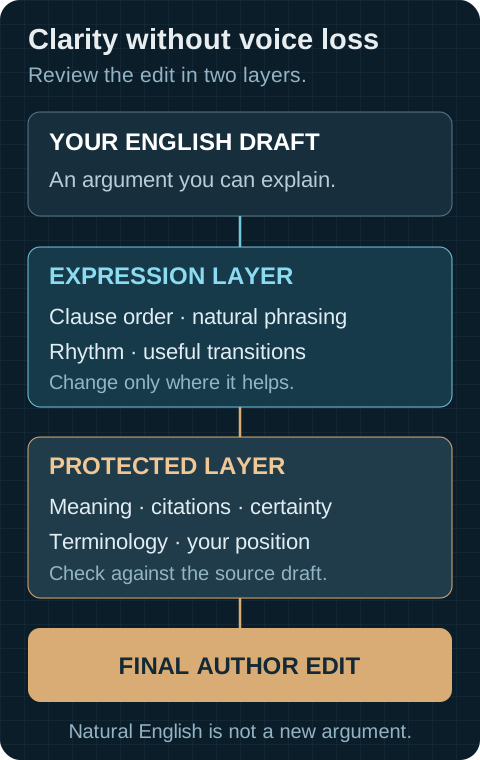
Review two layers: expression can change, but the evidence and authorial position need to remain stable.
What about humanizing translated academic text?
Treat translation and English revision as separate stages. First check whether the English translation accurately represents the source-language draft. Then improve its English expression. A polished rewrite of a mistranslation is still wrong.
Pay particular attention to negation, comparisons, tense, and ambiguous terms. For example, “no significant difference was found” must not become “the groups were identical.” The first statement reports a test result; the second asserts equivalence.
PaperHumanizer's workflow is designed to preserve the input language, not to provide a certified translation or automatically convert another language into English. Start the English humanization step with checked English text. Keep the original-language draft available when you need to resolve ambiguity.
A short review rubric for international students
After each revision, answer these questions:
- Can I explain every sentence without reading the output?
- Does the paragraph make the same claim at the same level of certainty?
- Are citations still connected to the correct findings?
- Did the meaning of a technical term change?
- Did the editor add a detail, experience, or conclusion I did not supply?
- Is the English clearer without becoming artificially elaborate?
- Does the use of AI-assisted editing follow the applicable rules?
If a sentence fails one of these checks, correct it manually or return to the source. More successive rewrites are not necessarily a solution.
Frequently asked questions
Will a humanizer make my English look native?
The useful goal is clear, appropriate academic writing, not concealing your linguistic background. Evaluate clarity, precision, and your ability to explain the text. No tool can promise how a reader will perceive the author's background.
Should I remove every repeated word?
No. Repeating a defined technical term is often more precise than switching to an approximate synonym. Revise repetitive framing and unnecessary restatement, not the terminology that keeps the argument stable.
Is this a grammar checker or a translator?
The workflow discussed here focuses on rewriting an existing academic passage. It may improve expression, but it does not replace source checking, specialist proofreading, or verified translation. Select the smallest editing intervention that solves your problem.
Will more natural English guarantee a lower AI-detector result?
No specific detector outcome follows from writing more naturally. PaperHumanizer's on-screen detector-style scores are simulated presentation values rather than live third-party scans. Follow your institution's policies and keep your drafting history; neither language background nor a score alone establishes authorship.
Try one paragraph before revising the whole paper
Choose a non-sensitive English passage whose meaning and sources you understand. Open PaperHumanizer, choose a suitable tone, and compare the completed result with your original. If the workflow saves useful editing effort on your real tasks, review the available plans before working through more sections.
Your research and perspective are the assets to preserve. Better English should make them easier to read, not replace them.