
The most common concern students and researchers have about using an AI humanization tool is this: "What if it changes something important?"
It's a valid worry. A wrong citation format, an altered p-value, a distorted conclusion — any of these could be catastrophic for an academic submission.
This article explains exactly how PaperHumanizer handles your content, what it is designed to protect absolutely, and how to verify the output for your own peace of mind.
What PaperHumanizer Actually Changes
PaperHumanizer operates at the stylistic layer of your text — not the factual or argumentative layer.
Think of it like a skilled copy editor who speaks your academic field fluently. A good copy editor makes your prose read more naturally and professionally. They never invent new claims, alter your data, or rewrite your conclusions. They reshape sentences, vary rhythm, and elevate word choice.
That's exactly the model PaperHumanizer follows.
What changes:
- Sentence structure and length variation
- Transitional phrasing and connective tissue
- Word choice at the level of synonyms and stylistic alternatives
- Active/passive voice balance
- Clause ordering and subordination patterns
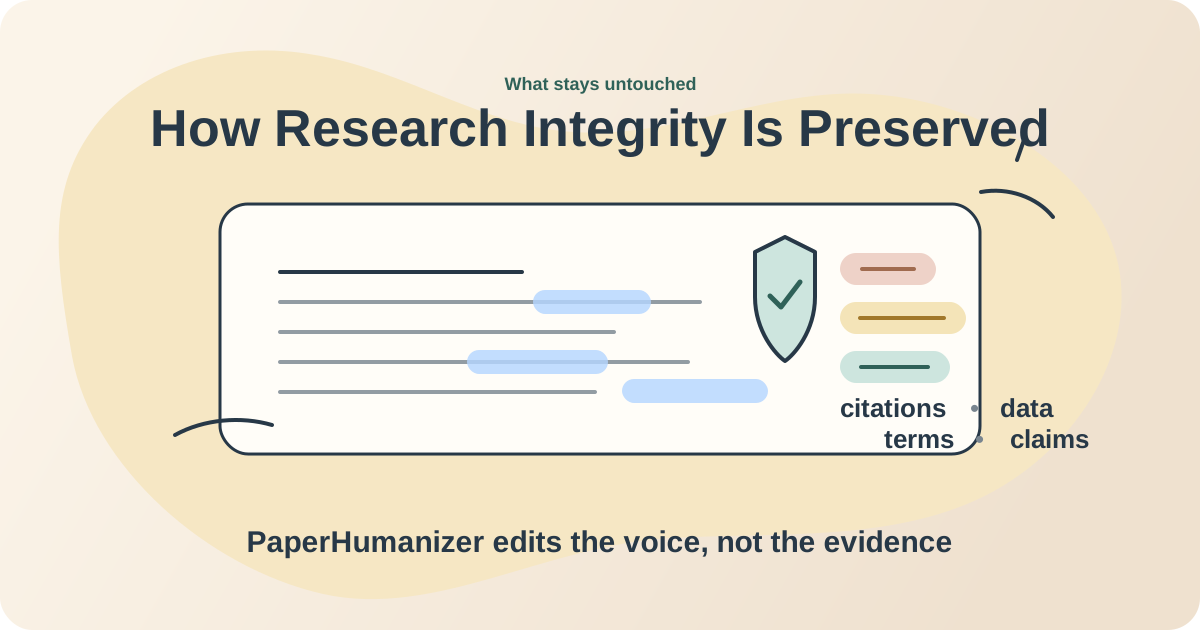
What never changes:
- Your thesis statement and conclusions
- All citations and references
- All numerical data, statistics, and measurements
- Technical terminology and discipline-specific vocabulary
- Proper nouns (author names, place names, institution names)
- Dates, years, and temporal references
Citations: A Deep Dive
Citations are sacred in academic work. PaperHumanizer treats them that way.
In-Text Citations
All in-text citation formats are recognized and preserved:
- APA: (Smith & Jones, 2021, p. 47) ✓
- MLA: (Smith 47) ✓
- Chicago: Smith^12 or (Smith 2021, 47) ✓
- Vancouver: [12] or (12) ✓
- Harvard: (Smith and Jones 2021) ✓
The model is trained to recognize these patterns and treat them as inviolable anchors. The sentence structure around a citation will be rewritten; the citation itself will not be touched.
Reference Lists and Bibliographies
If you include your reference list in the text you paste, PaperHumanizer will preserve every bibliographic entry exactly as formatted. Reference lists are structurally distinct from prose, and the model identifies and skips them.
Recommendation: For safety, paste your paper section by section, excluding the reference list. This gives you full control and avoids any edge cases with unusual citation formats.
Statistical Data and Research Findings
This is non-negotiable: numbers don't change.
Every p-value, F-statistic, correlation coefficient, sample size, percentage, confidence interval, and measured value in your text is preserved character-for-character.
For example:
Original: "Results revealed a statistically significant effect, F(2, 87) = 14.3, p = .003, η² = .25."
Humanized: "The analysis yielded a statistically significant main effect, F(2, 87) = 14.3, p = .003, η² = .25, indicating a large effect size by conventional benchmarks."
The statistical notation is untouched. Only the prose framing changes — making the sentence read more naturally while the numbers remain exact.
Arguments, Theses, and Conclusions
PaperHumanizer rewrites how you express an idea, not what the idea is.
Your paper's argumentative logic — the evidence you've marshalled, the claims you're making, the conclusions you've drawn — is preserved in full. The humanization process changes surface expression, not propositional content.
To put it technically: PaperHumanizer is a paraphrase model constrained to semantic equivalence. It operates within a tight semantic envelope around each clause, changing phrasing while maintaining the same truth-conditional meaning.
This means:
- A claim of causation stays a claim of causation (not correlation)
- A qualified conclusion stays qualified ("the results suggest" doesn't become "the results prove")
- A limitation statement stays a limitation statement
Technical Terminology
One of the hardest problems for generic paraphrasers is technical vocabulary. They'll replace "synaptic plasticity" with "brain flexibility" or "eigenvalue" with "characteristic number" — producing text that sounds absurd to any specialist reader.
PaperHumanizer avoids this entirely. Domain-specific technical terms are treated as proper nouns: immutable anchors in the text.
Whether you're writing about CRISPR gene editing, transformer architectures in NLP, heteroskedasticity in econometrics, or phenomenological reduction in philosophy — those terms stay exactly as you wrote them. The natural variation happens in the connective prose, not in the subject-matter vocabulary.
How to Verify the Output
Even with these protections, we always recommend a careful review pass. Here's a practical checklist:
Post-Humanization Verification Checklist
Citations:
- Spot-check 5–10 in-text citations against your original
- Verify at least the first and last entries in any included reference list
- Check that citation format (APA/MLA/etc.) is preserved
Data:
- Verify all p-values, effect sizes, and confidence intervals
- Check all sample sizes and participant counts
- Confirm any quoted figures or percentages from sources
Arguments:
- Re-read your thesis statement — is the claim exactly preserved?
- Check your conclusion paragraph — does it still say what you intended?
- Scan for any claim that seems stronger or weaker than you intended
Terminology:
- Scan for any technical term that looks altered or paraphrased incorrectly
- Check proper nouns (researcher names, institution names, geographical names)
Using the Compare tab in PaperHumanizer, you can view your original and humanized text side-by-side, which makes this review process fast and efficient.
A Note on Academic Integrity
PaperHumanizer is designed as a writing assistance tool, similar in principle to grammar checkers, style editors, and academic writing centers. It helps you express your existing research more naturally.
It is your responsibility to ensure that the research content itself — your ideas, your data analysis, your literature review — represents your own scholarly work. PaperHumanizer helps the presentation of that work communicate more naturally; it is not a substitute for original research.
Start Humanizing with Confidence
PaperHumanizer is built specifically for academic use cases. Every design decision — from the tone modes to the citation preservation to the semantic constraints — reflects the reality that you have real research at stake.
Try PaperHumanizer → — paste your abstract right now to see how it handles your text.