Do not decide how to write your Common App essay by guessing whether it will pass an AI detector. Common App's public rules address honesty and authorship, while receiving colleges publish their own requirements. The sources reviewed for this guide do not establish that every application receives the same automated scan, or that no application can be checked.
The more useful question is: what help may I use for this particular application, and what contribution must remain mine? A spelling suggestion, an outline, a translation, and a generated paragraph are different kinds of assistance, even when they appear inside the same app.
This guide is from the PaperHumanizer team, not Common App or an admissions office. Official sources were reviewed on October 30, 2026. It explains public guidance, not private screening systems, admissions odds, or a way to obtain detector clearance.
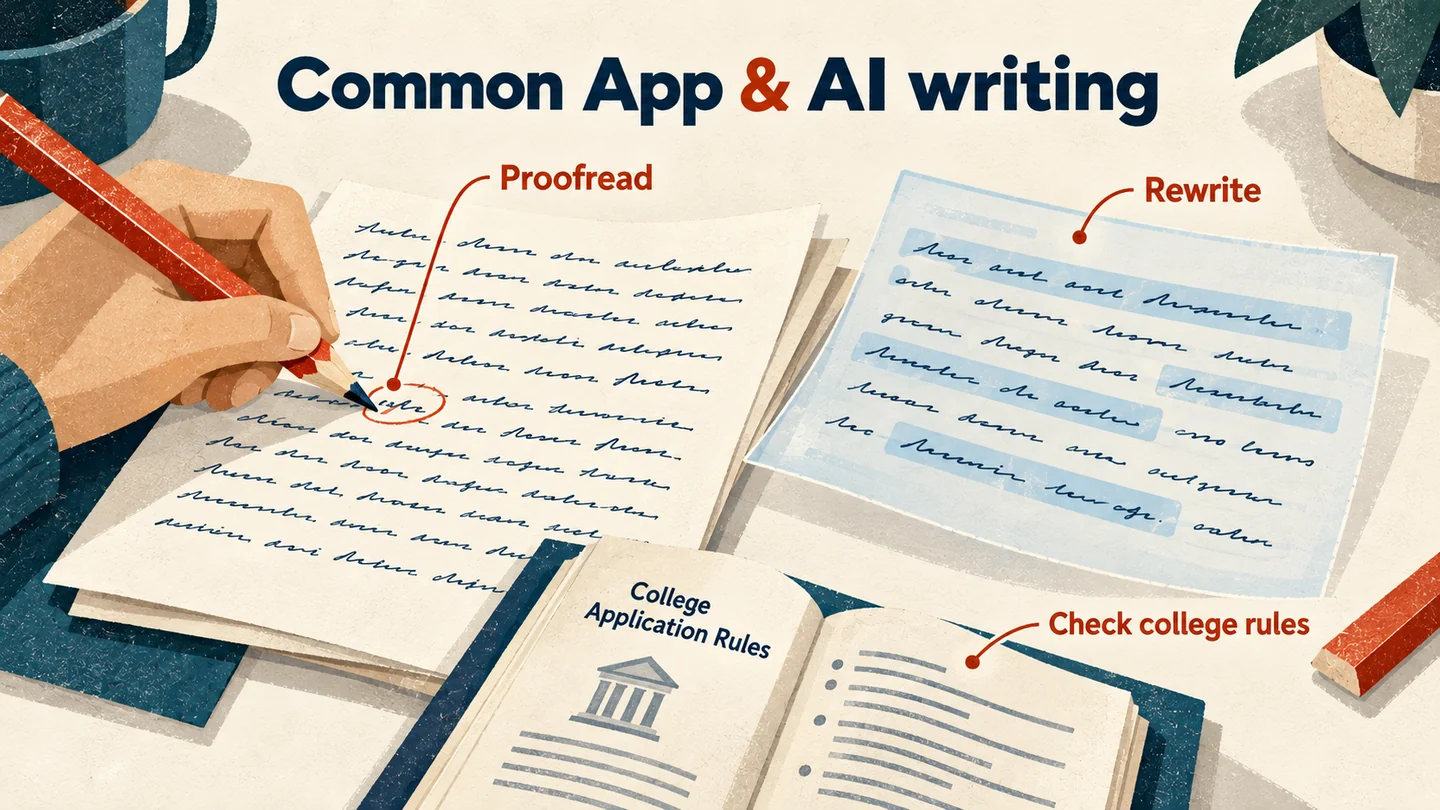
The kind of contribution matters more than the name of the writing tool. This is an editorial illustration, not Common App's interface.
What Common App actually says about AI
Common App's Fraud Policy addresses intentionally presenting substantive AI output as the applicant's original work. Its applicant support explanation also includes misrepresenting AI output among examples of application fraud.
The separate Application Affirmations require applicants to take responsibility for the truthfulness and authorship of submitted materials. One short phrase captures the standard: “my own work, factually true, and honestly presented.”
These are commitments about the application you submit. They are not a published AI-percentage threshold. A detector result cannot replace them.
Platform rules and college rules are separate checks
Start with the shared application requirements, then open the admissions guidance for every destination and any special program. Record the application cycle as well as the school name. A policy for a previous year, a classroom assignment, or a different program may not answer your current question.
| Question | Where to look | What not to assume |
|---|---|---|
| What am I affirming when I submit? | Common App's affirmations and fraud guidance | That a low AI score satisfies the certification |
| May I use grammar assistance? | Each college's admissions guidance | That every feature of a permitted app is permitted |
| May I use generated outlines or translations? | The specific college and program policy | That drafting in your first language makes AI translation automatically acceptable |
| Is there an automated check? | Any explicit published statement from the relevant institution | That an online rumor reveals its internal process |
Proofreading, rewriting, and generation are different tasks
It is easy to say “I only used a writing assistant” while overlooking what the assistant actually did. Describe the action instead:
- Proofreading: finding a spelling, punctuation, or grammatical error in your completed text.
- Feedback: pointing out a confusing sentence or asking you to explain a missing connection.
- Rewriting: supplying replacement language or reorganizing how your experience is expressed.
- Generation: producing the narrative, argument, outline, or paragraphs for you.
Those descriptions are a review aid, not an official list of approved activities. Check the actual policy before using the assistance. In particular, do not assume that a feature labeled “clarity,” “polish,” or “humanize” is limited to proofreading.
Two official examples show why the distinction matters
Yale's undergraduate AI policy permits grammar or spelling review and general advice or initial topic suggestions. It prohibits submitting application responses composed by text-generating software.
Caltech's Fall 2027 guidance allows grammar/spelling review of completed essays, brainstorming questions or exercises, and application-process research. It lists AI-generated outlines or drafts, replacement of the applicant's voice, and AI translation of an essay among unacceptable uses.
These examples illustrate differences in task boundaries. They do not authorize an activity for another institution. If your shared essay goes to several colleges, check that your process is acceptable for each destination.
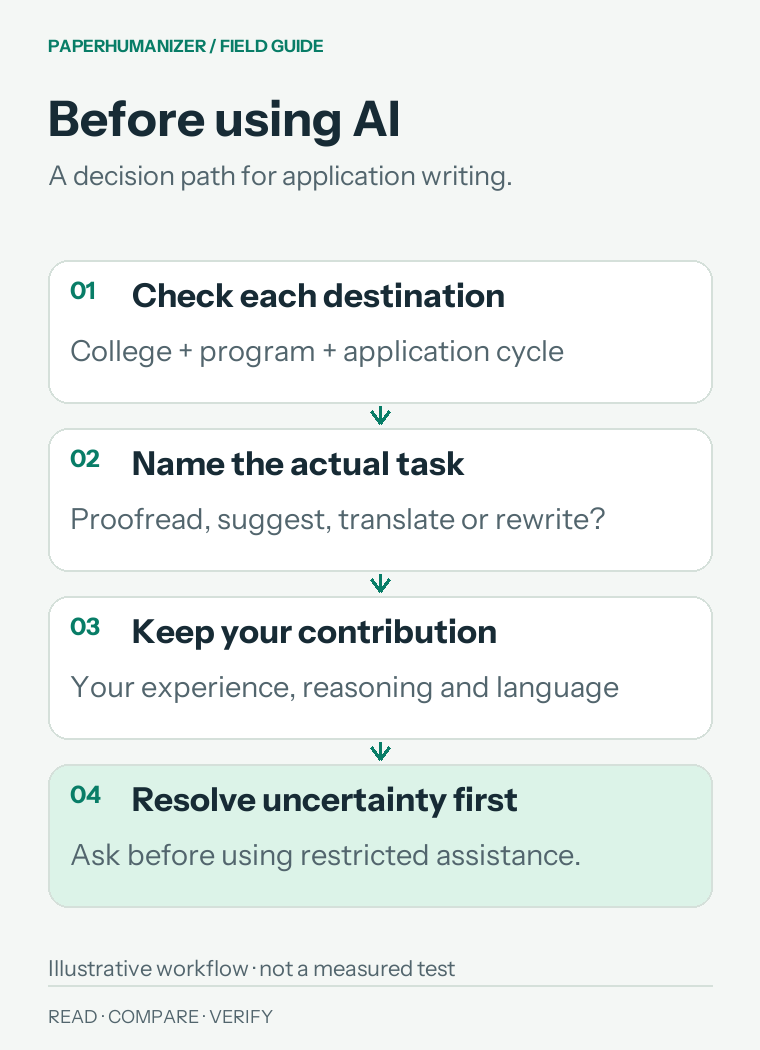
Check the destination and the task before opening a writing feature. This checklist does not certify that a particular use is allowed.
A practical example: feedback that leaves the writing to you
The following material is fictional. It illustrates a manual review process, not a successful application or a product-generated rewrite.
A student's rough sentence
Helping at the repair club was very meaningful because it taught me many important skills and made me more confident.
Instead of asking software to invent a more impressive version, ask yourself:
- What did I actually repair or help someone repair?
- Which moment changed what I understood?
- What did I do differently afterward?
- Which details can I describe from memory or my own notes?
If the student's genuine notes describe learning to test a broken switch before replacing a motor, that detail might become part of the student's own revision. If no such event happened, it does not belong in the essay, however convincing the sentence sounds.
This process keeps the hard work where it belongs: selecting a real experience, deciding what it means, and expressing the reflection. A more sophisticated adjective cannot supply that contribution.
Review the activities section and short answers too
Apply the same factual discipline beyond the main essay. An activity description can become inaccurate when a suggestion changes “helped organize” to “founded,” invents a participation figure, or turns occasional attendance into a leadership role.
For each entry, check the action, role, dates, hours, and any claimed result against your own records. Do not accept a numerical estimate simply because it makes the entry more concrete. If the wording sounds impressive but you could not explain it in a conversation, return to what actually happened.
Treat this as a truthfulness check, not a prediction about whether short text can be detected. No claim about an activities-section scanner is needed to recognize that an invented achievement is a problem.
What if your own essay gets a high AI score?
First identify what the number measures. A classification estimate, a share of flagged text, and a similarity percentage are different things; our AI detection percentage guide explains the distinction.
Then return to genuine drafts, notes, and the actual assistance you used. A flag alone cannot reconstruct how you wrote the essay. Equally, a reassuring second score cannot establish that a prohibited process was permitted. Avoid repeatedly replacing your wording simply to satisfy a private checker.
If an admissions office raises a concern, follow its instructions and describe your process accurately. Do not create retrospective drafts or invent a tool-use history.
A final checklist before submitting
| Review | A useful question |
|---|---|
| Experience | Did each described event happen as stated? |
| Contribution | Did I make the central choices and produce the required original writing? |
| Voice | Would I use and understand this language when discussing my experience? |
| Assistance | Can I name exactly what each tool or person changed? |
| Permission | Have I checked the receiving college, program, and cycle? |
| Records | Have I retained genuine notes and versions? |
| Consistency | Do dates, roles, and achievements agree across the application? |
If an answer is uncertain, resolve it before submitting. A counselor can help you locate an official rule; the admissions office can clarify a task-specific boundary. A writing tool cannot grant that permission.
Where PaperHumanizer fits—and where it does not
PaperHumanizer is a rewriting tool, so it should not be treated as a spelling-only service or an admissions-compliance checker. If your college prohibits the proposed rewriting, do not use it for that application. The same applies to any other product offering equivalent assistance.
For coursework or research where academic rewriting is explicitly permitted, PaperHumanizer's editor offers purpose and tone settings and original-versus-output comparison. Use it to evaluate expression while checking your evidence, citations, and argument yourself. The academic rewrite examples show review criteria; personal-statement revision guidance discusses preserving genuine experiences, subject to the destination's rules.
For repeated permitted academic editing, compare access plans after testing a suitable excerpt. A paid plan is access to a writing workflow, not approval from a college or a guarantee about an external detector.
Frequently asked questions
Does Common App use Turnitin or GPTZero on every essay?
The official sources reviewed here do not establish a named universal scanner or a universal checking process. Avoid presenting either “every essay is scanned” or “nothing is ever checked” as a verified fact.
Is using Grammarly automatically allowed?
Check the task and the college's policy. Grammar review and generated replacement paragraphs are different contributions, even inside one product. Yale and Caltech provide specific guidance; other destinations may differ.
Can I use AI to brainstorm or translate my essay?
Do not group those tasks together. Some published guidance allows initial questions or topic suggestions while restricting generated outlines or translation. Read the rule for each destination and ask if your proposed use is unclear.
What should I do if I already submitted inaccurate material?
Common App's affirmations direct applicants to contact the institution when providing additional information after submission. Follow that institution's correction process and explain the issue honestly. A private rewrite does not amend an application already submitted.