If your essay is flagged as AI even though you wrote it yourself, the score is not proof that you cheated. AI detectors estimate whether a passage resembles patterns found in machine-generated text. Formal wording, repetitive sentence structures, short samples, and predictable academic phrasing can produce a false positive.
Do not immediately rewrite the whole paper or add deliberate mistakes. First save your drafts, identify exactly which passages were flagged, and compare the result with your assignment history. Then revise only the sections that are both generic and genuinely weaker than your normal writing.
This guide explains why a human-written essay can be detected as AI, what the percentage means, and how to respond without losing your argument, evidence, or voice.
Review and humanize a flagged essay with PaperHumanizer
Why does an AI detector say my writing is AI?
An AI detector does not know who wrote a sentence. It analyzes the finished text and assigns a probability based on patterns such as predictability, sentence variation, and phrasing. That distinction matters: the tool is classifying language, not establishing authorship.
Several features of legitimate student writing can resemble model output:
- Sentences follow the same length and grammatical pattern
- Paragraphs repeat a claim-evidence-summary formula
- Transitions such as “Furthermore” or “In conclusion” appear frequently
- The introduction uses broad statements that could fit many topics
- Technical terminology makes word choices unusually predictable
- Grammar software has standardized the writer's phrasing
- A multilingual writer uses a consistent formal register
- The submitted sample is too short to provide much context
None of these features proves AI use. They only help explain why a classifier might produce a high score.
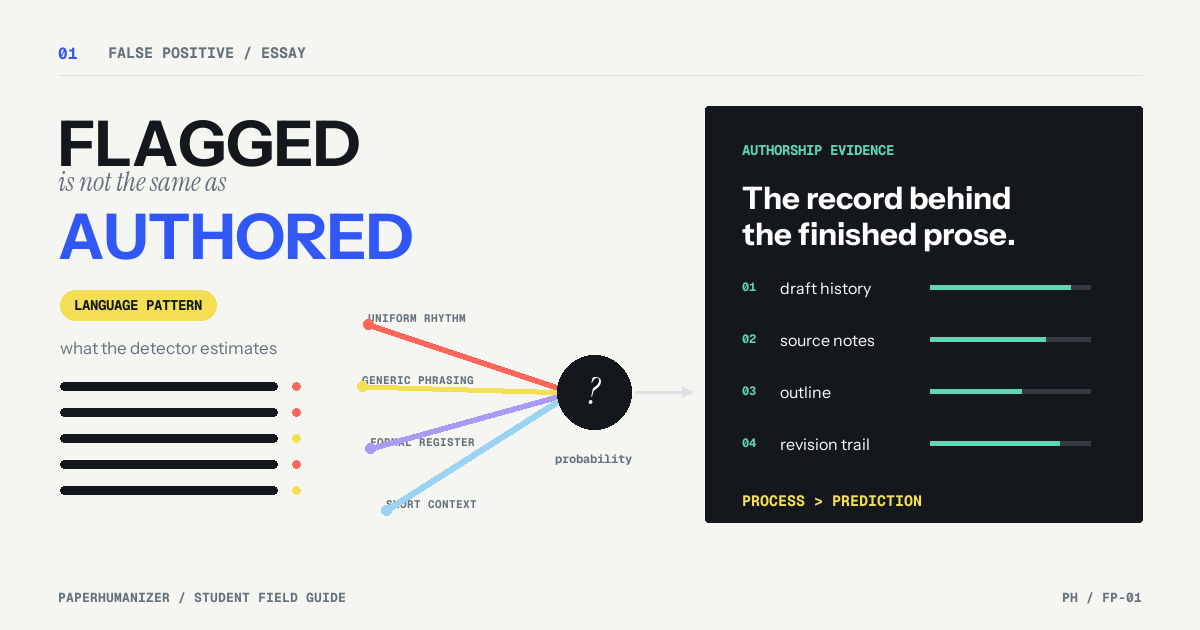
A detector combines language signals into an estimate; your drafts and source history answer the separate question of authorship.
What an AI detection percentage actually means
A detector score is easy to misread. A result labeled “60% AI,” for example, does not necessarily mean there is a 60% chance that you cheated or that 60% of every sentence came from a model. Products calculate and display scores differently. Some estimate the share of qualifying prose that resembles AI writing; others show confidence for a document or highlight individual passages.
The practical interpretation is narrower:
The submitted language contains patterns that this detector associates with text generated or revised by an AI system.
That is a prompt for review, not a complete conclusion. Detector models and thresholds change, so use the explanation shown in the specific report rather than transferring one platform's percentage to another.
You should also separate three questions that are often collapsed into one:
| Question | Best evidence |
|---|---|
| Does the prose look AI-like? | Detector result and highlighted passages |
| Who developed the argument? | Notes, outline, source annotations, and version history |
| Does the work follow policy? | Syllabus, assignment instructions, and disclosed tool use |
A detector can contribute to the first question. It cannot independently settle the second or third.
Common reasons a human-written essay gets flagged as AI
1. The writing is highly predictable
Academic writing often relies on conventional phrases: “The results indicate that,” “This evidence demonstrates,” or “It is important to consider.” Used occasionally, these phrases are normal. Used in nearly every paragraph, they create a predictable sequence that may resemble generated prose.
Predictability also appears at the idea level. A paragraph that announces a point, repeats it twice, and closes by calling it important has very little movement. The detector sees the regularity even if every word was typed by a student.
2. Sentence rhythm barely changes
Students are sometimes taught to produce consistently complete, balanced sentences. The result can be ten sentences of similar length, each with one introductory clause and one main clause. Human prose normally varies according to purpose: a claim may be short, evidence may require detail, and analysis may unfold across a longer sentence.
This does not mean you should manufacture random sentence lengths. It means sentence form should follow thought.
3. Your essay uses generic academic language
Compare “Technology has significantly transformed modern education” with “In our seminar's annotation exercise, the search tool changed which passages students discussed first.” The first sentence is polished but interchangeable. The second contains assignment-specific context and a decision about what matters.
Generic language is common in rushed introductions, literature review transitions, and conclusions. These sections deserve the first review.
4. Editing tools flattened your voice
Grammar checkers, translators, and paraphrasers can make unrelated sentences converge on the same smooth style. Even if the original ideas are yours, accepting every automated suggestion may remove the contractions, emphasis, qualifications, and unusual constructions that characterize your writing.
Check your course policy because some instructors distinguish basic proofreading from generative rewriting. The detector cannot reliably tell which tool produced a stylistic change.
5. The passage lacks enough context
Very short extracts contain fewer signals and can produce unstable results. A single definition, abstract, or formulaic opening may look more suspicious in isolation than it does inside the complete essay. When possible, evaluate a substantial section and review the highlighted text in context.
6. Your field requires constrained language
Methods sections, lab reports, case briefs, and technical explanations have limited ways to state recurring procedures. Required terminology also narrows vocabulary. A statistical model may interpret that legitimate consistency as machine-like predictability.
What to do when your essay is flagged as AI
Step 1: Preserve the evidence before editing
Save the submitted file and the detector report. Export or screenshot your document history if it shows how the paper developed. Keep your outline, research notes, annotated sources, library downloads, and assignment feedback.
Do this first. Replacing the original with a newly edited version can make a straightforward authorship explanation harder.
Useful process evidence includes:
- Google Docs or Microsoft Word version history
- A thesis proposal or outline with timestamps
- Notes connecting sources to paragraph claims
- Earlier drafts with instructor or peer comments
- Citation manager records
- Search history or library database exports related to the topic
These materials are more relevant to authorship than a score from a second detector.
Step 2: Read the assignment's AI policy
Determine what the course actually permits. Some instructors allow brainstorming or grammar support with disclosure; others prohibit generated prose; some assignments contain no tool-specific language. Do not assume that a low detector score automatically makes work compliant.
If you used a permitted tool, document what it did. A short, factual explanation is stronger than a broad denial that omits relevant assistance.
Step 3: Locate the flagged passages
If the report provides sentence or paragraph highlights, work from those rather than changing the entire essay. Label each flagged section by function:
- Background or definition
- Thesis or topic sentence
- Evidence
- Analysis
- Transition
- Conclusion
Patterns often emerge. For example, your evidence paragraphs may be fine while generic transitions and the conclusion account for most flags.
Step 4: Diagnose the writing problem
Ask four questions about each highlighted paragraph:
- Could this paragraph appear in an essay on a different topic with only nouns replaced?
- Do multiple sentences begin or end in the same way?
- Does the paragraph interpret specific evidence, or mostly restate a broad claim?
- Does it sound like the rest of my documented drafts?
If the passage is specific, accurate, and recognizably yours, the best response may be to preserve it and explain the false positive. If it is generic or mechanically repetitive, revise it because the writing itself can improve.
Step 5: Revise meaningfully, not cosmetically
Avoid synonym swapping. Change the relationship between ideas instead:
- Move from a broad claim to the actual case, text, experiment, or source
- Combine duplicated sentences and add analysis
- Replace generic transitions with the logical connection
- Let sentence length reflect each sentence's job
- Restore a qualification that matters to your argument
- Add course-specific terminology where it is genuinely relevant
For a focused automated pass, paste one complete section into PaperHumanizer, choose the academic tone that matches the assignment, and compare every change with the original. Keep quotations outside the rewrite where possible and verify citations afterward.
Step 6: Compare meaning and citations
Review in this order:
- Thesis and topic claims
- Names, dates, quantities, and technical terms
- Direct quotations
- In-text citations and page numbers
- Degrees of certainty such as “may,” “suggests,” or “causes”
- Connection to the assignment prompt
A lower AI score is not useful if the revised essay misstates a source.
Step 7: Add your own intellectual decisions
The strongest revision is usually not stylistic camouflage. It is more specific thinking. Explain why you selected one example, where a source's argument stops being persuasive, how two readings conflict, or what limitation changes your conclusion.
Those decisions make the essay more defensible because they connect the prose to your actual research process.
Before-and-after example: revise the reasoning, not just the words
Before: predictable and generic
Social media has significantly affected communication in modern society. Furthermore, it allows people to connect with others across the world. It also creates several challenges that can negatively affect interpersonal relationships. Therefore, it is important to understand both the positive and negative effects of social media.
The paragraph is grammatically correct, but every sentence performs a familiar move. It names no specific setting, evidence, or analytical tension.
After: specific and argument-driven
In Baym's account of digital relationships, distance is not simply removed; it is reorganized. A group chat can keep weak ties active across a semester, yet the same constant access creates an expectation of immediate response. That tension matters for this paper because connection and obligation grow from the same feature of the platform, not from separate “positive” and “negative” uses.
The revision does more than replace vocabulary. It names the source, identifies a tension, varies sentence function, and links the evidence to the paper's argument. Before using a revision like this, confirm that the source actually supports the interpretation and add the required citation.
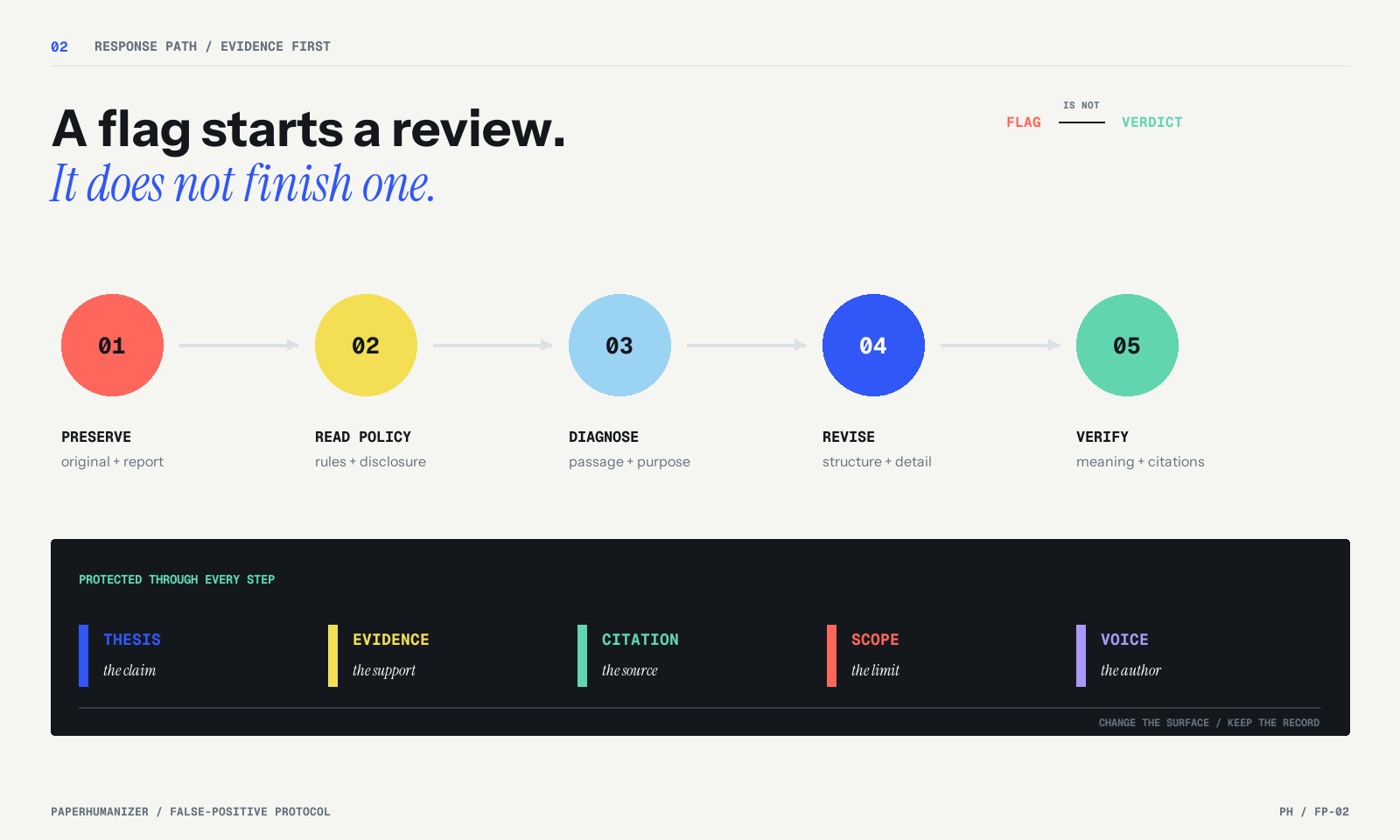
A responsible response protects the original record, separates authorship from language signals, and revises only where revision improves the work.
Should you ask your professor to review a false positive?
Yes, when the work is yours and the score has affected or may affect an academic decision. Keep the message calm and specific. Ask which passages raised concern, state any tools you used, and offer process evidence.
A concise message could say:
I wrote this essay and would appreciate the opportunity to review the flagged sections with you. I can provide my outline, source notes, and document version history showing how the draft developed. I used [name the permitted tool and purpose, if applicable]. Could we compare the highlighted passages with that record and the assignment policy?
Do not lead with claims that every detector is worthless. The more useful point is that a probabilistic result should be evaluated alongside direct evidence of your work.
What not to do after an AI flag
- Do not delete drafts or overwrite the original file
- Do not add typos to appear more human
- Do not run the essay through many paraphrasers until the meaning drifts
- Do not invent notes or version history
- Do not remove citations to simplify rewriting
- Do not treat a different detector's “human” label as proof
- Do not submit a rewritten version without reading the course policy
These actions either weaken the paper or make your authorship harder to demonstrate.
False-positive review checklist
Before resubmitting or meeting with an instructor, confirm that you have:
- Saved the original essay and detector report
- Collected authentic drafts, notes, and version history
- Read the assignment and course AI policy
- Identified the exact passages that were flagged
- Revised only generic or repetitive sections
- Preserved every source, quotation, fact, and citation
- Added your own analysis rather than cosmetic randomness
- Read the final essay aloud in context
- Prepared an accurate explanation of any tools used
Frequently asked questions
Why does Turnitin say my writing is AI when I wrote it?
Your prose may share statistical features with generated text, such as predictable phrasing, uniform sentence length, or formulaic paragraph structure. Turnitin's indicator is an estimate based on language patterns, not direct observation of how you wrote. Preserve your draft history and ask that the result be considered with authorship evidence.
Can Grammarly or another editor cause an AI flag?
Heavy acceptance of rewriting suggestions can make style more uniform, although the result depends on the text and detector. Check which features you used and whether your course permits them. If asked, describe the tool and its role accurately.
Does a high AI score prove academic misconduct?
No. A score alone does not establish authorship, intent, or policy violation. Institutions may use it as one signal in a broader review. Your process records and the applicable academic policy are central to that review.
Should I rewrite a human-written essay just to lower the score?
Revise passages that are vague, repetitive, or unlike your normal voice. If a precise passage is well supported and documented, changing it only to satisfy a classifier may reduce quality. Discuss high-stakes false positives with your instructor.
Can an essay humanizer fix a false positive?
It can help restructure repetitive or generic prose, but it cannot prove authorship or guarantee a particular detector result. Use PaperHumanizer's AI Humanizer as an editing aid, compare the output closely, and retain your authentic writing records.
How can I prevent this problem on my next essay?
Draft in a document with version history, keep notes tied to sources, write from an assignment-specific outline, and revise for concrete analysis rather than polished generalities. These practices strengthen the paper and create a clear record of its development.
The bottom line
When a human-written essay is detected as AI, separate the language signal from the authorship question. Preserve evidence first. Then review policy, diagnose the highlighted passages, and make selective changes that improve specificity and reasoning without altering the academic content.
A detector reports a pattern. Your drafts, sources, and intellectual decisions show how the paper was actually made.