
Students often reach the editing stage with a difficult combination: the essay's ideas are usable, but the prose sounds generated. They want to make the writing more natural without losing the thesis, changing the evidence, weakening citations, or drifting away from the assignment prompt.
To humanize an AI essay without changing its meaning, treat meaning as a set of protected decisions rather than a general impression. The thesis, paragraph claims, evidence, source relationships, and degree of certainty all need to survive the revision.
This guide presents a controlled workflow for college and university essays, including research-based assignments that use MLA, APA, or Chicago citations.
Try PaperHumanizer on one essay section
Why an essay's meaning can change during rewriting
Meaning is carried by more than topic vocabulary. A rewritten sentence can use the same keywords and still make a different claim.
Consider these changes:
| Original relationship | Meaning-changing rewrite |
|---|---|
| may contribute to | causes |
| is associated with | results in |
| some students | students |
| in the assigned case | generally |
| the author suggests | the author proves |
| one interpretation is | the meaning is |
Each rewrite sounds smoother or more confident, but each alters scope or certainty. Similar risks appear when a citation moves, a counterargument disappears, or two sources are blended into one broad statement.
A reliable essay humanizer without changing meaning must preserve relationships, not just nouns.
What to lock before humanizing an AI essay
Create a short essay protection map.
- Assignment: the question, required sources, format, and word-count range
- Thesis: the precise answer or position taken by the essay
- Paragraph claims: the contribution of each body paragraph
- Evidence: quotations, facts, examples, data, and textual details
- Citations: which source supports which sentence
- Qualifications: uncertainty, limits, counterarguments, and exceptions
- Voice: course level, discipline, and choices that sound like the student
Keep this map beside the original and revised drafts. It turns “the meaning seems similar” into a set of checks you can actually perform.
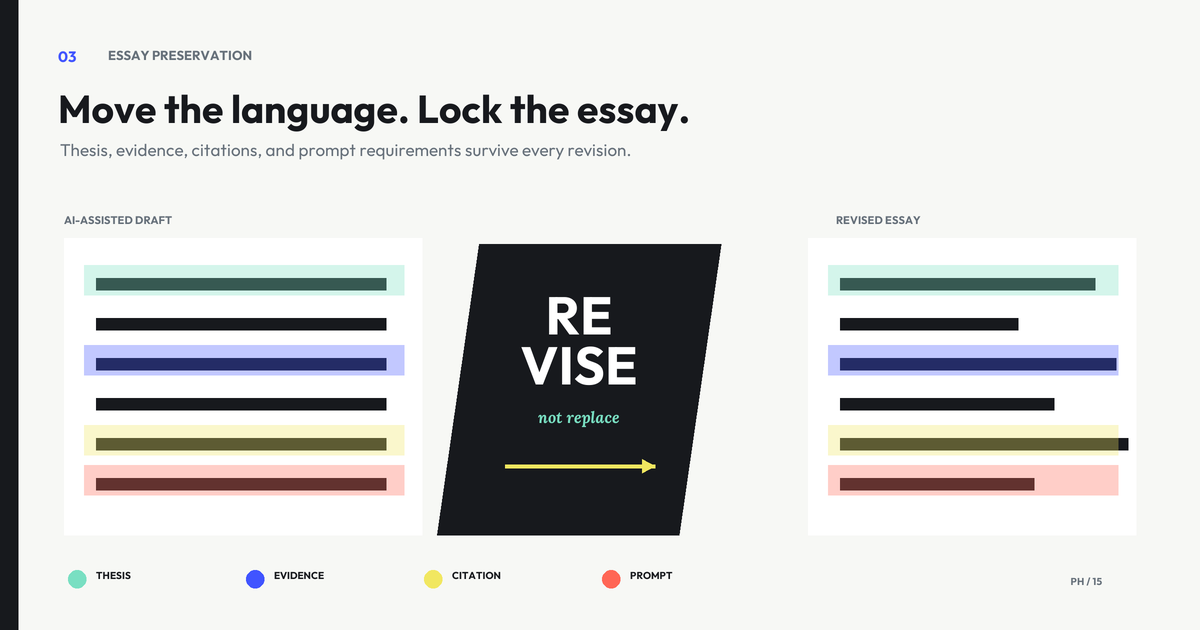
Phrasing can move, but the thesis, evidence, citation relationships, and assignment boundaries stay locked.
How to humanize an AI essay without changing meaning
1. Confirm that the essay answers the prompt
Do not begin with sentence polishing. Read the assignment prompt and underline its required action: analyze, compare, evaluate, explain, argue, reflect, or apply.
Then compare that action with the thesis. An essay that summarizes when the prompt asks for analysis needs substantive revision before humanization. A language tool cannot decide the argument for you.
Record required materials such as a course reading, number of sources, citation style, page range, or use of a particular concept.
2. Write a one-sentence argument map
Summarize the essay in this form:
This essay argues X because A, B, and C, while recognizing D.
The sentence does not need to appear in the paper. It is a control statement for the revision. If the humanized version changes X, removes D, or merges A and B into a different reason, the argument has shifted.
3. Build a paragraph-to-thesis outline
Write one line for every paragraph:
- Introduction: establishes the problem and thesis
- Body 1: defines the key distinction
- Body 2: analyzes the first example
- Body 3: presents a counterargument
- Body 4: responds with additional evidence
- Conclusion: answers the prompt within the evidence
This outline makes it easier to catch an AI rewrite that turns an analytical paragraph into background summary or removes a necessary counterargument.
4. Separate protected text from editable prose
Keep these elements outside the humanization pass when exact wording matters:
- Direct quotations
- Numerical data and formulas
- Assignment-specific headings
- Definitions required by the instructor
- Formal hypothesis or research questions
- Reference-list entries
- Code, tables, and figure labels
Revise the explanatory prose around them. Restore the protected material afterward and verify the placement.
5. Process the essay in meaningful sections
Open PaperHumanizer and work section by section. Useful units include one introduction, one or two connected body paragraphs, a counterargument-response pair, or the conclusion.
Processing an entire long essay makes differences harder to audit. Processing isolated sentences can damage paragraph flow. Choose the smallest passage that contains a complete analytical move.
For most U.S. undergraduate essays, Standard tone provides a natural academic register. Use Scholarly for advanced humanities or research synthesis and Technical / STEM for lab reports or technical explanations. See Academic Writing Tones Explained before mixing tones.
6. Compare the revision in a fixed order
Review content before style:
- Assignment response
- Thesis
- Paragraph claim
- Evidence and quotations
- Citation relationship
- Counterargument or limitation
- Transition to the next section
- Tone and sentence rhythm
If a higher-priority item changes, restore it before evaluating whether the prose sounds more natural.
7. Reconnect citations to claims
Keeping citation characters is not enough. A revised sentence must still represent the source accurately.
For every citation, ask:
- What exact proposition does this source support?
- Is the revised proposition stronger or broader?
- Did the population, text, period, or setting change?
- Did a correlation become a cause?
- Does the citation now appear after a sentence it did not support originally?
- Were two sources made to look as though they agree completely?
For research-heavy assignments, follow the expanded AI humanizer with citations checklist.
8. Restore the student's intellectual choices
Natural college writing reflects decisions that belong to the writer:
- Why this example is more important than another
- Which interpretation is most convincing
- Where a source is limited
- How a concept from class changes the analysis
- Why the counterargument does not fully resolve the issue
Add those choices after the automated revision. Personal judgment is more valuable than artificial imperfection.
9. Run the full-paper alignment check
Read the thesis, first sentence of each body paragraph, and conclusion together. They should form one coherent argument.
Then verify:
- The introduction promises what the body actually does
- Paragraphs appear in a logical order
- Repeated key terms have consistent meaning
- The conclusion does not make a larger claim than the essay established
- Word count and formatting still meet the assignment
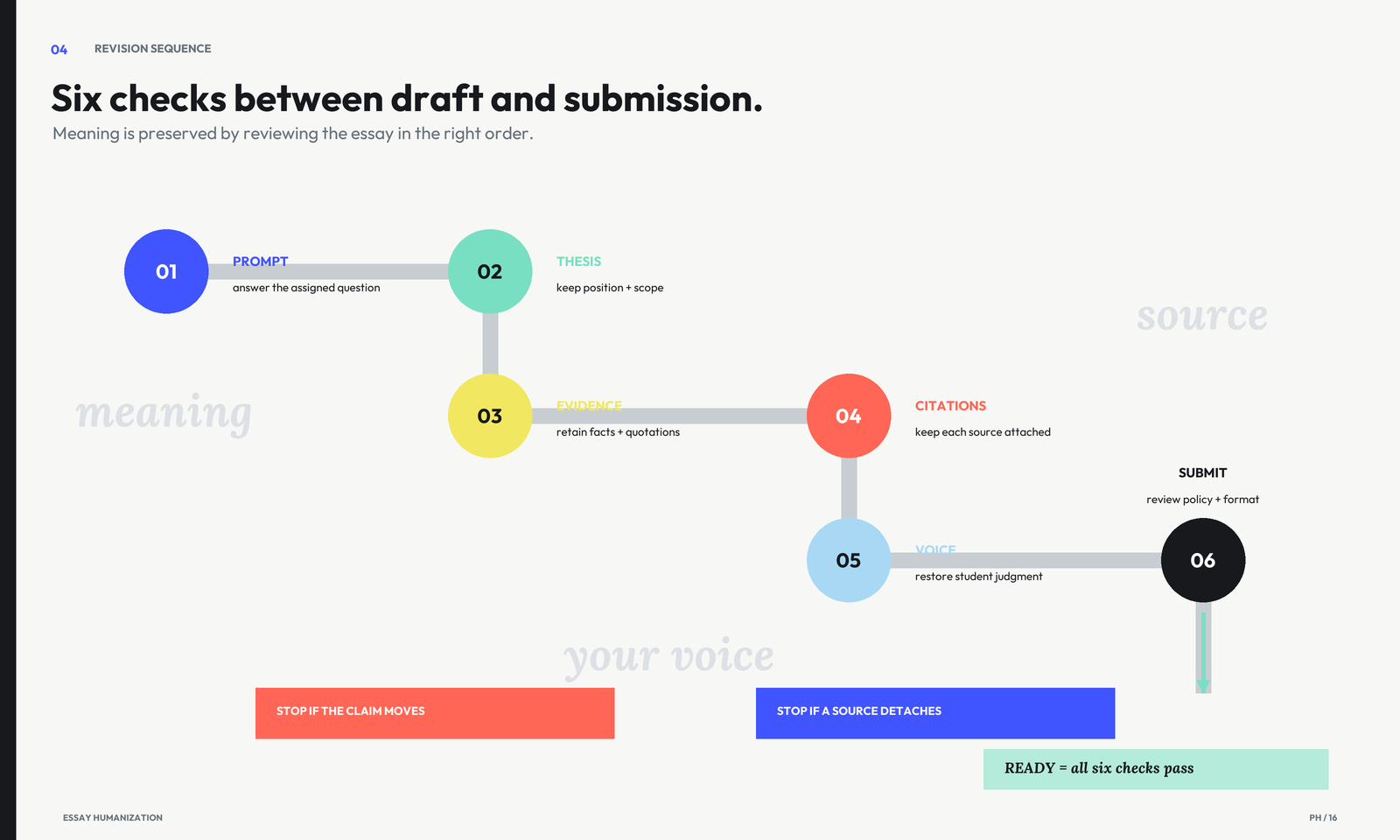
A safe essay rewrite passes through prompt, thesis, evidence, citation, voice, and submission checks in that order.
Before and after: improve the prose while keeping the point
AI-assisted draft
Social media has significantly transformed political participation among college students. Furthermore, it provides students with access to a wide variety of political information. This demonstrates that social media increases civic engagement because students are able to learn about political issues and share their opinions with others. Therefore, social media is an important tool for democracy.
Controlled revision
Social media has changed how many college students encounter political information, but greater access does not necessarily produce sustained civic participation. Students can share commentary or learn about an issue quickly, while activities that require more time—such as attending meetings, contacting officials, or organizing locally—remain less certain. Social media may lower the barrier to initial engagement without determining what students do afterward.
The revision preserves the topic but corrects an unsupported causal leap. It distinguishes access, expression, and sustained participation rather than treating them as the same outcome. In a sourced essay, citations supporting each relationship would need to remain attached and be verified.
How to preserve MLA, APA, and Chicago citations
MLA
Protect author names, shortened titles when required, and page numbers. Keep the citation immediately after the quotation or paraphrase it supports. Verify that punctuation remains correct.
APA
Check author-year pairs, page or paragraph numbers for direct quotations, and whether narrative citations still fit the sentence grammar. Do not alter technical claims while leaving the same citation behind.
Chicago
Preserve note numbers and their relationship to the sentence. If paragraphs move, confirm that footnotes or endnotes still appear in the intended order.
For every style, leave reference-list or bibliography entries outside the language-revision pass.
Humanizing different kinds of college essays
Argumentative essays
Protect the thesis, reasons, counterargument, and response. Do not let more confident language erase a genuine limitation.
Literary analysis
Keep quotations exact and preserve distinctions among author, narrator, speaker, and character. Revise the analysis around the textual evidence.
Research essays
Use a source-to-claim map. Verify every citation and preserve differences among studies, methods, populations, and findings.
Reflective essays
The experience, perspective, and interpretation must remain the student's own. A humanizer can improve clarity but should not invent memories, emotions, or personal details.
Compare-and-contrast essays
Protect the basis of comparison. Do not let a smoother transition imply similarity where the essay originally identified an important difference.
Lab and technical reports
Keep values, units, methods, outcome direction, and uncertainty exact. Process technical prose in small units and use Technical / STEM tone.
Essay humanizer versus academic paraphraser
An academic paraphraser mainly changes wording and sentence structure. It can be useful when a passage is unclear or when you need to restate your own writing more concisely.
An essay humanizer should address broader patterns: repetitive transitions, uniform cadence, generic analysis, overly balanced paragraph structures, and tone that does not fit the course. It still cannot verify a source or determine whether the argument is academically sound.
Use either tool only on work you are authorized to revise, and follow the policy that applies to the assignment.
Common meaning-changing errors
Reject or correct a revision if it:
- Changes the thesis or the essay's position
- Removes a counterargument, limitation, or exception
- Makes a claim more certain or universal
- Changes names, dates, numbers, quotations, or technical terms
- Moves a citation to a different proposition
- Adds a source, example, or detail you did not provide
- Replaces course vocabulary with generic wording
- Makes a reflective essay sound like someone else's experience
- Changes the assignment genre or required tone
- Produces a conclusion stronger than the body supports
Final essay-preservation checklist
- The essay still answers the exact assignment prompt
- The thesis has the same position, scope, and qualification
- Every body paragraph performs the same argumentative function
- Evidence, quotations, names, dates, and numbers are exact
- Citations remain connected to the correct claims
- Counterarguments and limitations remain visible
- Course concepts and technical terms are preserved
- The conclusion matches the evidence developed in the body
- The voice remains appropriate for the student and course level
- The final draft follows the instructor's AI-use policy
Frequently asked questions
Can I humanize an AI essay without changing its meaning?
Yes, when you define and verify the protected meaning: assignment response, thesis, paragraph claims, evidence, citations, qualifications, and conclusion. Never rely only on whether the revision “sounds similar.”
Is there an AI essay humanizer that preserves citations?
PaperHumanizer can retain citations during language revision, but no tool removes the need for source verification. Compare each revised claim with the cited source before submission.
How do I make an AI essay sound human without changing the content?
Revise sentence rhythm, transitions, specificity, and paragraph movement while keeping the argument map fixed. Add course-specific interpretation and the student's own judgment after the automated pass.
Should I humanize a whole essay at once?
For a short essay, one pass may be manageable. For research-based or longer assignments, process coherent sections so citations and paragraph functions can be reviewed carefully.
Can I humanize a ChatGPT essay without changing the thesis?
Yes, but record the thesis before revision and compare it word by word for position, scope, and certainty afterward. The ChatGPT essay checklist provides additional submission checks.
Is using an essay humanizer allowed in college?
Policies vary by institution, course, and assignment. Some allow language editing but not content generation; others require disclosure or prohibit AI assistance. Follow the policy and ask the instructor when it is unclear.
Humanize your essay section with PaperHumanizer, then compare the result against your thesis, evidence, and citations before moving to the next section.