
When Copyleaks says your writing is AI, start by reviewing the highlighted passages, not by chasing a perfect score. The result is a pattern-based estimate. It does not independently prove who wrote the assignment, whether a tool was permitted, or whether a highlighted sentence is inaccurate.
For students, the safest workflow is to preserve drafts, check the course policy, diagnose repetitive or generic sections, revise at the level of reasoning and structure, and verify every citation. This can reduce AI-like patterns while making the paper more specific and defensible.
This guide explains how to interpret Copyleaks AI detection, respond to a possible false positive, and revise flagged academic prose without sacrificing your argument.
Humanize flagged academic writing with PaperHumanizer
What is the Copyleaks AI detector for students?
Copyleaks provides AI-content detection alongside other text-analysis products. A school may expose the result through a learning platform, an instructor report, or a separate scan. The interface and labels can change, so use the definitions shown in the version of the report you receive.
At a high level, an AI detector examines patterns across prose and estimates whether they resemble text produced by generative models. It does not search for one forbidden word. Signals may include:
- Highly predictable word sequences
- Similar sentence lengths and constructions
- Repeated transition patterns
- Consistently generic explanations
- Abrupt changes in style between sections
- Clusters of sentences that share model-like regularity
The analysis is probabilistic. A highlight means “review this passage,” not “this sentence has a known machine author.”
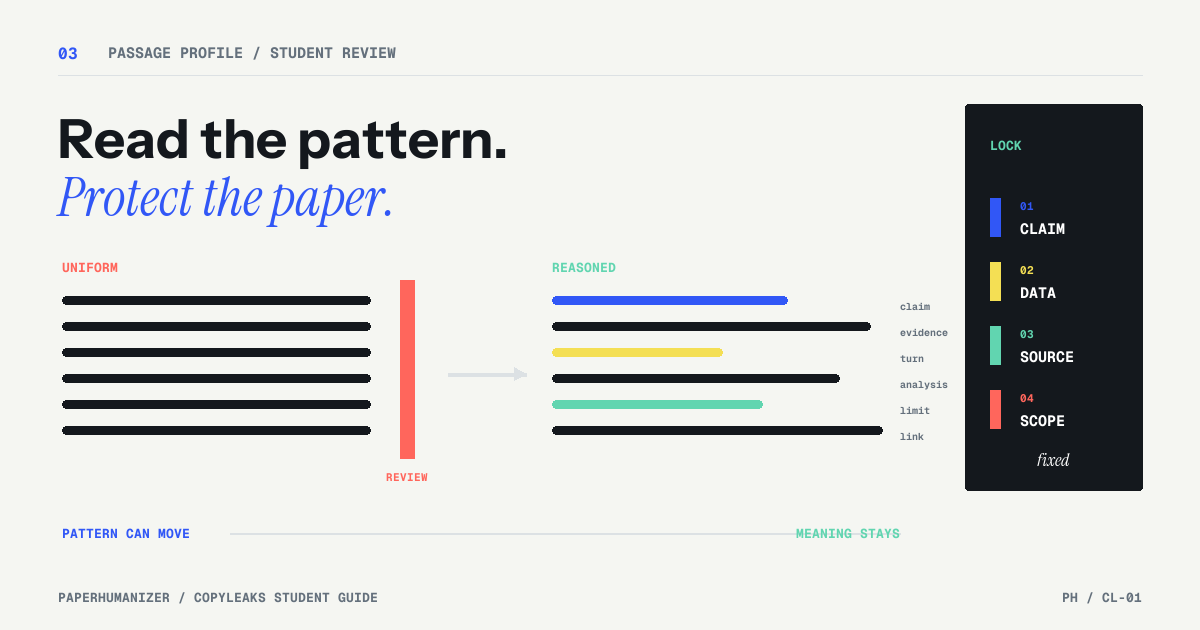
The useful unit of review is the passage: pattern, purpose, evidence, and context should be considered together.
How to read a Copyleaks AI detection result
Students often focus on the largest number in the report. That number needs context. A percentage can refer to text classification, the proportion of qualifying content, or a platform-specific confidence measure. It should not automatically be translated into “the detector is this certain I cheated.”
Read the report in four layers:
| Report layer | Question to ask |
|---|---|
| Overall indicator | What exactly does Copyleaks say this number represents? |
| Passage highlights | Which complete paragraphs contain the strongest signal? |
| Excluded content | Were quotations, references, or short sections excluded? |
| Writing context | Does the passage use required technical or formulaic language? |
Take screenshots or export the report before revising. If an instructor supplied only an overall score, ask whether passage-level information is available. A document-wide number gives you less actionable evidence than specific highlights.
Why Copyleaks may flag academic writing
Formulaic introductions
Generated essays and rushed student drafts often begin with broad statements such as “Throughout history” or “In today's rapidly changing world.” These openings contain little information specific to the assignment, so their wording is unusually predictable.
A stronger introduction moves quickly to the problem, text, case, or debate the essay actually examines.
Repetitive paragraph architecture
If every paragraph begins with a general topic sentence, adds two pieces of summary, and ends with “This demonstrates the importance of...,” the whole paper develops a mechanical rhythm. The issue is not simply the final phrase. It is the repeated sequence of functions.
Polished but non-specific analysis
Sentences can sound academic without doing analytical work. Phrases such as “This highlights the complex nature of the issue” or “There are many factors to consider” do not identify the complexity or the factors. Because these statements fit almost any subject, they are common in generated text.
Constrained technical prose
Lab procedures, definitions, legal rules, and standard methods use recurring language for legitimate reasons. A detector may see regularity where the discipline requires precision. Preserve essential terms and document your process rather than distorting accurate language to create artificial variation.
Strong editing or translation
Automated editing can flatten a student's idiosyncratic phrasing into a consistent register. Translation can also produce conventional English sequences. Whether that use is acceptable is a policy question; the detection result alone cannot answer it.
Mixed authorship patterns
A paper assembled from personal writing, generated drafts, quotations, group notes, and heavily edited sections may shift style abruptly. Even when every included resource is permitted, those shifts can attract review. Consistent authorship does not mean every sentence must sound identical, but the paper should have a coherent argument and voice.
How to pass the Copyleaks AI detector responsibly
Students use the phrase “how to pass Copyleaks AI detector” for different situations. Some wrote the assignment themselves and face a false positive. Others used AI in a way their course permits and need to turn a rough draft into their own supported work. The responsible goal is not to disguise prohibited activity. It is to produce writing you can verify, explain, and defend under the assignment policy.
No method can guarantee a score across every text or future detector update. The following workflow targets writing quality and authorship evidence rather than a temporary trick.
Step 1: Freeze the original record
Before changing anything, keep:
- The exact submitted file
- The Copyleaks report or screenshots
- Outline and research notes
- Document version history
- Annotated readings and source PDFs
- Earlier drafts and feedback
- A record of permitted tools you used
These records matter if the result becomes an academic integrity question. Never manufacture process evidence after the fact.
Step 2: Check policy and assignment boundaries
Read the syllabus and the instructions for this assignment. Identify whether they address brainstorming, outlining, translation, grammar correction, paraphrasing, or generated prose. If policy language is unclear, ask the instructor before resubmitting a substantially revised version.
The goal is policy compliance, not merely classifier compliance. A low score cannot make prohibited tool use acceptable, and a high score cannot erase authentic evidence that you wrote the work.
Step 3: Map the highlighted passages
Create a simple table with three columns: location, paragraph function, and likely issue.
| Location | Function | Possible reason for flag |
|---|---|---|
| Introduction 1 | Broad context | Generic opening and predictable wording |
| Body 3 | Source synthesis | Three sentences share the same structure |
| Body 5 | Method description | Required technical language; preserve and document |
| Conclusion | Restatement | Repeats thesis without adding implications |
This map prevents unnecessary rewriting. It also separates a style problem from constrained language that should remain precise.
Step 4: Recover the purpose of each paragraph
Write one sentence explaining what each flagged paragraph must accomplish. Examples:
- Contrast the two authors' explanations of the same result
- Show why the second data point limits the thesis
- Explain the choice of sampling method
- Connect the case study to the course concept
If you cannot state the purpose, the paragraph may be generic because the reasoning is unfinished. Solve that problem before changing the style.
Step 5: Revise patterns, not isolated words
Surface substitutions rarely solve repetitive structure. Revise at three levels:
Paragraph movement: Change the order when the evidence should lead, a counterexample should interrupt, or a qualification belongs next to the claim.
Sentence function: Alternate among claim, evidence, analysis, limitation, and connection according to the argument. Variation should emerge from function.
Specificity: Name the author, result, scene, concept, population, or limitation that makes the statement true in this paper.
You can use PaperHumanizer for a section-level revision after defining what must remain fixed. Paste enough context to preserve the argument, select an appropriate academic tone, and compare the output rather than accepting it automatically.
Step 6: Protect the academic core
Before revising, mark the elements that cannot drift:
- Thesis and subclaims
- Direct quotations
- Authors, dates, and page numbers
- Data, formulas, and units
- Technical terminology
- Causal versus correlational language
- Required citation style
Process quotations separately or restore them exactly afterward. A citation that remains visible can still become misleading if the sentence around it changes what the source supposedly supports.
Step 7: Add evidence of your own judgment
Natural academic voice comes from choices, not imperfections. Explain why one detail matters, what a source overlooks, how a concept applies to the assigned case, or why the evidence supports only a limited conclusion.
Avoid inserting personal anecdotes into assignments that do not call for them. “Human” does not mean casual. It means the prose reflects an identifiable line of reasoning.
Step 8: Recheck in context
Put the revised section back into the full paper and read the paragraph before and after it. Confirm that pronouns, terminology, transitions, and scope still work. Then run a new scan only if your access and course rules allow it.
Treat the new result as a quality-control signal. Repeatedly processing the same text until one system shows zero can create awkward prose and citation drift.
Before-and-after example for Copyleaks-flagged writing
Before: smooth but interchangeable
The study provides important insights into student motivation. Furthermore, the findings demonstrate that multiple factors influence academic success. These factors can have both positive and negative effects on students. Therefore, educators should consider these findings when developing effective strategies.
This paragraph uses grammatical academic English, but it does not identify the study, factors, finding, or implication. Its four sentences also repeat a highly familiar explanatory pattern.
After: specific and traceable
Perez and Lin found that weekly peer feedback predicted course persistence, but only for students who attended at least half of the workshops. That condition changes the practical takeaway. Adding a feedback tool by itself may do little; instructors also need a routine that gives students a reason to return and respond. The study therefore supports a structured workshop model, not a general claim that “more feedback” improves motivation (Perez & Lin, 2025, p. 18).
The revision varies because the reasoning varies: finding, limitation, interpretation, and bounded conclusion. It also makes the citation relationship visible. The names and result are illustrative, so replace them with accurate details from your source rather than adding invented evidence.
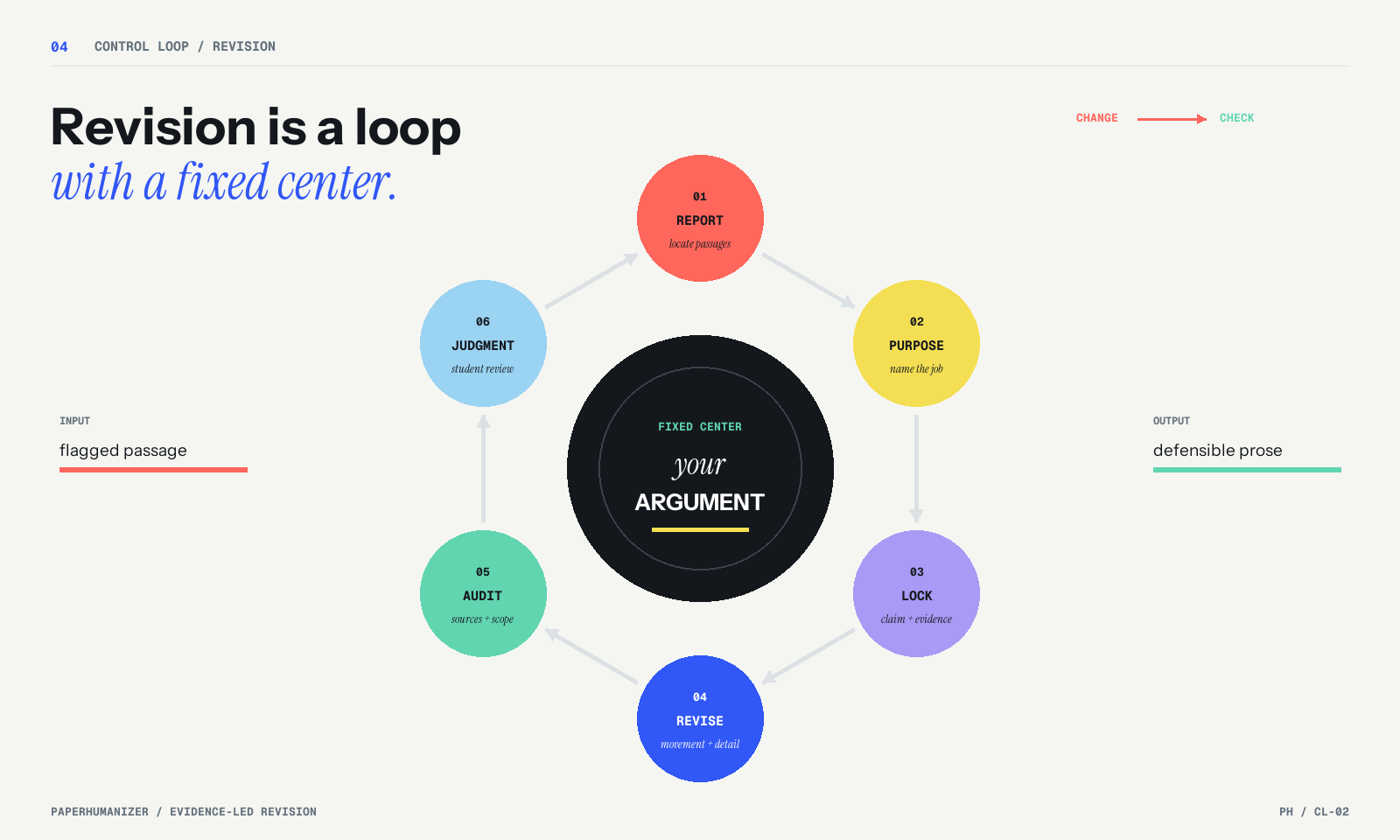
A controlled loop changes detectable patterns while repeatedly checking the argument, evidence, and authorship record.
Changes that usually do not solve the problem
Synonym spinning
Replacing “important” with “significant” leaves the sentence pattern and generic reasoning intact. It can also introduce words that do not fit the discipline.
Deliberate grammar errors
Typos do not demonstrate human authorship. They lower quality and may still leave document-level patterns unchanged.
Random sentence splitting
Turning every long sentence into two short ones creates a new uniform pattern. Vary sentences based on purpose, not a mechanical length rule.
Translation and back-translation
This can distort technical terms, hedging, and citations. It does not produce reliable results across detectors.
Removing citations before revision
Citation removal makes it harder to verify which claim belongs to which source. Protect citations and audit them after any substantive rewrite.
Testing fragments repeatedly
One or two sentences may lack enough context for a stable result. Diagnose complete paragraphs and evaluate them inside the paper.
Copyleaks false positive: how to talk with an instructor
If you believe the result is wrong, ask for a review centered on evidence. Avoid framing the conversation as a contest between competing detectors.
Bring:
- The flagged report and exact submitted document
- Version history showing development over time
- Outline, source notes, and annotated readings
- Earlier feedback incorporated into the draft
- An accurate list of writing tools used
- A short explanation of how one paragraph developed from a source or class idea
You might write:
I would like to review the Copyleaks result because I developed this paper from my outline and source notes. I can share the document history and explain the highlighted passages. I used [tool and permitted purpose, if applicable]. Could we evaluate the report alongside those materials and the course policy?
That response does not ask the instructor to ignore the result. It asks them to place it in the correct evidentiary context.
Student revision checklist
Before submitting the final version, verify that:
- Each paragraph has a clear job in the argument
- General claims have assignment-specific support
- Sentence structures change because sentence functions change
- Formulaic transitions have been replaced with real logical connections
- Quotations match the source exactly
- Citations still support the same claims
- Numbers, names, dates, and technical terms are unchanged
- Your version history and notes are preserved
- Any required AI-use disclosure is complete
- You can explain and defend every paragraph
Frequently asked questions
Is Copyleaks AI detection accurate for student essays?
It can identify statistical patterns associated with generated writing, but no detector is a perfect authorship test. Results depend on the text, sample length, genre, model version, and threshold. Treat the report as one source of evidence and review it with the student's writing process.
Why does Copyleaks say my writing is AI when it is human-written?
Formal register, repetitive structure, generic phrasing, constrained technical language, or extensive automated editing may contribute to a false positive. Preserve drafts and inspect the specific passages rather than assuming the overall label explains the cause.
How can I reduce a Copyleaks AI score?
Focus on the writing: make claims specific, vary paragraph movement, replace empty transitions with logical ones, and add your own analysis. Keep all evidence and citations accurate. A score may change, but the primary outcome should be a stronger, more defensible paper.
Can a humanizer guarantee that writing will pass Copyleaks?
No responsible tool can guarantee a result for every document or future detector version. PaperHumanizer can help revise AI-like academic patterns while preserving meaning, but you must review the output, comply with course rules, and keep authentic authorship evidence.
Is passing Copyleaks the same as avoiding plagiarism?
No. AI detection and source attribution address different questions. A passage can receive a human label and still plagiarize a source, or it can be original and still receive an AI flag. Cite borrowed ideas and language regardless of the detector result.
Should I use several AI detectors before submitting?
Multiple reports may show disagreement, but they do not replace a careful review. If your school uses Copyleaks, prioritize the report you actually received, your assignment policy, and direct evidence of your writing process.
The bottom line
If your institution uses a different provider, do not reuse Copyleaks score assumptions automatically. The Pangram student guide explains that provider's report terminology and a passage-by-passage review workflow.
For students, the best response to Copyleaks AI detection is a controlled academic revision. Preserve the original record, interpret highlights in context, fix generic reasoning, protect citations, and document permitted tool use.
Passing a detector is not the final standard. The stronger standard is an essay whose argument is specific, whose evidence is traceable, and whose development you can explain.