
Imagine a sentence in your literature review comes back from an AI humanizer sounding smoother. There’s one small change: “may be linked to” now reads “improves.” You’ve gone from describing an association to claiming a cause. The citation is still there, which makes the mistake easy to miss.
That is the test I would run when choosing between Walter Writes and PaperHumanizer for a paper. Put the same evidence-bearing paragraph through each tool, then read the result as if you had to defend it in front of your supervisor. A tool that saves five minutes of writing but creates twenty minutes of checking is a bad fit for that draft.

An imagined peer feedback session from the article’s pilot study. The rewrite has to preserve what the study design can tell us about the results.
The paragraph to put on the desk
Here is a fictional test paragraph. The source marker and study details were invented for this exercise. The paragraph is long enough to contain a claim, a limitation, and a practical implication, but short enough to check line by line.
In a six-week pilot involving 48 first-year students, scheduled peer feedback may have been linked to higher revision completion rates (Rivera, 2025). The groups were not randomly assigned, so differences in completion may reflect who signed up rather than the feedback sessions themselves. These findings justify a larger trial but do not establish that the sessions caused the improvement.
Copy this exact passage into each tool. Choose the closest available academic tone, keep the original beside both outputs, and compare the first completed rewrite from each before trying more settings. If you use your own material, choose a passage you’re allowed to share and whose source you have open.
Check 1: Did the conclusion quietly change?
Write a short note before you compare results: six weeks, 48 students, nonrandom groups, association only. These are facts or limits the edit has to retain. Check scope as well: “first-year students” cannot become “university students in general.”
A sentence such as “Peer feedback improves revision completion” is a poor trade even if the rest of the paragraph reads beautifully. A possible faithful edit is “Among the 48 first-year students in the six-week pilot, scheduled peer feedback was associated with higher revision completion (Rivera, 2025).” The next sentence still needs to explain the nonrandom groups. This is an illustrative edit, not output from either tool.
Check 2: Does the citation still support the right claim?
Look at the words immediately before each source marker. Rivera belongs with the pilot’s observation. If the rewrite moves the citation to a new sentence about why students revise more, it may be making the source support a mechanism you never observed. For multiple references, check each one against its own claim. A citation count alone won’t catch a citation that has moved.
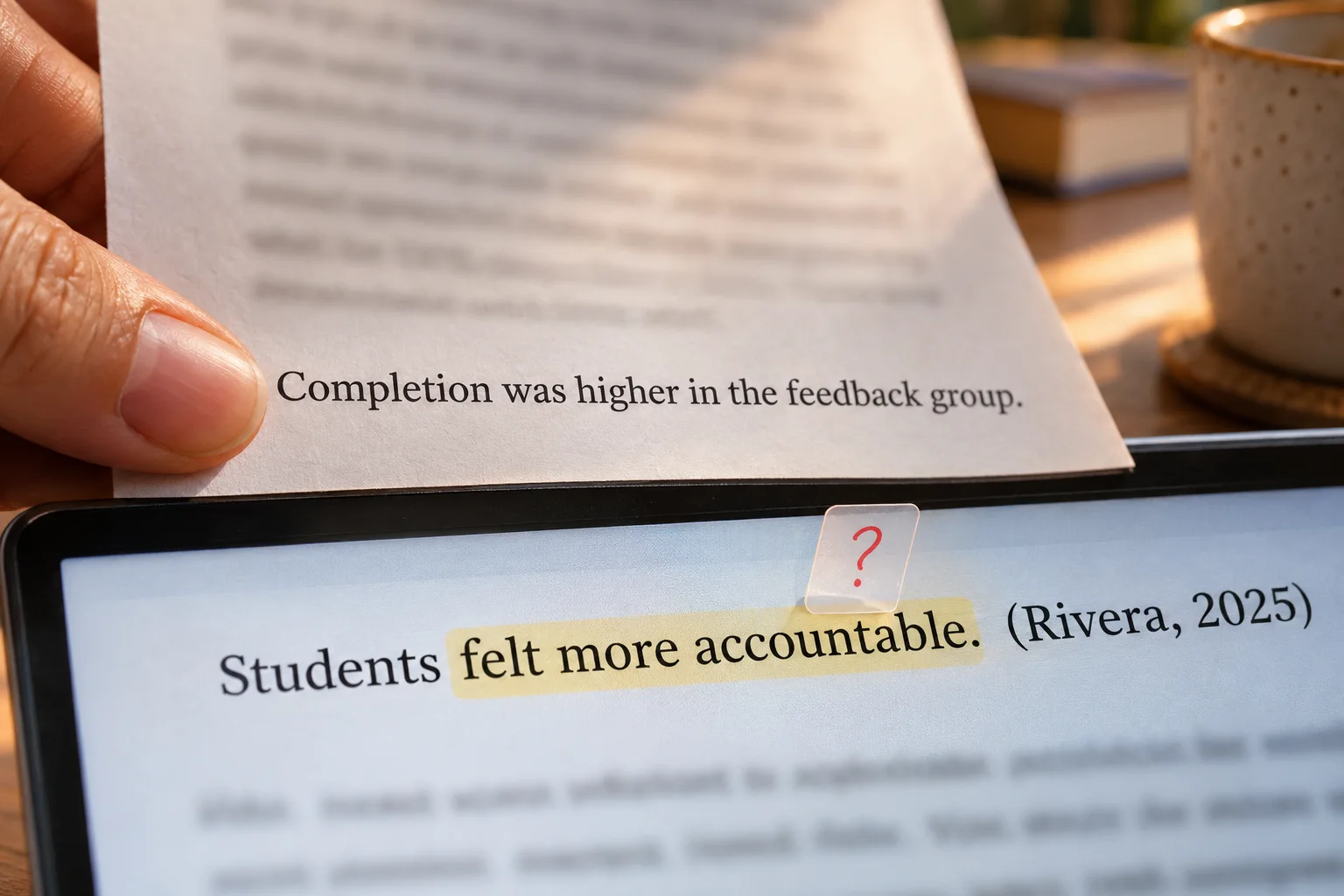
Compare the source excerpt with the highlighted claim. The fictional study measured completion rates, so the draft needs separate evidence for how the students felt.
Check 3: How much work is left?
Set a timer for the review and record the fixes you actually make. Mark whether you had to restore a number, repair a citation, reinsert a qualification, or undo a tone change. Then read both accepted versions aloud. The better draft should make the logic easier to follow without flattening the paragraph into generic prose.
Try the exercise again with a different part of your paper. A literature review tests the boundary between sources; a methods paragraph tests procedure and sequence. One smooth paragraph tells you little about the tool’s fit for both.
What the two tools give you to work with
Walter Writes describes a broad rewriting tool that accepts pasted text and offers tone options, including academic and professional. It also offers a separate detector workflow. Walter is a reasonable one to try when you edit a mix of essays, emails, and other everyday copy and want to see how one tool handles those voices.
PaperHumanizer, which publishes this guide, is built around academic drafts. You can open the Humanizer, paste a paragraph or import text from a supported file, select an academic purpose and tone, then use Compare to check input and output side by side. That view is useful when you know what you need to protect and want to spot changes in the passage quickly. For a manuscript with several sections, review one at a time before putting the revised text back into the source document.
The two products’ descriptions were checked on November 4, 2026. This is a workflow comparison and a test you can run, with no independent head-to-head detector benchmark. A detector result cannot tell you whether a citation is attached to the right statement.
When to choose
If you write mostly academic work with citations, run the trial first on a paragraph that has a number, a qualifier, and a reference. Prefer the tool that gets you to an acceptable, traceable paragraph with less cleanup. If you edit mostly everyday copy, give both a practical test with the same email or short report and judge how well each handles your audience.
If the original idea or evidence is still missing, go back to your notes first. When a draft is permitted to use editing assistance and the substance is already yours, try the sample paragraph in PaperHumanizer and keep the Compare tab open for the checks above. For a longer manuscript, use the research writing guide on protecting citations as you work through the remaining sections.