
An AI resume humanizer helps revise an existing resume so that it describes your work clearly rather than sounding like a generic professional profile. The strongest improvement is usually more specific language: what you did, what you worked with, and what you can support. Replacing “results-driven” with another flattering adjective does little for a recruiter trying to understand your experience.
For students, recent graduates, and research applicants, the task is especially concrete: turn coursework, placements, campus roles, or research contributions into accurate evidence without making them sound like senior professional responsibilities.
Have a draft already? Try a resume section in PaperHumanizer using Professional purpose and Standard Academic tone as a starting point. Review each bullet and restore a concise resume format before using it.
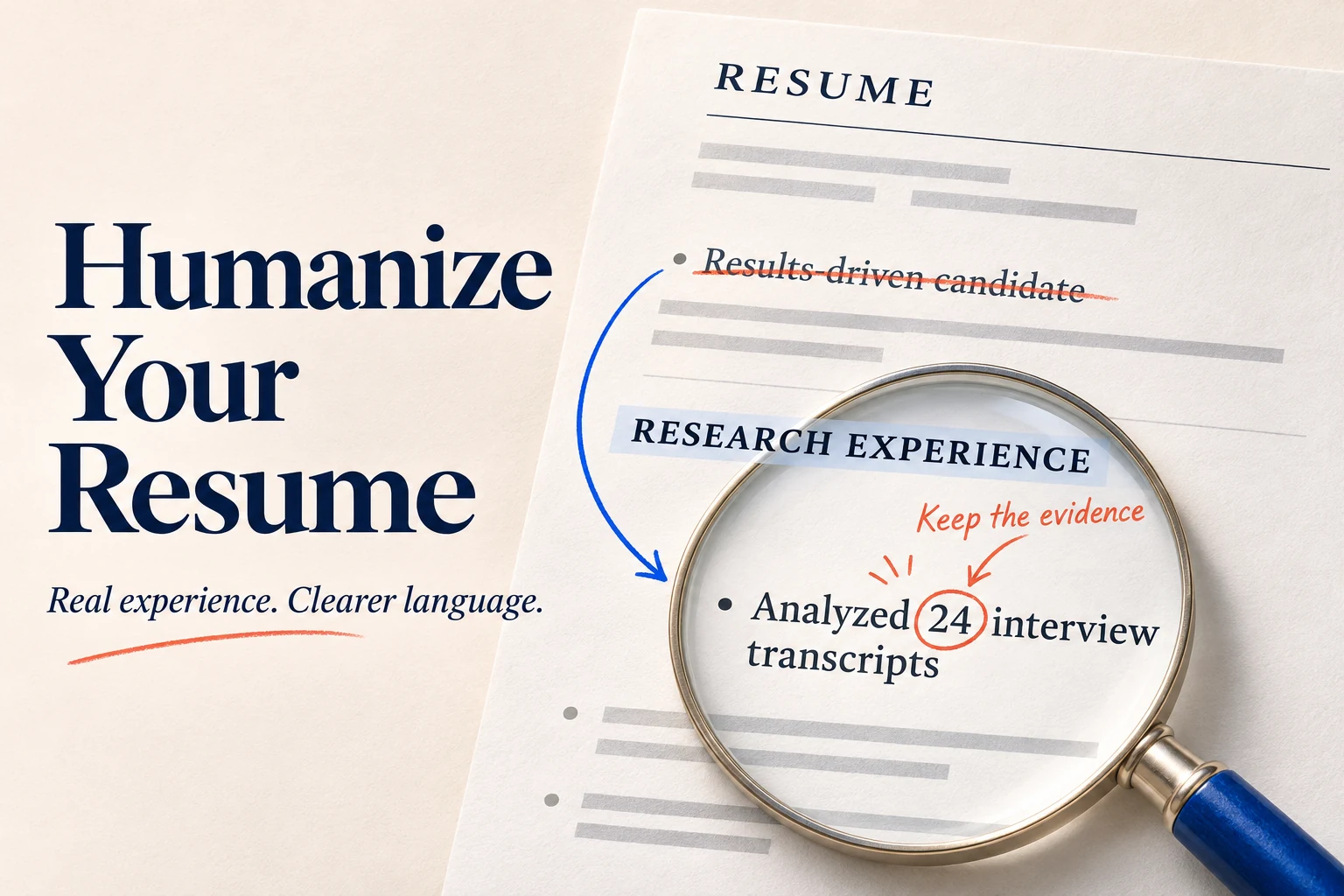
Make the experience easier to understand. Keep the facts, the scope of your contribution, and the evidence behind every number.
Why a ChatGPT resume often sounds generic
A generated resume can be fluent while revealing very little. Phrases such as “dynamic problem-solver,” “proven track record,” and “leveraged innovative solutions” are broad enough to fit many applicants. They do not tell the reader which problem you solved, what you actually contributed, or what changed.
Look for these editing targets:
- A summary full of qualities without an example of the work.
- Multiple bullets beginning with the same vague verb.
- A class assignment described as a company-wide initiative.
- A skill taken from the job description without evidence that you used it.
- An impressive percentage that never appeared in your notes.
- Long sentences that hide a simple, useful contribution.
The issue is not whether an individual word proves AI use. Common resume vocabulary is not an authorship test. The issue is whether a reader can understand and trust the experience behind it.
Humanizing a resume means editing the evidence you have
Start from your existing draft and accurate notes. Harvard's guidance on AI for resumes and cover letters recommends using generated wording as an edit to review, with attention to whether it accurately represents your experience. That is a useful standard for a humanizer too.
Before revising, separate the fixed facts from the wording you want to improve:
| Keep fixed | You may revise |
|---|---|
| Employer, organization, course, and role names | The order in which useful details appear |
| Dates and qualification status | Empty framing and repeated openings |
| Tools you actually used | Verb choice, if it still describes your role |
| Your own contribution versus the team's work | Awkward phrasing and unnecessary jargon |
| Verified counts, results, and limitations | Sentence rhythm and concision |
Do not let an editing tool fill a factual gap with a plausible achievement. If you did not measure an outcome, describe the task and its scope instead. A truthful account of useful work is stronger than a fabricated improvement rate you cannot explain.
Before-and-after resume bullets you can learn from
These are fictional teaching examples, not real candidates or measured PaperHumanizer outputs. The “facts” in each example are the information the applicant has supplied. Use the pattern with your own experience rather than copying the claims.
1. Research assistant: retain the contribution boundary
Facts supplied: You coded 24 interview transcripts in NVivo and discussed inconsistent labels with a doctoral researcher. You did not design or lead the study.
Generic AI draft
Leveraged advanced qualitative research methodologies to drive actionable insights and support impactful academic outcomes.
More useful bullet
Coded 24 interview transcripts in NVivo and reviewed inconsistent labels with the doctoral researcher.
The revision names the material, tool, and contribution. “Led a qualitative research program” would misrepresent your responsibility even if it sounded more confident.
2. Internship: use scope when you do not have an impact metric
Facts supplied: You checked 180 spreadsheet rows against receipts and sent exceptions to your supervisor. No error-reduction rate was measured.
Generic AI draft
Demonstrated exceptional attention to detail while optimizing financial operations and enhancing organizational efficiency.
More useful bullet
Checked 180 expense entries against receipts and flagged discrepancies for supervisor review.
A documented count can make the work concrete. It does not justify adding “reduced accounting errors by 35%.” When no reliable number exists, omit the number rather than inventing one.
3. Class project: identify it as coursework
Facts supplied: In a four-person course project, you wrote Python scripts to clean a public dataset and documented missing-value decisions. Your team presented the analysis to the class.
Generic AI draft
Spearheaded a transformative data analytics initiative, delivering strategic recommendations to key stakeholders.
More useful bullet
Wrote Python data-cleaning scripts for a four-person course project and documented how missing values were handled.
That wording makes the technical contribution visible without turning a classroom audience into business stakeholders. The project can still be relevant to a real job; it does not need a false setting to become useful.
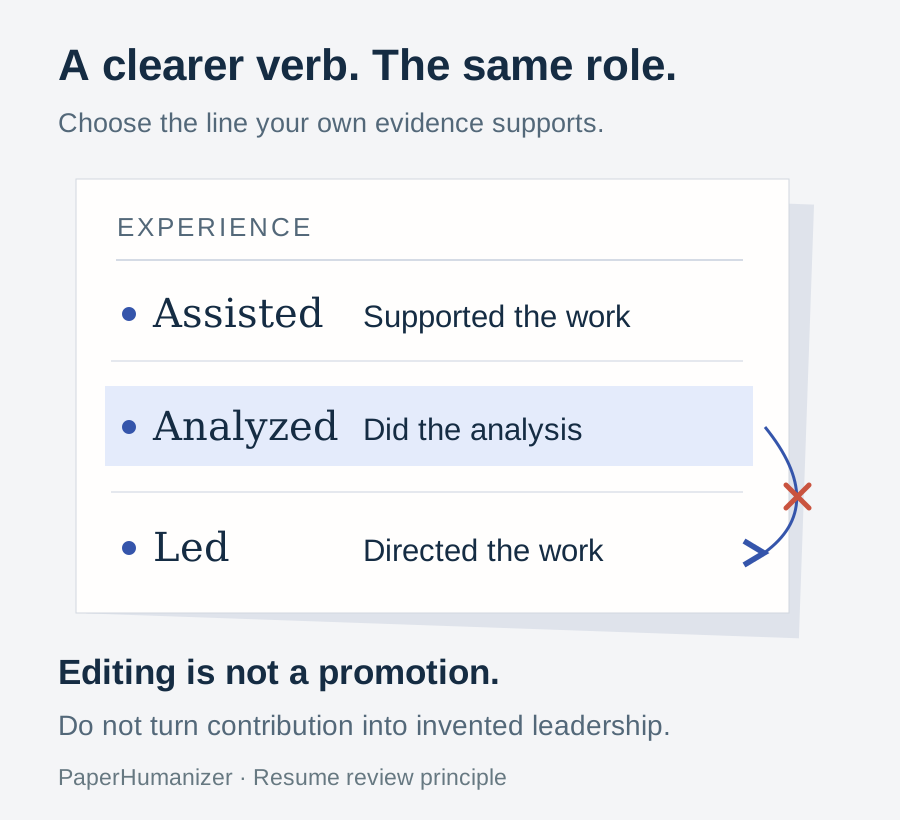
A stronger verb is useful only when it is accurate. Editing should clarify your contribution, not silently promote your level of responsibility.
A five-step workflow for humanizing your resume
Step 1: build a small fact sheet for each role
For each experience, record your role, actual tasks, tools, scope, and any result you can verify. Include the context: paid work, internship, volunteering, course project, or research placement. Keep that fact sheet outside the rewriting tool as the source of truth.
Remove contact details, student identifiers, client names, unpublished research details, and other confidential material from the excerpt you send to any AI service. You can restore necessary information in your final document afterward.
Step 2: identify the real requirement in the job description
Choose one or two requirements your experience can support. If the role asks for data cleaning and documentation, the class-project example above is relevant. If it asks for staff supervision, that example does not establish it.
Keep exact technical terms when they accurately describe your work. A humanization pass should not turn Python into “programming solutions” merely to sound different. It should also not add SQL because the advertisement mentions it when you did not use it.
Step 3: revise one coherent experience section
In PaperHumanizer, paste the relevant summary or experience text. Professional purpose is a reasonable starting point for employment writing. For a research-oriented passage, compare an academic tone with the actual expectations of the role.
The editor is a rewriting workspace, not a resume template builder or an ATS scoring system. Work on the wording, inspect the completed result, and then return accepted text to your resume document. If a rewritten bullet becomes a paragraph, shorten it manually. If the original was already precise, keep it.
Step 4: compare every verb and number
Use the original and rewritten text side by side. Check that assisted has not become led, a team result has not become an individual result, and a proposed project has not become a completed one. Confirm the spelling of technical terms, dates, and qualification names.
Read each accepted bullet as an interview question: “Tell me how you did this.” You should be able to answer from your own experience. If the wording implies knowledge you do not have, edit it before it reaches an employer.
Step 5: check the final file separately
Return the wording to the master resume and inspect the actual file you will upload. A text rewrite does not establish that the file will parse correctly, fit a page, or retain the right reading order.
For the accompanying letter, use the AI cover letter humanizer guide. The resume states the relevant evidence; the letter explains why selected evidence fits this particular opportunity. Avoid sending the same generic paragraph twice.
A focused prompt for revising AI-written resume bullets
For a general chat assistant, use a request that constrains the edit. This is a prompt you can copy into a chat tool; PaperHumanizer uses its own purpose and tone controls rather than a custom-prompt field.
Edit these resume bullets for a [role] application.

Use only the facts in my notes and original bullets.
Keep role names, dates, tool names, numbers, and my contribution level.
Do not invent metrics, leadership, clients, qualifications, or outcomes.
Remove generic praise and make the actual work easy to understand.
Keep concise bullets rather than full paragraphs.
Use a job-description keyword only when my notes support it.
If information is missing, ask me a question instead of filling the gap.

Facts: [my accurate notes]
Original bullets: [my draft]
Relevant job requirements: [selected requirements]
Evaluate the result against the fact sheet. A well-written prompt still does not verify the output for you.
Human-sounding and ATS-readable are different checks
An applicant tracking system may extract information from a document into fields. That is different from deciding whether a passage sounds natural, and different again from an AI-detector score. Do not use those labels interchangeably.
Greenhouse's resume-parsing guidance lists potential problems including image-only resumes, graphics, complex tables, headers or footers, and column layouts. These are documented concerns for that product, not proof that every ATS rejects every such file.
Use the employer's required format. Keep essential experience and skills in selectable text, use clear section headings, and review any fields the application fills automatically. A copy-and-paste text check can reveal missing words or strange reading order, but it is only a useful screen, not an ATS certification.
Do not upload the illustration from this article as a resume template. It explains an editing principle; your actual resume needs real text, an appropriate layout, and your own details.
How to humanize a resume summary
A summary should orient the reader, not repeat a list of adjectives. If it helps your application, use it to connect your current background, relevant work, and intended role.
Generic
Highly motivated and results-driven professional with excellent communication skills and a passion for leveraging innovative solutions.
More specific, if accurate
Final-year psychology student with experience coding interview transcripts in NVivo and documenting coding decisions. Seeking a research assistant role focused on qualitative analysis.
The second version is useful because it tells the reader what kind of applicant they are considering. It is not a universal template: an experienced engineer, a career changer, and a first-year student need different summaries. If a summary adds nothing that your headings and experience already show clearly, you may not need one.
Academic CVs need a different final review
For an academic CV, protect publication titles, author order, journal or conference names, dates, and status labels. Submitted, under review, accepted, and published are distinct states. Do not let a rewrite change one into another or turn a team paper into a solo achievement.
Focus language assistance on descriptions of research responsibilities, projects, or teaching. Keep bibliographic entries and formal qualification names in their verified form. If you are also preparing an application narrative, the personal statement guide covers a different task from a CV's factual record.
Frequently asked questions
Can I humanize a ChatGPT-generated resume?
Yes, but first replace any invented or unsupported material with your real experience. A humanizer can revise wording; it cannot make a fabricated qualification accurate. Use the examples above to turn broad claims into specific tasks and contributions.
Can a resume humanizer guarantee interviews or beat an ATS?
No language rewrite establishes either result. Relevance, evidence, employer requirements, file parsing, and the hiring process are separate factors. Evaluate writing quality and inspect the final application rather than relying on a claimed pass score.
Will removing AI-sounding words remove useful keywords?
It can if you edit mechanically. Keep accurate terms such as Python, NVivo, regression analysis, or customer support when they describe your experience. Remove empty framing around the work rather than replacing the terms a recruiter needs to understand it.
Is a resume humanizer different from a cover letter humanizer?
The language tools can overlap, but the finished documents have different jobs. Resume bullets present concise evidence. A cover letter connects selected evidence to the employer and role. The same long paragraph rarely serves both well.
Do I need a paid tool for one resume?
Not necessarily. Manual editing may be sufficient for a few bullets. Try a small excerpt first; if a repeatable rewriting workflow helps with several applications and other writing, compare PaperHumanizer's current access options against your workload. Judge it by accepted edits and time saved, not words changed.
Start with the section that sounds least like your work
Pick two or three bullets with generic claims. Bring the real tasks and evidence back into view, revise the language, and check that every statement is one you can explain.
Open PaperHumanizer and revise one section. Keep your factual notes beside the output, accept useful changes, and return the final wording to a clean resume file. Your next step is a more credible application, not a more elaborate description of experience you did not have.