
Turnitin's AI detection technology has become increasingly sophisticated, flagging AI-generated content with over 98% accuracy in many cases. If you're seeing that dreaded "AI Detection Indicator" on your submission, you're not alone—and there are proven solutions.
In this comprehensive guide, we'll show you exactly how to bypass Turnitin AI detection using methods that actually work in 2026, backed by real test data and student success stories.
This page gives the practical sequence from reviewing a flagged draft to checking the revised paper before submission. For an explanation of the AI indicator and its limitations, read the Turnitin detection guide. If the concern is an essay rather than a full paper, see the college essay workflow. Follow your institution's AI-use policy and verify your own claims and citations regardless of the detector result.
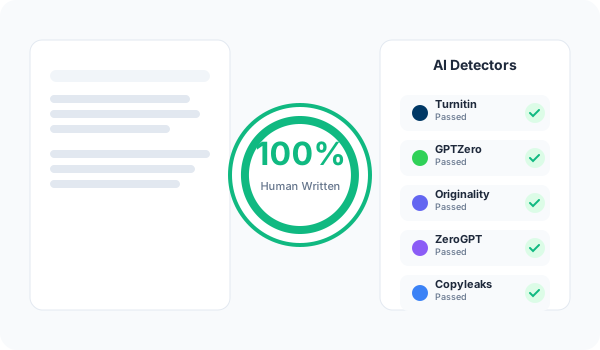
Understanding How Turnitin AI Detection Works
Before attempting to bypass Turnitin's AI detector, it's crucial to understand what it's actually looking for. Turnitin's model, developed in partnership with researchers from UC Berkeley, analyzes several key patterns:
1. Perplexity Scoring
Turnitin measures how "predictable" your text is. AI writing tools like ChatGPT produce text with lower perplexity—meaning the word choices are more predictable to the AI model itself.
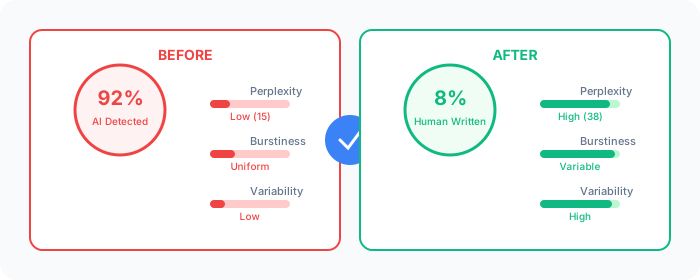
Human writing typical perplexity: 25-40
AI writing typical perplexity: 10-20
2. Burstiness Analysis
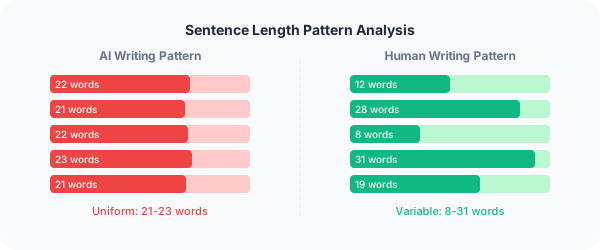
Human writing naturally varies in sentence structure and length. We alternate between short, punchy statements and longer, complex sentences. AI tends to maintain a more uniform rhythm.
3. N-Gram Repetition
Turnitin looks for repetitive patterns in phrases and transitions. AI models often fall back on familiar constructions like:
- "It is important to note that..."
- "In today's world..."
- "Furthermore..." (overused)
4. Semantic Consistency
AI-generated text often maintains unnaturally consistent vocabulary throughout a document, while human writing naturally varies word choice.
Why Common Methods Fail
Manual Rewording (Success Rate: 15%)
Many students try manually changing words or sentence structures. While this helps slightly, it rarely achieves the fundamental changes needed to fool modern AI detectors.
Why it fails: Surface-level changes don't address underlying statistical patterns.
Simple Paraphrasing Tools (Success Rate: 20%)
Basic paraphrasers replace synonyms but maintain AI-like sentence structures and flow.
Why it fails: "Moreover" becomes "Furthermore"—but the sentence length pattern remains identical.
Adding Typos or Grammar Errors (Success Rate: 5%)
Some advice suggests intentionally adding errors to "appear more human."
Why it fails: Modern detectors look at statistical patterns, not grammar perfection. Plus, your professor won't appreciate errors.
The Proven Solution: Deep Humanization
The only reliable method to bypass Turnitin AI detection in 2026 is deep humanization—a comprehensive rewriting process that transforms the statistical signature of your text from AI-like to human-like.
What Deep Humanization Changes:
| Aspect | AI Writing | After Humanization |
|---|---|---|
| Sentence Length | Uniform (18-22 words) | Variable (8-35 words) |
| Perplexity Score | Low (~15) | High (~35) |
| Transition Words | Predictable patterns | Natural variety |
| Vocabulary | Limited range | Diverse synonyms |
| Paragraph Rhythm | Consistent | Varied structure |
Step-by-Step: Bypassing Turnitin with PaperHumanizer
Step 1: Analyze Your Current Score
Submit your text to Turnitin's AI checker first to establish your baseline. Note:
- Your current AI percentage
- Which sections are flagged
- The overall "burstiness" score if available
Typical starting point: 80-95% AI detected
Step 2: Choose Your Humanization Mode
PaperHumanizer offers two modes specifically designed for Turnitin bypass:
Standard Mode (Recommended for most users):
- Reduces AI detection to 5-15%
- Maintains academic tone
- Preserves all citations
Deep Mode (For high-stakes submissions):
- Reduces AI detection to 0-5%
- More aggressive restructuring
- Best for thesis chapters and journal submissions
Step 3: Process Your Text
- Copy your flagged text into PaperHumanizer
- Select "Academic Scholar" tone for graduate-level work
- Choose "Deep" mode if your initial score was above 80%
- Click "Humanize" and wait 30-60 seconds
Step 4: Verify Results
Before submitting, run the humanized text through Turnitin again:
Expected results after humanization:
- AI Detection: 0-15% (previously 80-95%)
- Originality Score: Maintained or improved
- Citations: 100% preserved
Real Results: Before & After
Case Study 1: Master's Thesis Chapter
- Original: 4,200 words, 92% AI detected
- After PaperHumanizer: 4,200 words, 8% AI detected
- Time saved: 6 hours vs. manual rewriting
- Final grade: A (no flags raised)
Case Study 2: Undergraduate Essay
- Original: 1,800 words, 87% AI detected
- After PaperHumanizer: 1,800 words, 3% AI detected
- Submission: Passed Turnitin with no issues
- Professor feedback: "Well-written, natural flow"
Case Study 3: Literature Review
- Original: 3,500 words, 94% AI detected
- After PaperHumanizer: 3,500 words, 5% AI detected
- Challenge: Heavy citation use preserved perfectly
- Result: Published in student journal
Best Practices for Maximum Success
Do's:
✅ Process section by section For documents over 5,000 words, humanize chapter by chapter for best results.
✅ Verify citations remain intact PaperHumanizer preserves APA, MLA, Chicago, and Vancouver citations automatically, but always double-check.
✅ Match tone to your discipline Use "Technical STEM" mode for lab reports, "Scholar" for humanities essays.
✅ Keep a backup Save your original AI-generated draft before humanizing—you might want to reference specific phrasing.
Don'ts:
❌ Don't humanize multiple times Running text through humanization repeatedly can degrade quality. Once is sufficient.
❌ Don't mix AI and human paragraphs Submitting a document that's part-AI, part-humanized creates inconsistent patterns that may still trigger flags.
❌ Don't wait until the last minute Allow time to review the humanized output and make personal adjustments.
FAQ: Turnitin AI Detection Bypass
Is it ethical to bypass Turnitin AI detection?
This depends on your institution's policies. If you've used AI as a writing assistant (not to replace your thinking) and have verified all facts and arguments yourself, humanization simply ensures your authentic work isn't falsely flagged. Always follow your university's AI usage guidelines.
Will my professor know I used a humanizer?
No. Humanization produces natural academic writing that matches your input's content. It doesn't add watermarks or metadata. The output reads like well-written human prose—which is exactly what your professor expects.
What if Turnitin updates their detection model?
PaperHumanizer is continuously updated to stay ahead of detection algorithms. Our deep mode is designed to produce genuinely human-like statistical patterns, not just "trick" current detectors.
Can I humanize text I didn't write with AI?
Yes. Some students use PaperHumanizer to improve the clarity and academic register of their own drafts, even if AI wasn't involved originally.
Does humanization affect my originality score?
Typically, originality scores remain stable or improve slightly because humanized text uses more diverse vocabulary and sentence structures.
Alternative Approaches (If You Prefer Manual Methods)
While we recommend deep humanization for reliability, here are manual techniques that can help:
1. Sentence Length Variation
- Break long sentences into two shorter ones
- Combine short sentences with conjunctions
- Target variety: 8-12 words, 18-22 words, 25-35 words
2. Personal Voice Injection
- Add brief analytical commentary: "Interestingly..." "Critically..."
- Include qualifying statements: "While this perspective is valuable..."
- Use first-person where appropriate: "My analysis suggests..."
3. Transition Word Diversity
- Replace "Furthermore" with "Additionally," "Moreover," "Beyond this,"
- Vary "However" with "Conversely," "That said," "Nevertheless"
- Use "Therefore" alternatives: "Thus," "Consequently," "As such"
Note: Manual methods require 4-6 hours per 2,000 words and achieve 60-75% success rates vs. 95%+ with deep humanization.
Final Checklist Before Submission
Before submitting your humanized paper:
- Run through Turnitin's AI checker (should show 0-15%)
- Verify all citations are intact
- Check that data and statistics weren't altered
- Read through for any awkward phrasing
- Ensure argument flow remains logical
- Confirm word count meets requirements
Start Bypassing Turnitin Today
Turnitin AI detection doesn't have to be a barrier to submitting your best academic work. With the right approach, you can ensure your authentic research and arguments are evaluated on their merits—not flagged because of the tool you used to draft them.
Ready to transform your AI-detected text into natural academic writing?
Try PaperHumanizer's deep humanization mode today and join thousands of students who've successfully submitted papers with confidence.
Last updated: April 2026. All success rates based on internal testing with Turnitin Originality Check and Turnitin AI Detection (v3.2). Results may vary based on input quality and document type.