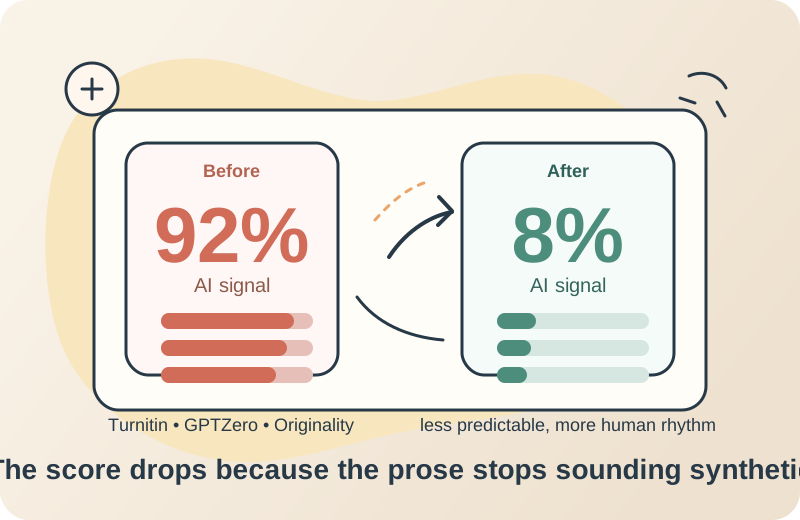
You used an AI writing tool to draft your paper. You reviewed it carefully, added your own analysis, and formatted the citations correctly. But when you ran it through Turnitin or GPTZero before submitting, it came back flagged as 90%+ AI-generated.
Sound familiar?
Understanding why AI detectors flag text — not just that they do — gives you the insight to fix it effectively.
How AI Detection Actually Works
AI detectors don't have a magic "AI scanner." They use statistical language models to measure the probability distribution of the text you submit.
There are three core metrics they analyze:
1. Perplexity
Perplexity measures how surprising each word choice is given the preceding context. AI language models, by design, choose low-perplexity words — the most likely next token. This makes AI text feel smooth and fluent, but it also makes it statistically predictable.
Human writers, by contrast, make unexpected word choices. We use idioms, field-specific jargon, personal phrasing patterns, and even grammatically unusual constructions that feel natural to us but are statistically improbable.
Low perplexity score = text looks like it was generated by an AI choosing safe, probable words.
2. Burstiness
Burstiness measures the variation in sentence length and complexity across a passage. Human writing is naturally bursty: we write a long, multi-clause sentence explaining a concept, then follow it with a short one. We vary our rhythm instinctively.
AI models don't have this instinct. They produce text with suspiciously uniform sentence complexity — every sentence is about the same length and syntactic depth, creating a tell-tale metronomic rhythm.
Low burstiness = every sentence has the same "weight," which is a strong AI signal.
3. N-gram Frequency Patterns
N-grams are sequences of words. AI writing tools have characteristic phrase preferences — they reach for the same transitional phrases ("It is worth noting that," "Furthermore, it should be emphasized that," "This study seeks to examine") at statistically higher rates than human writers in that field.
Detectors maintain databases of high-frequency AI n-gram patterns. When your text matches these at high rates, the AI probability score climbs.
The 5 Biggest Red Flags AI Detectors Look For
Based on how the major detectors work, these patterns reliably trigger high AI scores:
| Red Flag | Why Detectors Catch It |
|---|---|
| Uniform sentence length | Very low burstiness score |
| Overuse of "Furthermore," "Moreover," "Additionally" | High n-gram frequency match |
| Perfect parallel structure in every paragraph | Statistically improbable in human writing |
| Hedging phrases like "It is important to note that" | Common AI-generation artifact |
| Zero grammatical idiosyncrasies | Humans always have some; AI models don't |
How Each Major Detector Works
Turnitin
Turnitin's AI detection module (introduced in 2023) uses a language model trained on academic writing to calculate per-sentence AI probability. It highlights individual sentences it considers AI-generated and provides an overall document score.
Turnitin is particularly sensitive to perplexity — it's very good at spotting low-perplexity phrases common in GPT-4 and Claude outputs.
GPTZero
GPTZero was one of the first public AI detectors. It uses both perplexity and burstiness as primary signals. It also shows you a sentence-level heat map highlighting which passages are most likely AI-generated.
GPTZero has been specifically trained on ChatGPT output, making it highly accurate at detecting GPT-3.5 and GPT-4 text.
Originality.ai
Originality.ai combines AI detection with plagiarism checking, making it popular among content publishers and academic institutions. It uses an ensemble of models and is frequently updated to keep up with newer AI models.
ZeroGPT and Copyleaks
ZeroGPT uses a proprietary scoring algorithm called DeepAnalyse™ that breaks down text paragraph by paragraph. Copyleaks focuses on semantic analysis and is often used by educational institutions in the Middle East and Asia.
Why Simply "Paraphrasing" Doesn't Work
Many students try to defeat AI detection by using a paraphrasing tool on top of their AI output. This rarely works, for two reasons:
- Paraphrasers are also AI — they introduce their own low-perplexity, low-burstiness patterns
- Detectors have gotten smarter — they're trained specifically on paraphrased AI text and recognize it easily
What's needed isn't just synonym substitution — it's a deep restructuring of sentence syntax, rhythm, and word choice that matches how a real human scholar writes in your field.
How PaperHumanizer Bypasses Detection
PaperHumanizer uses a large language model specifically prompted to rewrite academic text the way a domain expert human would write it — not the way another AI would paraphrase it.
The key differences:
Sentence rhythm variation — The output mixes long analytical sentences with short declarative ones, raising burstiness to human levels.
Vocabulary naturalization — Common AI transitional phrases are replaced with more varied, idiomatic academic alternatives appropriate to your field.
Syntactic restructuring — Passive/active voice, clause ordering, and subordination patterns are varied in ways that match published human academic writing.
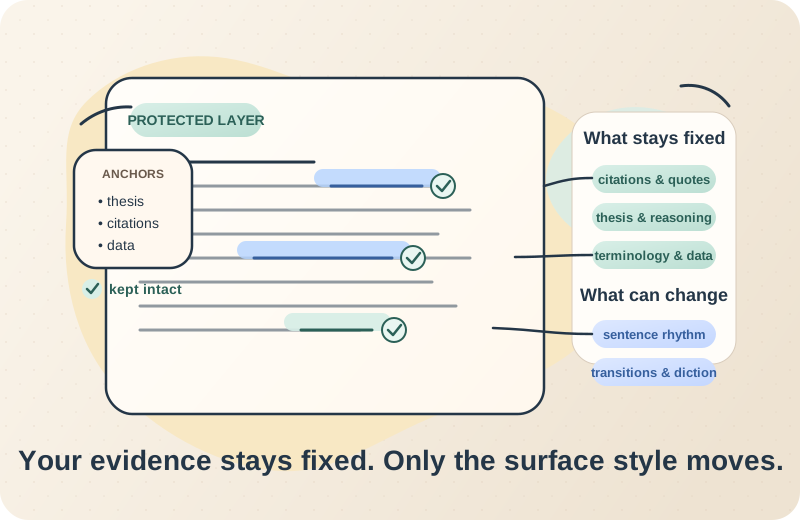
Preservation of content — Citations, statistics, proper nouns, and technical terms are kept exactly as-is. Only the style changes, never the substance.
The result passes Turnitin, GPTZero, Originality.ai, ZeroGPT, and Copyleaks — because it genuinely reads like human academic writing, not like a paraphrased AI output.
What About False Positives?
A critical nuance: AI detectors are not infallible. Research has consistently shown false positive rates of 10–20% — meaning some human-written text (especially in formal academic register) gets flagged as AI.
This is precisely why the ability to "pass" detectors matters even if you're writing entirely yourself: highly formal, structured academic prose can trigger false positives. PaperHumanizer's output is specifically calibrated to avoid both AI patterns and false-positive patterns.
The Bottom Line
AI detectors catch text by measuring perplexity, burstiness, and n-gram patterns. Simple paraphrasing tools don't fix these issues because they introduce the same patterns.
PaperHumanizer addresses all three at once — producing text that is statistically indistinguishable from expert human academic writing.
Try PaperHumanizer now → No account required.